Power Generating Backpack

[youtube=http://www.youtube.com/watch?v=UL_CUbN9F7E]

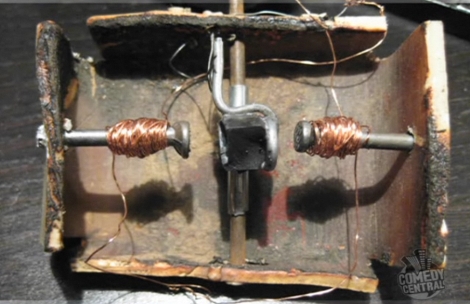
In the military, you have to carry tons of stuff. This is something we hear and see all the time. They are always trying to come up with ways to reduce the weight or quantity of the things that you bring into the field. This power generating backpack harnesses the natural up and down motion of your steps to produce power. This could reduce the amount of batteries carried into the field greatly. That’s what they say anyway, how many batteries do soldiers normally carry around? Aside from that point, we think it is pretty cool. We could see using this to keep our cell phone or GPS charged on long hiking and camping trips. You could also build something of your own to work similarly.

Seawater Cooled Data Centers

swac-mauritius

Remember Mauritius from High School geography? We didn’t either, but apparently it’s a small island nation east of the southern tip of Africa. It seems they are trying to develop an industry in eco-friendly data centers. The plan is to use a pipeline to gather cold water from the ocean, run it two miles to the island, and use it as inexpensive cooling. Because rooms packed with servers generate copious amounts of heat it’s easy to see how this can reduce the cost of maintaining a data center.

The thing that struck us here is, how eco-friendly is this? The article mentions that this technology is fairly mature and is already used in several places. With that in mind, isn’t this just another way to raise the temperature of the oceans, or does the environmental savings of not using electricity or gas to produce the cooling offset this?

[Thanks Vesanies]

Tapping Tree Power

[bugloaf] tipped us off about this flower power hack. University of Washington researchers, [Babak], [Brian], and [Carlton] have developed very low power circuits to run directly off of trees. This builds upon the work of MIT researchers and Voltree Power. A voltage of up to around 200mV is generated between an electrode in a tree and an electrode in the ground. Identical metals can be used as electrodes as the process is not like that of a lemon or potato battery. The significant development here is the use of a boost converter and exceptionally low power circuits. What kind of applications can you come up with for this source of power? Maybe you could try to combine this power with the power from donuts and hair.

12kW Solar Collector

[youtube=http://www.youtube.com/watch?v=jTvAL7ty53M]

Though not much info is readly available about it on the web, [Joe Carruth] is trying to build publicity (and venture capital) for his home-built solar electric generator. At its essence, it is a Stirling dish system with an adjustable composite mirror surface. This means that instead of having to rotate the entire contraption in order to follow the Sun, [Joe] only has to make  the mirror segments pivot. A Stirling steam engine at the tip converts the energy into the movement used to generate electricity. Solar power plants (or ‘farms’) that are emerging are beginning to consider the advantages of using more efficient Stirling dishes rather than less efficient solar panels. If anyone has an idea as to how [Joe] can automate sun tracking for the mirrors, please post it in the comments. A couple more videos on the topic (in general) are available below: Continue reading “12kW Solar Collector”

DIY Solar Panels

solar

Reader [unangst] pointed out to us an article in the U.K.’s Daily Mail, where a teenager from Nepal had managed to create a 9v, 18W solar panel using human hair rather than the usual semiconductors (usually crystalline-silicon). The complex silicon in solar panels are what keep the prices out of reach of developing nations, and while there are a number of new technologies that are helping  bring down the cost, [Karki] managed to make his solar panel for only £23 (roughly $38). He also claims that when mass produced the price could drop substantially down to under $10 a panel, which would shatter the $1/watt sweet spot.

The melanin in hair acts as an organic-semiconductor, and while the hair does not have the longevity that silicon panels have (months rather than years), these panels can be made cheaply and serviced with little to no complex knowledge. Using melanin as an organic semiconductor seems to be a newer idea, because information seems hard to come by, but we managed to find a research paper from 2007 that explored the energy absorption attributes of melanin, as well as some good background info for the science types.

Research Paper (Warning: PDF)

So, Hack a Day readers, which one of you is going to make your home-brew solar panels first? Let us know when you do.

Thanks [unangst].

[digg=http://digg.com/environment/Teenager_Makes_DIY_Solar_Panels_from_Hair_Hack_a_Day]

Variable Range Sprinkler

[vimeo http://vimeo.com/6409575 w=470&h=352]
[Pete], a musician, and the guy behind SparkFun’s pogobeds and locking footprints has a sprinkler hack. He wanted to keep his dog, Choppy, happy with a green lawn while also keeping his sidewalk water free. To solve this problem, he hacked his sprinkler and hose to adjust the sprinkler’s range. He uses an Arduino to read a potentiometer signifying the direction that the sprinkler is facing and a servo to adjust a hose valve that controls the sprinkler’s water flow. Be sure to check out the video above to see it in action.

Wireless Electricity

[ted id=619]

[Eric Giler] has a talk available over at TED that discusses and demos delivering electricity without wires. Called WiTricity, these methods were developed by a team at MIT a few years ago who were working off of the concepts of Nicolai Tesla. The facts shared about our current energy delivery system are a bit shocking; we’ve spent over $1 trillion in infrastructure and produce more than 40 billion disposable batteries each year.

The demonstration in the video starts about 6:30 into it. At first we see a flat panel television powered wirelessly from about 6 feet away, then the T-Mobile G1 powered from the same distance. The thought of new TVs coming with WiFi and WiTricity standard would mean just hanging it on the wall with no cords to run. We can also image cellphones that have a battery only for backup purposes when you were not near a transmitter.

The power transfer occurs between two coils that resonate at the same frequency and only that frequency. This remind us a bit of Orson Scott Card’s fantasy communications device from the Ender’s Saga.