Mechanical Engineering Primer

So you’re master of electrons; able to program multiple chip architectures without batting an eye. Good for you. The only problem is that blinking LEDs gets boring after a while and you’re going to want to do something else. Here’s a chance to expand on your physical construction skills. Make: Skill Set is sharing the first chapter from the book Making Things Move by [Dustyn Roberts].

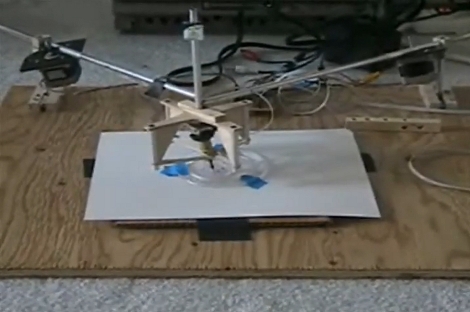
This chapter, which comes in PDF form, covers simple machines. It’ll guide you through the three different types of levers, including examples of how you use these in your everyday life. Next it’s on to pulley systems, wheels and axles, inclined planes and wedges, screws, and gears. [Dustyn] rounds out the chapter by talking about how these concepts are combined into machines like the Rube-Goldberg device seen above. Take some time to look this chapter over and then put it on the holds list from your public library if you’re interested in reading more.

Lightweight Robosuit Is Like Stilts On Steroids

What would you do if you were a foot or two taller? How about if you had an arm span two times as wide as you have now?

A group of Japanese engineering students asked themselves the same question and built a wearable chassis that does just that. Their project is called “Sukerutonikusu”, which we believe roughly translates to: “This is freaking awesome, we’ll take two!”. [Thopter] however informs us that it translates to “Skeletonics”, a fusion of the words “skeleton” and “mechanics”.

The suit is comprised of lightweight aluminum pipes and sheeting, allowing for it to be powered solely by the person wearing it. Stepping inside the chassis looks like it lifts the wearer about a foot and a half off the ground, while increasing their wingspan by nearly 6 feet! In the video embedded below you can see that while in the suit, the wearer is quite agile, and even has the ability to run at a decent tick.

If this ever comes to market, you can bet we will buy one in a heartbeat – until then, we will have to settle for making RoboCop sounds as we walk about the office.

Continue reading “Lightweight Robosuit Is Like Stilts On Steroids”

Twittering Wall Switch Lets Dutch Hackers Know When It’s Time To Play

hackerspace_open_switch

Hack42, a hackerspace in Arnhem, Netherlands recently moved into some new digs, and they wanted an easy way to let their members know whether they were open or not. Fixed hours of operation typically do not fit this sort of organization, so that was out of the question. Instead, they built a switch into the wall** that will let their members know when they are open for business.

The switch separates the TX and RX pins of two Ethernet ports that reside in an old access point embedded in the wall. When the hackerspace is open, the switch is thrown and the circuit is closed. A cron job checks the state of the eth1 port once a minute, sending the “Open” status message to Twitter and IRC once it notices the status change. When the switch is thrown again and the eth1 port goes down, a “Closed” message is broadcast.

It is a simple but cool hack, and quite befitting of a hackerspace.

**No direct Google Translate link is available, though Chrome will translate it for you without issue.

[Thanks, _Danny_]

Coming Soon To A Store Near You: Remote-control Cockroaches

roboroach

Given a box full of cockroaches, the first thing most of us would do is try to locate the nearest source of fire. Lucky for the roaches, the team over at Backyard Brains look at things a bit differently than we do.

Their latest effort combines cockroaches and electronics to create a bio-electrical hybrid known as the RoboRoach. Using control circuitry donated from a HexBug inchworm and some 555 timers to create properly timed pulses, they have been able to control the gross movement of cockroaches. Stimulation is directly delivered to the antennae nerves of the cockroaches, enabling them to tell the roach which direction to turn and when.

Currently there are some ahem, bugs in the system, which they are working diligently to resolve. Only about 25% of the roaches they wire up can be controlled at present. Once that ratio improves however, they will be looking to offer RoboRoach as a beta product. If you are aiming to add a beetle air force to supplement your remote-controlled cockroach army, be sure to check this out.

Continue reading to see a video of the RoboRoach in action.

Continue reading “Coming Soon To A Store Near You: Remote-control Cockroaches”

How Escher’s Impossible Waterfall Was Faked

Study the image above closely. You’ll notice that physically it is an impossible object, yet this is a screenshot of full-motion video. The clip after the break shows a gentleman pouring water into the waterfall where the wheel is located. The liquid flows in a direction that appears to be uphill, then falls onto the waterwheel where it was originally poured. Ladies and Gentleman, we have the solution to the world’s energy crisis. Nope, we have a hoax and the real question is how was it done?

[David Goldman] has come up with quite the explanation. He watched the video very closely and the put together a three-dimensional diagram showing how he would build theĀ apparatus. If you saw the movie Inception (we highly recommend you do) you will remember the infinite stair puzzle that is exposed as an optical illusion. [David’s] proposed method for debunking this hoax uses a similar build that comes in four different, precisely placed elements.

We’ve got to hand it to him. That’s a brilliant theory! Of course the first commenter on the post linked above calls this out as CGI and we’re inclined to go with that answer but that’s much less fun.

Continue reading “How Escher’s Impossible Waterfall Was Faked”

Cutting Out Your Own Breakout Boards

[Caleb] needed to use some surface mount components when prototyping. Instead of buy a breakout board he made one himself without doing any etching. The process he shows off in the video after the break uses copper tape to layout the traces for the board. It’s quite an interesting method which requires a sharp knife and a steady hand.

He used regular protoboard as a substrate and applied a layer of copper tape on the side without copper pads. From there he poked holes for the DIP pin headers. Now it’s time to do some cutting. [Caleb] removed the band of copper that would fall in between the pins of the surface mount device. He then tackedĀ it in place with one dot of solder and drew the traces from the part to the pin headers. After removing the part he cut out the waste in between each line he drew with marker. What he’s left with is a set of thin traces that connect each pin of the surface mount component to the corresponding through-hole pin header.

This is very time-consuming, but then again so is soldering jumper wires to small-pitch components.

Continue reading “Cutting Out Your Own Breakout Boards”

Pint-sized Nixie Display Fits Neatly In Your Pocket

[Brett] has had Nixie tubes on the brain ever since being introduced to them by a good friend of his. He decided that building a Nixie-based key chain would be the best way to familiarize himself with the technology, while also giving him a project to enter in the 555 Design Contest. He dug up the smallest Nixie tube he could find that displayed digits, and got down to business.

The biggest obstacle he ran into was figuring out how he would provide the high voltage required to light the Nixie tube. He eventually built a transformer circuit driven by a 555 timer, using a small 12v battery as his power source. Once everything was up and running on a breadboard, he designed and etched some PCBs, then soldered everything together.

The end result is a nifty little key chain that flashes the number 5 when a button is pressed – pretty appropriate for the 555 contest. It’s a great looking project, though we’re still not 100% sure what we think about a naked high voltage circuit residing in our pocket.

Keep reading for a pair of videos documenting the key chain’s construction and operation.

Continue reading “Pint-sized Nixie Display Fits Neatly In Your Pocket”