NES Cartridge Hack Makes Great Novelty Gift

NES cartridge with arduino

Most all of us recall the Blinking Screen of Death on original NES systems. This was caused by a bad connection between the cartridge and the NES cartridge connector. For whatever reason, it became a very popular idea to give a quick blow down the cartridge, even though this didn’t really help. [Dale] decided to play on this annoying problem by making the NES Blow Cart!

Inspired by a previous cartridge hack, [Dale] mounted a custom made circuit sporting the ever popular ATtiny85 in a Super Mario / Duck Hunt cartridge. A small microphone sits where the original cartridge connector was, along with the on/off switch and program header. A quick blow triggers the ATtiny85 to play a song.

The most difficult part for [Dale] was to figure out how to get the ATtiny to play “music”. This was solved with the discovery of a library called Rtttl. This allowed him to take old Nokia Super Mario and Zelda ringtones and get them on the Attiny85. All files, including the rtttl library are available on his github. Be sure to stick around after the break for a video of the project in action.

Continue reading “NES Cartridge Hack Makes Great Novelty Gift”

Interactive Gloves Turn Gestures Into Music

Imogen Heap wearing her Mi.Mu gloves

[Imogen Heap] is a UK-based musician who is trying to change the way we think about making music. She’s been working on a pair of gloves called the Mi.Mu, and they’re getting close to production.

In the included interview she explains that while computers and technology have brought many new advances to music, twiddling dials and pushing random buttons “is not very exciting for me, or the audience”. With these gloves, the artist becomes one with the music and interaction.

The current iteration of gloves use flex sensors along each finger to determine the movement (along with motion sensors for other gestures). She’s been through many designs and hopes to integrate e-materials into the next — using the actual glove as the sensor (not physical flex sensors).

She’s been working with both developers and musicians mapping the various motions of the gloves to music which makes sense in an intuitive way, and it’s very unique to see in action.

Continue reading “Interactive Gloves Turn Gestures Into Music”

Kyub MIDI Keyboard Puts A Piano In Your Pocket

[Keith Baxter] loves making electronic instruments. His latest vision has come to life as Kyub, an open-source MIDI keyboard. [Keith] has previously graced our site and cracked Popular Science with his servoelectric guitar.

[Keith] wanted to make a completely open source instrument that’s elegant, useful, and a bit more accessible than the servoelectric guitar, so he teamed up with a hacker/electronic music expert and an industrial designer. He built the early prototypes around an Arduino Uno. The current iteration uses a Teensy 2.0 and is available in various forms through Kickstarter. [Keith] opened the Kyub up to crowd funding in an effort to obtain volume pricing on some of the parts as well as an Eagle license to make the PCB files available commercially.

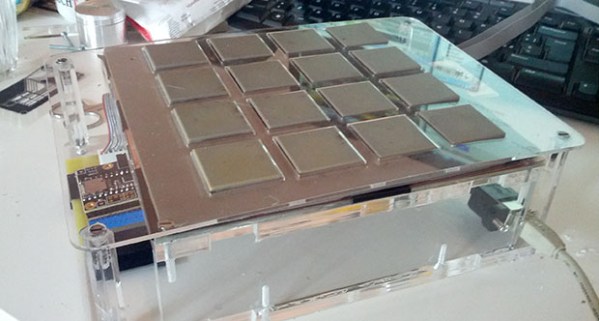
The Kyub has eleven pressure-sensitive capacitive keypads on five sides of the cube. The accelerometer can be used to vary note volume, bend the pitch, or whatever else you program it to do. Of course, you’ll need a computer with a synthesizer program, but [Keith] says it is compatible with most software synth programs, some of which are free.

There’s a demo video of an early prototype after the break. Videos of the Kyub in its current form are available on the Kickstarter page.

Continue reading “Kyub MIDI Keyboard Puts A Piano In Your Pocket”

Frozen Instruments Played At Swedish Music Festival

[Tim Linhart] wanted to do something different for this Swedish music festival — so he decided to carve all the instruments by hand, out of ice.

The festival consists of seven bands playing very different musical styles, with over 40 concerts occurring during the festival. [Tim Linhart] has painstakingly carved each instrument from violins to cellos out of individual sheets of ice. He adds strings and fret-boards to complete each piece, and if the temperature goes above zero it’s game over. The concerts are held in a building made of ice to make sure this doesn’t happen.

And since they are built out of layers — he’s also thrown in some RGB LEDs to give the instruments a bit more pizzazz. They actually sound pretty good too!

Continue reading “Frozen Instruments Played At Swedish Music Festival”

Transcribing Piano Rolls With Python

Piano Roll


Perforated rolls of paper, called piano rolls, are used to input songs into player pianos. The image above was taken from a YouTube video showing a player piano playing a Gershwin tune called Limehouse Nights. There’s no published sheet music for the song, so [Zulko] decided to use Python to transcribe it.

First off the video was downloaded from YouTube. This video was processed with MoviePy library to create a single image plotting the notes. Using a Fourier Transform, the horizontal spacing between notes was found. This allowed the image to be reduced so that one pixel corresponded with one key.

With that done, each column could be assigned to a specific note on the piano. That takes care of the pitches, but the note duration requires more processing. The Fourier Transform is applied again to determine the length of a quarter note. With this known, the notes can be quantized, and a note duration can be applied to each.

Once the duration and notes are known, it’s time to export sheet music. LilyPond, an open source language for music notation, was used. This converts ASCII text into a sheet music PDF. The final result is a playable score of the piece, which you can watch after the break.

Continue reading “Transcribing Piano Rolls With Python”

Zenotron: The Looks Of A Kaypro II With The Soul Of A Nebulophone

This beautiful instrument of musical delight is called the Zenotron, and it was built by [Mike Walters] for his friend [Zeno] in exchange for some keyboards. The Zenotron is the latest musical hack in a long line of awesome from the same guy who built the Melloman, its successor, the Mellowman II, and Drumssette, a programmable sequencer.

The sweet sounds of those babies all come from tape loops, but the Zenotron is voiced with a modified [Bleep Labs] Nebulophone synthesizer. Instead of the Nebulophone’s pots controlling the waveform and arpeggio, he’s wired up a 2-axis joystick. He left the LFO pot wired as-is. When it’s turned all the way down, he’s noticed that the joystick takes over control of the filter. [Mike] fed the audio through a 4017 decade counter and each of the steps lights up an array of four to five of the randomly-wired 88 LEDs.

[Mike] made the case from the top half of a small filmstrip viewer and an old modem, which is way better than the Cool Whip container housing we made for our Nebulophone. He re-purposed a toy keyboard and made a contact board for it with small tactile switches. This results in nice clicky feedback like you get from mouse buttons.

Of course there’s a demo video. You know the drill.


Continue reading “Zenotron: The Looks Of A Kaypro II With The Soul Of A Nebulophone”

Recreating The THX Deep Note

THX logo

Few sounds are as recognizable as the THX Deep Note. [Batuhan] did some research, and set about recreating the sound. The original Deep Note (mp3 link) was created in 1982 by [Dr. James A. Moorer]. [Dr. Moorer] used the Audio Signal Processor (ASP) (AKA SoundDroid) to create the sound. The ASP was a complex machine to program. The Deep Note took about 20,000 lines of C code to program. The C code was compiled to about 250,000 discrete statements to command the ASP.

Only one ASP was ever built, and LucasFilm owned it. Instead of recreating the hardware, [Batuhan] used SuperCollider to recreate the sound. Just like the ASP, SuperCollider is a tool for real-time audio synthesis. The difference is that SuperCollider is open source and runs on modern computers. [Batuhan] used his research and ears to perform an analysis of the Deep Note. He created two re-creations. The first is carefully constructed to replicate the sound. The second is a Twitter worthy 140 character version. Both versions are reasonable facsimiles of the original Deep Note, though they’re not quite perfect to our ears.

[Batuhan] isn’t the only person working on recreations. Deep Note in 1KB of JavaScript can be heard at  http://thx.onekb.net/. We’d love to hear other versions created by Hackaday readers!

[Via Reddit]