Snap Together Boombox Great For Taking Your Music On The Go

fab-boombox

[Matt Keeter] wanted to take his music on the go, and wrote in to share a great looking boombox he built for under $100. His goal was to put something together that could be made in pretty much any hackerspace/fab lab, so his boombox was made using simple materials.

He first modeled the boombox using cardboard, later fabbing it from wood on a laser cutter. The design allows the stereo to be snapped together, though [Matt] says that some joints were glued as an extra precaution. Inside the boombox resides an custom PCB he built which incorporates an ATmega328, an MP3 decoder, and an SD card to store his music.

One feature we really like is the control scheme [Matt] built into the boombox. Each of the capacitive touch buttons are positioned on top of a copper pad, which are wired into the control board. He says that while good in theory, he had a difficult time getting the buttons to work properly, though they seem to do the job well enough.

If you’re looking for a portable music solution and have access to a laser cutter, be sure to check out [Matt’s] page for schematics and firmware.

Bitbuf Delivers Some Of The Best Chiptune Effects Around

Wow. And furthermore, WOW! Just looking at that clean prototype you know that a lot of work has gone into the project, but when you hear this chiptune MIDI device you’ll really be impressed. We know what you’re thinking, but really, you’ve got to hear this to appreciate the quality [Linus Akesson] achieved in this synthesizer. You can catch it after the break.

He does a great job of showing off the different waveforms that can be produced by the ATmega88 on this board. But there’s much more. It also serves as a 16 frame, 16 channel sequencer for creating and layering your own loops.

He mentions that eight oscillators are used for the waveform generation. We don’t see hardware for this on the board. Either we’re missing it, or these oscillators are being created with software? If you have an idea of how this works please clue us in by leaving a comment.

Continue reading “Bitbuf Delivers Some Of The Best Chiptune Effects Around”

Playing With Routers, Vinyl And Music Concrete

When Danish musicians Vinyl Terror and Horror visited [Daniel] and his CNC router at EMS in Sweden, things were sure to get interesting. The band uses heavily modified record players and modified vinyl records to produce strange soundscapes. During their time at EMS, Vinyl Terror and Horror were able to produce some strange vinyl that shouldn’t play on a record, but do.

Most of VTaH and [Daniel]’s work is centered on a CNC router. This soundscape took two records to produce. The spare rectangles were cut from a second record and designed to be press-fit into the host. When the newly assembled record is played, truly bizarre ‘skipping-but-still-playing’ sounds are made. The same process was used on the puzzle piece record the guys made.

The experiments continued by cutting a circle out of a record and gluing it back into place with a different orientation. This idea was taken to its logical conclusion that serves as the exemplar of music concrete.

[Daniel] and Vinyl Terror and Horror came up with a pretty neat spin (HA!) on century-old way of making electronic music, so we’ll give all of them some props. Check out all the videos from VTaH’s time at EMS after the break.

Continue reading “Playing With Routers, Vinyl And Music Concrete”

MIDI Synth Arduino Shield

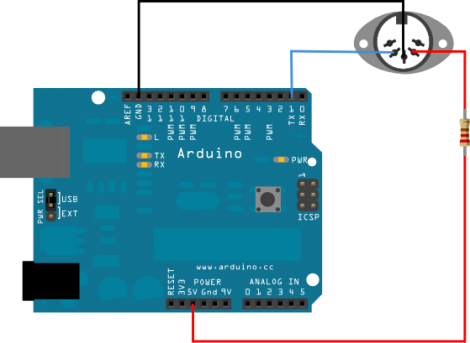
There’s a million and one ways to play around with MIDI and an Arduino. It’s trivial to have a ‘duino spit out a scale to a MIDI keyboard, or even respond to SysEx messages to change a lighting or effects rig. There’s one thing that has eluded MIDI-duino builders, though: implementing a MIDI synthesizer with a DIY shield. It’s a good thing, then, that [Keith] put up a Kickstarter for his AvecSynth project.

[Keith]’s AvecSynth is based around the Dream.fr SAM2195 single chip MIDI synthesizer. It’s a neat little IC that takes in MIDI messages from a sequencer or keyboard and spits out stereo audio. The AvecSynth takes this IC and puts it in a standard Arduino-sized package so building a gigantic light-up, foot-operated piano is now well within the purview of the weekend solder junkie.

While the SAM2195 and AvecSynth doesn’t have fancy subtractive or FM synthesis, it does have the full set of 128 voices in the General MIDI spec. It’s a great project to play around with MIDI, and the price for the DIY kit is right up our alley.

EDIT: [Keith] changed the $20 reward for his Kickstarter to PCB or two SAM2195 chips

Magnetotron Is An Armonica Mellotron Mashup

[Michael] is a huge fan of old media formats. There’s something special about quarter-inch thick 78s, fragile blue cylinders holding music, and thin strips of mylar that preserve the human voice. He’s had an idea for a tape-based instrument for a while, and now that the Magnetotron is complete, we’re in awe of this glass harmonica and Mellotron mashup.

The Magnetotron is a large rotating cylinder that has dozens of strips of audio tape attached to it. The cylinder rotates with the help of a small motor. As the strips of tape rotate in front of him, [Michael] presses two tape heads up to the instrument, making some sort of sound.

Each strip of tape contains a recording of one note, like the venerable Mellotron. Instead of physical keys, the Magnetotron is played in a much more tactile fashion like the glass harmonica. The output of the Magnetotron is interesting with a whole bunch of wow and flutter. Check out the demo of [Michael] playing his instrument at NIME in Brooklyn after the break.

Continue reading “Magnetotron Is An Armonica Mellotron Mashup”

Building The Ocarina Of Time With An FPGA

[Joe] and [Evan] wanted to have some fun with their FPGA course at Cornell. When faced with what to do at the beginning of the semester, they figured additive synthesis was a worthy pursuit. They ended up building the Ocarina of Time for their final project.

The guys started by recording a real ocarina and figuring out the relative power levels of each harmonic. Because any sound can be synthesized from a bunch of sine waves, having their Altera FPGA board replicate those frequencies produces a nice ocarina sound

[Joe] and [Evan]’s ocarina has a ‘mouthpiece’ that is just a small microphone. This mic is hooked up to the FPGA board and controls the volume. Sadly, the guys didn’t have time to take apart an N64 controller so 6 red buttons serve as the finger holes.

From the video after the break, [Joe] and [Evan] really pulled together something that sounds like Link’s Ocarina. Great work, guys.

Continue reading “Building The Ocarina Of Time With An FPGA”

Half Keyboard, Half Guitar, Totally Radical, The Tabstrummer!

While tablature-based music probably annoys “properly” trained musicians to no end, it has given many musicians and musical-hobbyists their first introduction to the world of guitar. The [Tabstrummer] takes this to a whole new level, allowing chords to be programmed into this instrument and played back. Once pre-programmed chord is set, the “conductor-strings” are strummed to allow the chord to play.

This device is based around an Atmel microcontroller and features a MIDI output as well as an audio-out jack. Besides the interesting electrical hardware, the housing seems to be quite well-built featuring what appears to be an acrylic or polycarbonate body. Although not quite the same thing, possibly some influence was gained from the [Keytar]. It’s heyday may be past, but not forgotten.

Check out the video below for a Christmas-themed jam played on the [Tabstrummer] or check out their video page for several more songs. This “hack” is being considered as a commercial product, so the inventors would love to hear your feedback! Continue reading “Half Keyboard, Half Guitar, Totally Radical, The Tabstrummer!”