Arduino-based MIDI Synth

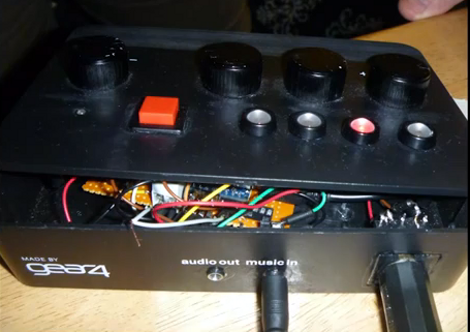
[Charles Gershom] has been tinkering around with his keyboard and Arduino in order to build his own version of a MIDI controlled synthesizer. It looks like he’s gutted the enclosure of some commercially available MIDI hardware to use for the project. This works nicely since it gives him both the MIDI and audio jacks that he needs. The box also provides a nice control surface where a set of four LEDs indicates the synth mode currently in use. There are also four potentiometers mounted on the panel, but they’re not yet up and running.

Check out the video after the break to see what this can do so far. [Charles] shows the device synthesizing sounds coming in from the keyboard. It is also used to playback the audio from Super Mario Bros. which is fed in by a music notation program on a computer. Only one voice is playing when this happens which makes us think this can only handle one channel at a time right now (but we could be wrong).

Continue reading “Arduino-based MIDI Synth”

Wireless MIDI Piano Glove

Sometimes you just don’t have space for a baby grand. [Abdullah] got around this problem and built a virtual wireless MIDI piano. Unlike it’s inspiration, it’s not bad but we still love it.

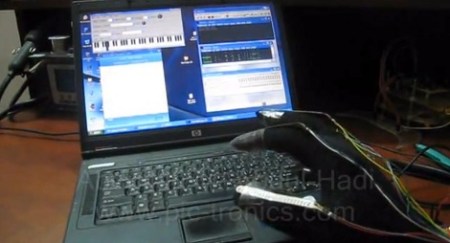
[Abdullah] got his hands on some flex sensors and attached them to a glove. These resistive sensors are put through a voltage divider and sent to a microcontroller (a PIC16F778, we believe) and corresponding MIDI notes are chosen. These MIDI notes are sent to a computer and played over a speaker.

Right now, only a single arpeggio is coded into the microcontroller. Depending on which finger is bent shifts this arpeggio up and down the keyboard. That being said, the firmware can be easily modified to recognize standard piano fingering so chords can be played. The only issue is moving the hand up and down the keyboard.

[Abdullah] is planning on making his glove completely wireless with a microcontroller and battery sewn into the glove. Here’s to hoping he’ll keep us posted.

Check out [Abdullah]’s demo after the break.

Continue reading “Wireless MIDI Piano Glove”

DIY Drum Triggers & Recreating [Bonzo]’s Vistalites

[Rob] has been working on his drum trigger build, and he’s finally decided to share it with us. His drum heads and triggers don’t look like anything we’ve ever seen, but he’s pretty confident he has a good kit in the works.

The first unconventional of the build is the drum triggers. The triggers are piezo elements folded up or cut down to fit inside highlighter bodies. These piezo/highliter/drum triggers were filled with melted candle wax to make sure the piezo doesn’t rattle around. [Rob] seems to have taken an empirical approach to cutting up piezo elements – smaller elements are less responsive, so they’ll be used for the zones of the drum head.

[Rob]’s drum heads are made from tennis and badminton raquets. The implementation is actually kind of clever: [Rob] restrings the raquets on the bias to vary the feel and responsiveness of the head. Check out the Flickr photoset of the build here.

The ultimate goal of [Rob]’s build is a “glass” drum set certainly inspired by [John Bonham]’s Vistalites. Whenever [Rob] puts up a video playing Moby Dick on his new kit, we’ll be sure to put it up.

Annoy Your Sound Guy Even More

“I can’t hear myself in the mix,” “yeah, man, I’ll be there at 8,” and “dude, we need like four more mics.” Each and every one of these words is documented in actuarial tables and doesn’t bode well for your sound tech’s risk of a stroke. Luckily, there’s an even better way to kill your sound guy and this time, it’s actually pretty clever.

[@dop3j0e] at the Stuttgart hackerspace Shackspace came up with the Noiseplug. It’s a very small build that could almost fit into a quarter-inch jack. It’s all SMD with a tiny (unknown) ATtiny9 microcontroller powered by a watch battery.

The music coming out of the Noiseplug is really interesting. All the code on the microcontroller is a one-liner written in C. Similar ‘algorithmic chiptune’ programs can be run on any PC: check out these three examples.

These potential entries to the International Obfuscated C Code Contest throw chars into an 8-bit PCM stream. Piping the output of these programs to /dev/audio would generate an actual song – written entirely in one line of C.

Of course, [@dop3j0e] could have made his Noiseplug a little less annoying, but sound techs are underappreciated for a reason, right?

Check out the Noiseplug in action after the break along with a few one-liner C songs.

Continue reading “Annoy Your Sound Guy Even More”

Halloween Hacks: A Light And Music Show Fit For [Jack Skellington]

Halloween Hacks Banner

singing_pumpkin_halloween_show

[Greg] was looking for something to build using his recently acquired Arduino, and with Halloween approaching, he thought a cool light display would make a great project. He browsed around online and found this tutorial that shows how to build a chorus of singing pumpkins controlled by a computer’s parallel port. Since he didn’t have any computers with a parallel port kicking around anymore, he decided to try his hand at recreating it with an Arduino.

[Greg] gathered eight light up Jack-o-Lanterns, along with a handful of relays and other miscellaneous components. He wired up the relays to trigger each individual pumpkin’s built in light when switched by the Arduino. He sat down and carefully listened through “This is Halloween” from The Nightmare Before Christmas, choreographing each of the pumpkins to take on the voice of one of the movie’s characters.

When the show begins, the display transforms from a group of unassuming pumpkins with candles a-flicker to a chorus of ghouls extolling the virtues of Halloween.

It really is fun to watch, so be sure to check out the video below. If you’re looking to throw together a quick display before the big day rolls around, [Greg’s] source code and diagrams should get you headed in the right direction.

Continue reading “Halloween Hacks: A Light And Music Show Fit For [Jack Skellington]”

Adding A Compact Flash Reader To A Korg Triton

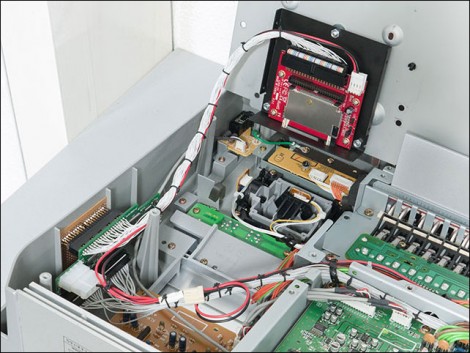
[Roberto Barrios] has a Korg Triton sampling keyboard which he enjoys very much, but has grown tired of using media of yesteryear to store his work. He had the option of floppy disk or Jazz drive and for a time he was using a floppy-to-USB emulator, but the keyboard still insisted on a 1.44 Mb storage limit using that method. He decided to crack open the case and add his own CF reader.

It should be noted that this hack could have been avoided by using the 25-pin connector on the back of the keyboard. He didn’t want to have external hardware, which is understandable if you’re gigging–it’s just more equipment to keep track of. His solution uses the floppy disk drive opening to mount the card reader. His electrical connections are made with a ribbon cable. He cut off one end, and soldered the individual wires to the contacts on the motherboard. The reader is seen as a SCSI drive by the Korg firmware thanks to a SCSI-to-IDE adapter, so the storage limitation is based quite fittingly on the size of the CF card used.

Look at that cable management. You’d think it came straight from the factory like this!

7400 Drum Machine Is A Delight

[74hc595] just finished his entry in the 7400 logic contest. It’s a drum machine built entirely from 7400-series logic chips. He hasn’t quite reached full completion of the project yet. The hardware works just fine, and he’s built a foam core face plate with many more controls than you see here but much of the circuit is still on a breadboard at this point and only two of the channels have been complete thus far.

Jump to the video clip after the break to get the details of how the system works and to hear it in action. This demonstration is one of the best we’ve seen for a synthesizer project as he actually talks about what each control does, and how that is accomplished with the hardware. We’re not going to go into detail about the circuitry he’s designed. As we said before, it uses 7400 logic but also sources a 555 timer to keep the beat. The page linked above has a PDF of the schematic available and you could really lose a lot of time studying how he did this. We might even try to build it in a simulator to see what we can learn.

Continue reading “7400 Drum Machine Is A Delight”