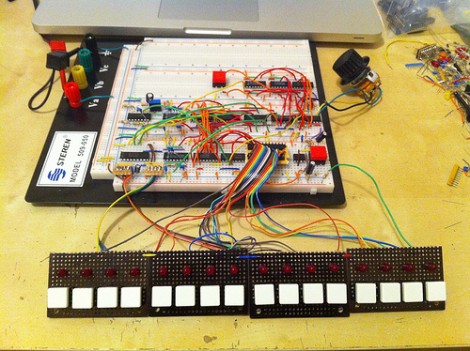
7400 Drum Machine Is A Delight

[74hc595] just finished his entry in the 7400 logic contest. It’s a drum machine built entirely from 7400-series logic chips. He hasn’t quite reached full completion of the project yet. The hardware works just fine, and he’s built a foam core face plate with many more controls than you see here but much of the circuit is still on a breadboard at this point and only two of the channels have been complete thus far.

Jump to the video clip after the break to get the details of how the system works and to hear it in action. This demonstration is one of the best we’ve seen for a synthesizer project as he actually talks about what each control does, and how that is accomplished with the hardware. We’re not going to go into detail about the circuitry he’s designed. As we said before, it uses 7400 logic but also sources a 555 timer to keep the beat. The page linked above has a PDF of the schematic available and you could really lose a lot of time studying how he did this. We might even try to build it in a simulator to see what we can learn.
Continue reading “7400 Drum Machine Is A Delight”

Hydrocrystallophone Probably Won’t Make You Insane

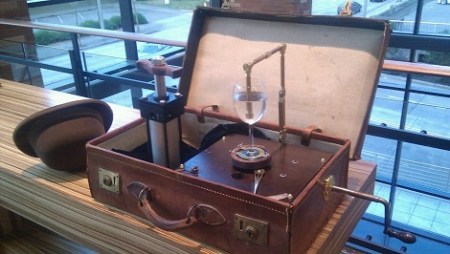
[Fish] is really proud of his newest creation, the Hydrocrystallophone. This new instrument reminds us of an even more steampunk version of [Benny Franklin]’s glass armonica – an instrument that reportedly plunged the player into a, “dark and melancholy mood.”

The build is based around a 1920s hand-cranked phonograph motor. The phonograph motor spins a wine glass filled with water. The water level (and thus tone produced by the wine glass) is varied by a brass tube inside the glass connected to a hydraulic cylinder. Pushing and pushing on the handle of the hydraulic cylinder causes the water level in the glass to change.

We’ve all seen wine glass music before, but this is the first time we’ve seen it with just one glass. [Fish] is working on modifying the phonograph’s governor to get rid of the effects of 78 RPM on the water. He hasn’t quite mastered his new musical invention yet, but we can’t wait to see what [Fish] is able to play with some practice.

In case you’re keeping track of the musical instruments featured on Hack A Day that fall into the “why didn’t I think of that” bin, The Hydrocrystallophone would be the second such instrument in as many months. It’s a very simple but really ingenious device. Check out the video of the Hydrocrystallophone after the break.

Continue reading “Hydrocrystallophone Probably Won’t Make You Insane”

Cheap Acoustic Panel DIY

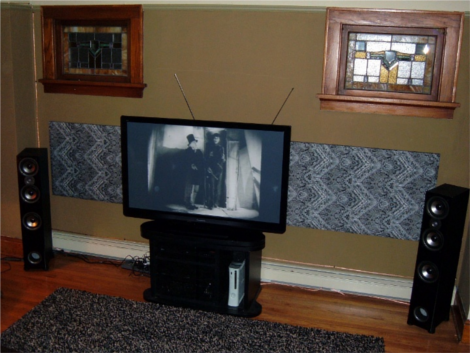
[Eric Wolfram] wrote in to let us know about a simple and cheap acoustic panel DIY he put together.  When installing a home theater acoustics are often neglected (especially if you spend so much on the TV you cannot afford any furniture for the room) resulting in reduced listening quality and poor spacial sound imaging from your surround system (also responsible for the furniture problem). The addition of sound absorbing panels helps control the acoustics of the room and may even class up the place a bit.  These are also come in handy for home studio usage where a low level of reverberation is preferred.

The panels are relatively simple to produce on a budget, just a sheet of 2″ thick dense fiberglass board glued into a wooden frame and covered in a sound-transparent fabric. [Eric] goes into a lot of the material selection process to help you along your way. The best part about the project (aside from its obvious utility) is that all of the materials can be found cheaply at your average home improvement store, with the exception of the fabric.  [Eric] mentions that you can substitute colored burlap if need be.  Once the panel is assembled and glued it just has to be hung on the wall of your choice like a large heavy picture frame. This could certainly help the acoustics and reduce some slap-back echo in your warehouse/shop. We might have to try this one over the weekend.

Thanks [Eric]!

Analog IPhone Amplifier Made From Recycled Trumpets

analog_telephonographer

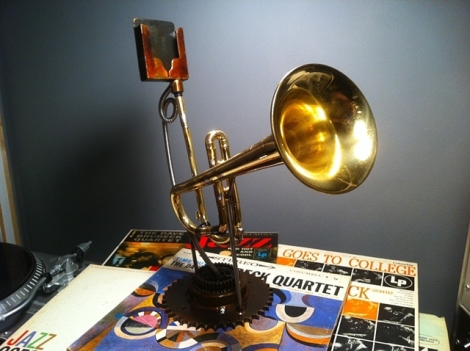
It’s no secret that the audio quality of the iPhone’s built-in speakers isn’t exactly what you would consider to be hi-fi. Sound quality aside, there are plenty of times where even the volume doesn’t do the music justice. While you can always go out and buy a fancy dock to amplify your iGadget’s sound, artist [Christopher Locke] has a different take on the subject.

For a while now, he has been constructing what he calls “Analog Tele-Phonographers”, metal sculptures that can be used to amplify a mobile phone’s audio. Built out of steel and old trumpets, his audio sculptures require no electricity, instead utilizing the same amplification technology as the original phonographs.

While the Tele-Phonographers won’t make your iPhone sound like a high quality tube amp, they do undoubtedly increase the phone’s volume and they are nice to look at. We can certainly get behind this sort of recycling/reuse of old items.

Continue reading to see a quick video of his Analog Tele-Phonographer in action.

[Thanks, Chris]

Continue reading “Analog IPhone Amplifier Made From Recycled Trumpets”

Playing Dubstep On Real Instruments

When we first saw the live cover of Skrillex Scary Monsters And Nice Sprites by the band Pinn Panelle, we had to know how a band is able to play live dubstep on real instruments. We emailed the band and they spilled the beans on how to process the hell out of an instrument in a live environment.

First up is the bassist, [Nathan Navarro]. He wears a Source Audio Hot Hand on his right thumb. This little box is a two-axis accelerometer that communicates with his pedal board using RF frequencies. With the Hot Hand, he has control over two parameters on Hot Hand Pedals. The envelope effect is awesome, but it’s worth noting that [Nathan] is sponsored by Source Audio. We’re thinking it would be relatively easy to cram a Wii MotionPlus and microcontroller into a wristband. Tied to a computer and MIDI interface, the homebrew solution would do the same thing.

[Derek Song] is the guitarist and he’s used multieffects for most of his musical life He has a small Bluetooth keyboard and touchpad mounted to the front of his guitar that controls just about everything on his pedal board. The Bluetooth controller sends commands to [Derek]’s computer that outputs MIDI CC messages to his pedal board.

In a studio, Pinn Panelle’s cover would be impressive. The fact that it’s being played live opens up a number of doors as to what a band can do in real-time. If you’ve got a pedal board or electronic music build, send it into the tip line. Also, check out the videos after the break for a better demo of [Derek]’s Bluetooth setup.

Continue reading “Playing Dubstep On Real Instruments”

AVR Chiptune Project Turns This Simple Code Into Music

[Mark] had seen a few examples of algorithmic music generation that takes some simple code and produces complex-sounding results. Apparently it’s possible to pipe the output of code like this directly to audio devices on a Linux box, but [Mark] decided to go a different direction. His project lets you play simple algorithms as audio using AVR microcontrollers.

Now the code work for this is very simple, but he hardware implementation is where things get interesting. Ostensibly, [Mark] didn’t have the components available to build a filter to use PWM as an audio signal. Being that he’s a ham operator, he grabbed some radio equipment he had on hand and whipped up an alternative. He’s feeding the PWM from an Arduino into the voltage controlled oscillator on a board meant for high-altitude balloon telemetry. The signal broadcast by this board is then picked up by his radio receiver, and played on some speakers.

Rube-Goldberg contraptions aside, the effect is pretty interesting, as you can hear in the latter half of the video clip which we’ve embedded after the jump.

Continue reading “AVR Chiptune Project Turns This Simple Code Into Music”

Star Wars Imperial March Played By Dual Floppy Drives

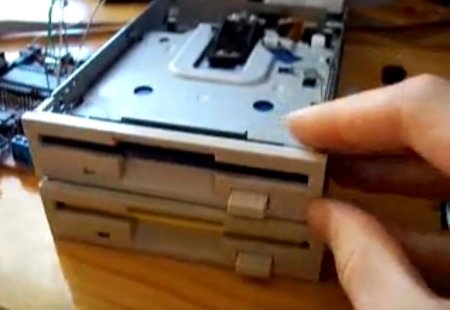
Although many have made some sort of music with improvised electronics, few sound as cool as this Imperial March from Star Wars played by two floppy drives. According to [Pawel], “It’s nothing new” and quite simple. This may be true as we’ve featured an Imperial March-playing floppy drive here before, but it was only one drive. Although it may not be the London Symphony Orchestra, the two drives together sound quite good!

According to him, the FDD has a fairly simple interface. To move the head, one simply needs to pull the DRVSB pin low and then activate the STEP pin on a falling edge.  This will make the head move one direction dependent on the DIR pin state. In this case, an ATMega microcontroller is moving everything. An explanation of the pins used in this hack can be found here.

Although it may look like an intimidating hack on the surface, something like this might be a neat project to try with some old hardware and an Arduino or other controller! [Pawel] did have the idea to hook up a 5 1/4″ and 8″ drive to make a full FDD orchestra, so we can’t wait to see what he comes up with! Continue reading “Star Wars Imperial March Played By Dual Floppy Drives”