Machine Learning Lets Micro Decode Your Handwriting

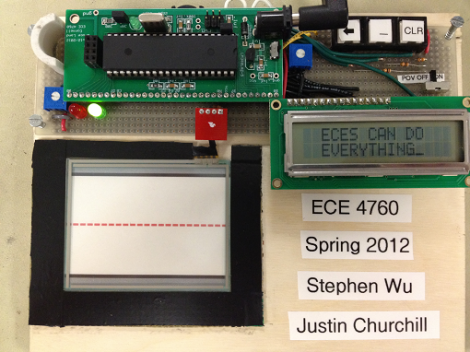
This rig will take the letters you write on the touchpad using a stylus and turn them into digital characters. The system is very fast and displays near-perfect recognition. This is all thanks to a large data set that was gathered through machine learning.

The ATmega644 that powers the system just doesn’t have the speed and horsepower necessary to reliably recognize handwriting on its own. But provide it with a dataset to compare against and you’re in business. [Justin] and [Stephen] designed a neural network algorithm that took a large volume of character handwriting samples, and boiled them down into a set of correlations that can be referenced when encountering a new entry. This set is about 88 kilobytes, too much to store in the microprocessor, but easy to reference from an external flash memory device.

There’s plenty of gritty details in the write up linked above, but you may want to start with the video overview found after the break.

Continue reading “Machine Learning Lets Micro Decode Your Handwriting”

Tindie: An Etsy For Electronics

If you have a finished project you’re now bored with, here’s Tindie. It’s a one-man operation headed b [emile] that hopes to connect makers with people who think DIY projects are really cool and have money.

There are already a few websites that cater to the builder who wants to sell projects: Kickstarter for one, but this is based on the concept of campaigns. Tindie aims to be a techie etsy, according to [emile]’s market research post on reddit;  a places for makers with a soldering iron to sell stuff, but who are baffled by the concept of knitting.

Right now there’s nothing to buy on Tindie – [emile] is looking for hackers to sell their projects so the store doesn’t launch with an empty stockroom. If you’ve got an old project sitting on your shelf that you’d like to sell, put it up. [emile] is only taking 5% of the sales – just enough to pay for the hosting. Hopefully it will be popular enough for the eventual Tindie/regretsy blog.

Iron Casting In The Parking Lot

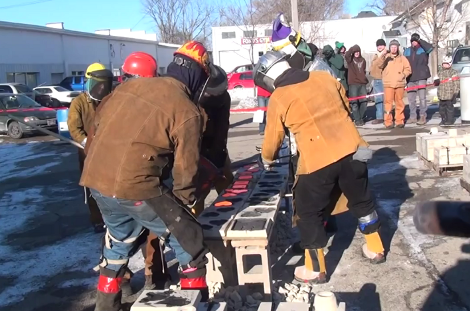
Here’s one good thing about the bitter cold Midwestern winter, it helps keep you from overheating when working around a hot furnace. Back in February this iron pour happened in the parking lot of the Madison, Wisconsin based Sector67 Hackerspace. Look, they’re making iron hearts!

Now this isn’t just a bunch of members who got together and decided to do some casting. As you can tell in the video after the break the team knows what they’re doing. The event was a collaboration with FeLion Studios, a custom cast-iron art boutique. But the Hackerspace participants did get to take part in the process of building the cast, watching the pour, and cleaning up the rough results.

One of the people from FeLion Studios just appeared on the Martha Stuart Show, along with a 550 pound cast-iron frying pan United States map.  [Chris] from Sector67 tells us the New York frying pan that [Martha] is hold was a product of the parking lot pour.

Continue reading “Iron Casting In The Parking Lot”

Nuka-Cola Prop Looks Deliciously Radioactive

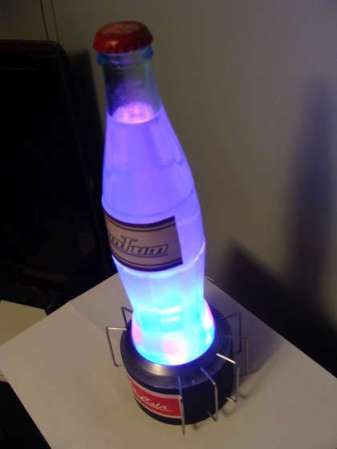
Yet another Fallout post here on Hackaday. This time, instead of the PIP-Boy, someone has built a fantastic prop for the iconic Nuka-Cola. The circuit is super simple, really just an LED array to light up the beverage just right. The construction of the base is quite nice though. If you’re a fan of functional props, or at least semi-functional (we doubt it tastes very refreshing), you’ll enjoy the build.

In case you’re wondering just what is in that bottle, it is basically just tonic water. For those who are unaware, tonic glows under UV light. [Kfklown] did add a few drops of paint to get the perfect color though. You’ll note that there are red and blue LEDs in the base as well as UV for color as well.

Retrotechtacular: Science Fair Robot Ca. 1984

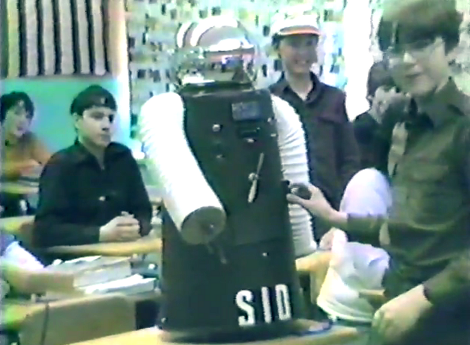
[Michael Surran] just came across this video from his seventh grade science fair project. He really had some fun building and showing off the robot and we’re glad the footage wasn’t lost in the annals of time. Take a look at the clip after the break. That’s not a robot peeing, it’s the ‘fire defense unit’ that pumps liquid to put out very near-range fires. There’s a solar-powered fan on the front, and the claw will spin if you know how to activate it. The shoulders and base are also motorized, and it looks like the keypad from an early calculator gives some extra control on the back of the bot.

We can’t watch this without smiling, and it’s inspired us to launch a recurring feature on Hackaday. We want you to dig out and digitize your old footage. Anything hack-related is fair game… and don’t be bashful! It doesn’t necessarily have to be you either. For example, we loved the video of [Grace Hopper’s] nanosecond lecture. If you’ve got some old time footage send us a link to it!

Continue reading “Retrotechtacular: Science Fair Robot Ca. 1984”

Westport Mini Maker Faire Is The First For Connecticut

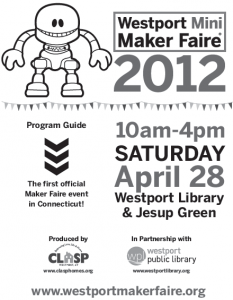
If you’re in Westport CT, or within day-trip distance, you might want to check out the Mini Maker Faire happening there this weekend. Being held at the Westport Library & Jesup Green, there are going to be several interesting planned events, on top of the usual gathering of makers and hackers. Local hackerspaces will be in attendance as well.

Some of the planned events include a battle of the home made bands, rube goldberg events, and jam sessions with the home made bands. Check out the guest speakers as well, there are a few names there that we would love to see.

Modeling An Object With Internal IMUs

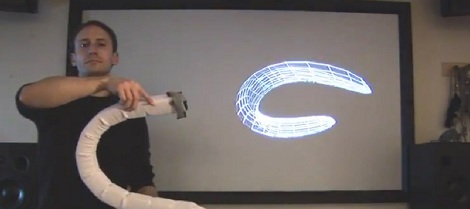
[Joseph Malloch] sent in a really cool video of him modeling a piece of foam twisting and turning in 3D space.

To translate the twists, bends, and turns of his piece of foam, [Joseph] used several inertial measurement units (IMUs) to track the shape of a deformable object. These IMUs consist of a 3-axis accelerometer, 3-axis gyroscope, and a 3-axis magnetometer to track their movement in 3D space. When these IMUs are placed along a deformable object, the data can be downloaded from a computer and the object can be reconstructed in virtual space.

This project comes from the fruitful minds at the Input Devices and Music Interaction Lab at McGill University in Montreal. While we’re not quite sure how modeled deformable objects could be used in a user interface, what use is a newborn baby? If you’ve got an idea of what this could be used for, drop a note in the comments. Maybe the Power Glove needs an update – an IMU-enabled jumpsuit that would put the Kinect to shame.

Continue reading “Modeling An Object With Internal IMUs”