Fully Characterized Systems

A friend from my old hackerspace was in grad school for electrical engineering. He had a professor who would ask, when something went wrong with a student project, “Have you fully characterized the system?” It’s a good, if lofty, goal, but it also became an inside joke around the hackerspace because YOLO was our MO about 95% of the time. Head crashes on the 3D printer – “not fully characterized”. Forgot to take out the trash last weekend? Was the system fully characterized?

It’s maybe also the difference between theory and practice: In theory, there’s no difference between theory and practice, and all systems can be fully characterized. But in practice, it’s hard to fully characterize a system that you don’t yet fully understand.

Case in point: we have nine small saplings growing in our front yard, and I have to water them. It’s boring moving the hose from tree to tree, so I thought I’d take a length of hose, stopper it at one end, and drill enough holes in it so that it could irrigate all of the trees at once. I kinda characterized the system: I figured out how much water flows per minute through our hose, and divided that up into a reasonable outflow in my mind, and drilled holes that ended up being way too large.

Why? Because a length of hose has a resistance to flow, and the water came pouring out of the first few holes, while the last few were dry. It wasn’t a constant pressure system like I thought it would be. I hadn’t even thought that the drag in the hose would matter, so there was no way I would have tried to measure it. But how would I characterize this resistance anyway? You could make a hose with too-large holes and measure the falloff. (Oops, that’s exactly what I did.)

In retrospect, professional drip irrigation systems always have holes that are tiny relative to the pipe diameter, which avoids this pressure-drop phenomenon, which means that they don’t have to worry about characterizing the hose resistance. So that’s what I ended up doing. I cut the hole size in half, and later widened up some of the downstream holes until it looked about right. Not even close to fully characterized, but it works.

So now, in addition to the engineer’s “have you fully characterized the system?”, I have the hacker’s “can you avoid characterizing parts of the system?” in my mind. And a holey chunk of hose in the trashcan.

Supercon News

Just briefly, in case you missed it: Tickets are on sale now for Supercon Ten, and we’ve extended the call for participation by another two weeks. If you’re a Hackaday fan, you owe it to yourself to join us at our annual gathering.
Measurement Is Science

I was watching Ben Krasnow making iron nitride permanent magnets and was struck by the fact that about half of the video was about making a magnetometer – a device for measuring and characterizing the magnet that he’d just made. This is really the difference between doing science and just messing around: if you want to test or improve on a procedure, you have to be able to measure how well it works.

When he puts his home-made magnet into the device, Ben finds out that he’s made a basically mediocre magnet, compared with samples out of his amply stocked magnet drawer. But that’s a great first data point, and more importantly, the magnetometer build gives him a way of gauging future improvements.

Of course there’s a time and a place for “good enough is good enough”, and you can easily spend more time building the measurement apparatus for a particular project than simply running the experiment, but that’s not science. Have you ever gone down the measurement rabbit hole, spending more time validating or characterizing the effect than you do on producing it in the first place?

3D Printed Caliper Extensions Make Hole Measurement Easier

If there’s anything more frustrating than mounting holes that don’t line up with the thing you’re mounting, we don’t know what it could be. You measure as carefully as possible, you drill the holes, and yet at least one hole ends up being just out of place. Sometimes you can fudge it, but other times you’ve got to start over again. It’s maddening.

Getting solid measurements of the distance between holes would help, which is where these neat snap-on attachments for digital calipers come in. [Chris Long] came up with the 3D printed tools to make this common shop task a little easier, and they look promising. The extensions have cone-shaped tips that align perfectly with the inside edge of the caliper jaws, which lines the jaws up with the center of each hole. You read the center-to-center distance directly off the caliper display, easy peasy.

Of course, there’s also the old machinist’s trick (last item) about zeroing out the calipers after reading the diameter of one of the holes and then measuring the outside-to-outside distance between the two holes. That works great when you’ve got plenty of clearance, but the shorter inside jaws might make measuring something like a populated PCB with this method tricky. For the price of a little filament and some print time, these might be just the tool to get you out of a bind.

Continue reading “3D Printed Caliper Extensions Make Hole Measurement Easier”

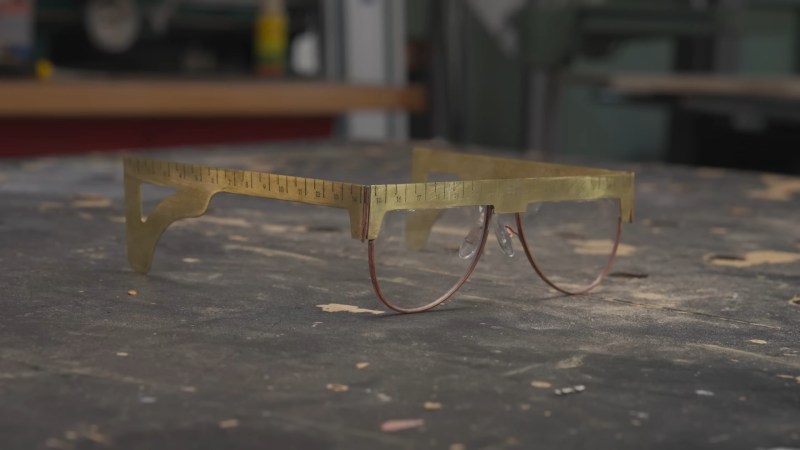
A set of brass safety glasses sit on a marred black workbench. The top and earpiece sections of the frames are in squarish brass plate and have ruler marks on them.

Combination Safety Glasses And Measurement Tool

While rulers and tape measures are ubiquitous, they always seem to disappear when you need them. We know you’d never forget your safety glasses (safety first!), so what if they were also a measuring tool?

Starting by snapping pieces from a folding yardstick, [Simone Giertz] and [Laura Kampf] worked out a rough prototype before letting [Giertz] complete the project in brass. Some initial issues with the weight of the frames were alleviated by switching to a lighter weight plate material and using thinner frames and weight-saving holes near the ear pieces.

Beauty is in the eye of the beholder, so we’ll let somebody else decide whether or not these will be the newest fashion craze. But it’s hard to argue with the timelessness of brass unless you have a copper allergy. We could definitely see a less expensive plastic version catching on in makerspaces for the PPE bin.

Want some other cool wearable gear? How about [Giertz]’s grocery bag hat, an evening gown with servo-driven flowers, or a shirt that reflects heat out the atmospheric window?

Continue reading “Combination Safety Glasses And Measurement Tool”

Digitally Reading A Micrometer’s Output

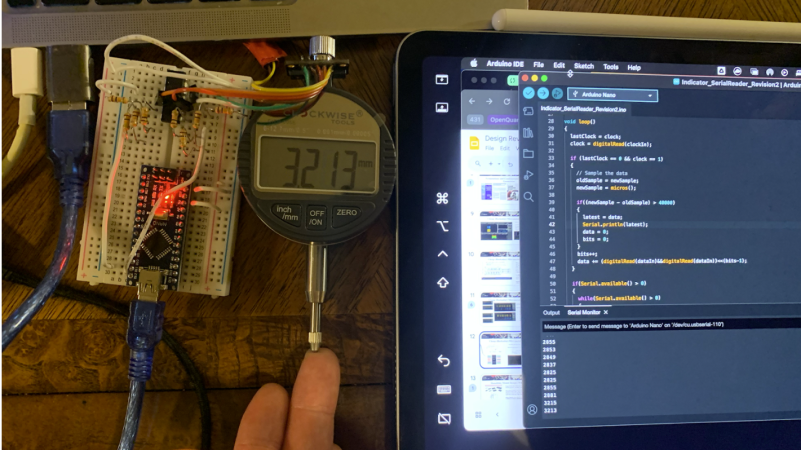
If you’re instrumenting your machine tools, or if you’re just curious, you might want to get granular access to the output of a digital micrometer or the like. [Tommy] set his mind to figuring out the communications protocol of the ClockWise Tools dial indicator for this very purpose. And he succeeded!

Work began by finding the clock and signal lines for the gauge. With those identified, and the signals up on an AD2 logic analyzer, it was determined that once every 40 milliseconds, the device sent a data burst of six nibbles separated by 1.58 milliseconds apiece. The device communicates the absolute position of the gauge, and the data can be readily decoded with the aid of an op-amp to help boost up the 1.5-volt logic to a more reasonable level for a modern commodity microcontroller like the Arduino Nano. From there, the information can be trucked over serial to a PC, or you can do just about anything else with it besides.

We’ve seen similar hacks performed on calipers before, too, making automated measurements a breeze. If you’re working on something that needs precise measurements down to the, well… micrometer… this project might be just the thing you’re looking for.

Rulers Of The Ancient World — Literally!

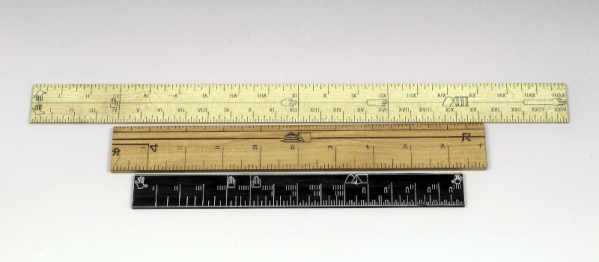
If you were expecting a post about ancient kings and queens, you are probably at the wrong website. [Burn Heart] has a fascination with ancient measuring devices and set out to recreate period-correct rules, although using decidedly modern techniques.

The first example is a French rule for measuring the “pied du Roi” or king’s foot. Apparently, his royal highness had large feet as a the French variant is nearly 13 inches long. The next rulers hail from Egypt and measure cubits and spans. Turns out the pyramid builders left a lot of information about measurements and their understanding of math and tools like dividers.

Other rules from Rome, Japan, and the Indus Valley are also included. According to the post, one set of these rulers used locally sourced wood, but a second “limited” edition used wood that the originals might have. Most of the rulers were etched via CNC, although the French ruler was hand-etched.

The Romans, apparently, had smaller feet than French royalty, as their Pes or foot was about 11.65 inches. There are plenty of little tidbits in the post ranging from the origin of the word inch to why the black wood used for piano keys is called ebony.

We’ll stipulate this isn’t exactly a hack, although it is fine workmanship and part of hacker culture is obsessing over measuring things, so we thought it was fair game. These days, rulers are often electronic. Which makes it natural to put them on a PC board.

Is This The World’s Smallest Multichannel Voltmeter?

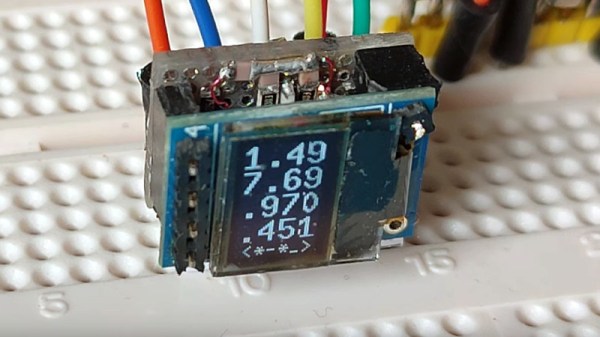
The instrument which probably the greatest number of Hackaday readers own is likely to be the humble digital multimeter. They’re cheap and useful, but they’re single-channel, and difficult to incorporate into a breadboard project. If you’ve ever been vexed by these limitations then [Alun Morris] has just the project for you, in the world’s smallest auto-ranging multichannel voltmeter. It’s a meter on a tiny PCB with a little OLED display, and as its name suggests, it can keep an eye on several voltages for you.

At its heart is an ATtiny1614 microcontroller on a custom PCB, but for us the part we most like lies not in that but in the prototype version made on a piece of protoboard. There’s considerable soldering skill in bending surface mount components to your will on this material, and though these aren’t quite the smallest parts it’s still something that must have required some work under the magnifier.

All of the code and hardware details can be found in the GitHub repository, and for your viewing pleasure there’s a video showing it in action which we’ve placed below.

Continue reading “Is This The World’s Smallest Multichannel Voltmeter?”