DRM Causes Vulnerabilities

This image is from Microsoft's DRM page.

We often hear people touting the evilness of DRM, but usually they are talking about the idea of ownership. In this case, DRM is actually causing harm. It turns out that Microsoft’s msnetobj.dll, which is supposed to enforce DRM on your computer, stopping you from doing certain things like saving files you don’t “own” is open to 3 attacks.  Vulnerable to buffer overflow, integer overflow, and denial of service, this sucker is riddled with issues.

The vulnerabilities in this file aren’t groundbreaking. Buffer overflow is a common method to get to many systems. The problem here, according to some commenters at BoingBoing, is the fact that this DLL is called every time you open a media file.

[via BoingBoing]

Thieves, Armed With A Vacuum Cleaner, Still On The Run

Thieves in Paris have been stealing money with the clever use of a vacuum. Not just bits of change here and there, they’ve stolen over 500,000 euros. They noticed that Monoprix supermarkets use a pneumatic tube system to transport rolls of cash to and from the safe. Realizing this was the weakest point in the security, they simply drilled a big hole in the tube, hooked up a vacuum and sucked the cash out. Forget lock picking or safe cracking, this had to be ridiculously easy.

The thieves are still out there, sucking their way to riches. At this point, they’ve hit 15 locations. Their luck has to run out some time right?

[via Slashdot]

Hackerspace Competition: Looks Promising

This is what happens when [Mitch Altman] comes together with hackerspaces nationwide to have a contest. In short, 5 hackerspaces  will “take on the machine” and come up with 5 original ideas for existing devices. There are a few more rules, but you can catch them in the video in the link above. There is hinting at a slot machine that mixes drinks, a bike that makes ice cream, and more. What do you guys think is in store?

This is also a great opportunity to mention the hackerspaces wiki, find a community (or start one!) near you today and maybe [Mitch] will call on your hackerspace next competition. For now, we’ll keep you up to date with each hackerspace’s project and progress.

[Thanks Deven]

Continue reading “Hackerspace Competition: Looks Promising”

Something Wicked This Way Comes

Halloween is rapidly approaching. This is just a reminder to you all to send in your Halloween hacks now so that we can all see them and steal your ideas get inspiration for our own projects. We’ve seen fantastic stuff in the past from motorized pumpkins to costumes that are simply awe-inspiring. Take a few moments to dig through the Halloween hacks we’ve run in the past.

Of course we understand that some of you will be pushing up to the big day to complete your projects. Just remember to take good pictures and document it all well.

Line Following Tank Without A Microcontroller

This line following tank uses analog circuitry to sense where a dark line is and adjust its course. Despite the opening paragraph on the schematic page (which looks to be leftover from a past project writeup) this circuit relies on a set of transistors for motor control. [Chris] does a great job of explaining the setup in detail; it boils down to a phototransistor detecting reflected light and flipping which motor is running based on what is detected. A couple of potentiometers are included to tune up the accuracy of the circuit. There’s a short clip of the treaded-terror making a loop around the track after the break.

This is another great way to try your hand at analog circuitry. Once you’ve built the body (tank or otherwise) and line tracking circuit it can be repurposed by swapping out the brains for your next project.

Continue reading “Line Following Tank Without A Microcontroller”

Controlling The Power Of A Flash With A Tv Remote

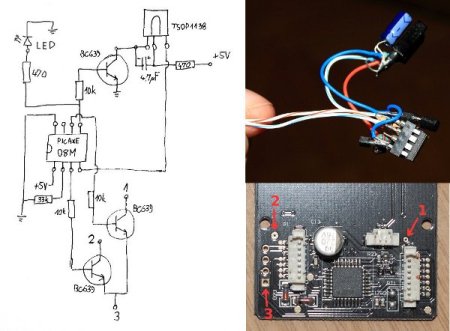
For those who do fancy photography, setting up the lighting ends up being one of the larger tasks of each session. There are flashes out there that can be controlled via a remote control to help ease the process, but they can cost a considerable amount more. [Dsvilko] shares with us a fairly simple circuit that allows you to use a tv remote to control your flash. He’s using a picaxe 08m and he states that before this project, he had never messed with microcontrollers. We say great job on your first microcontroller project. You can catch a video of it in action after the break.

Continue reading “Controlling The Power Of A Flash With A Tv Remote”