Black Hat 2008: What’s Next For Firefox Security

Mozilla security chief [Window Snyder] made some surprising announcements about Firefox Next, Mozilla’s next major browser overhaul. In her chat at the Black Hat security conference, she introduced three new initiatives that focused on threat modeling, training, and vulnerability metrics. For the threat modeling initiative, she’s hired Matasano Security consultants to review Firefox’s code for weaknesses and recommend mitigation tactics to protect the browser from hacker attacks. This isn’t inherently unusual; what is abnormal is that the information, once the work is done, will be revealed to the public. The training initiative will have IOActive trainers working with Mozilla engineers on secure computer programming practices. At the end, according to [Snyder], online versions of the classes will be released to the public, along with the class materials. The last initiative revolves around security metrics, and is already in progress. Essentially, the project will ideally take the focus off of patch-counting and provide a better assessment of security and vulnerability issues. [Snyder] says “We’re in the early phase, working on incorporating feedback from the rest of the industry.” She also reveals some more Firefox developments, including possibly incorporating NoScript into the core browser and implementing protected mode, but they’re still a long way from becoming standard features.


New E-Passports Cloned


Within an hour, Jeron Van Beek was able to create a successful clone of Britain’s new E-Passport. All he needed was a £40 card reader, two £10 RFID chips, and a small, improvised script. Although the exact details were not specified, it looks like he read the ID on the real passport using the RFID reader, then he wrote it to the two blank chips and put them in the fake passports. There is also a flaw which may allow outright forging of the passports. Nearly all of the 45 countries using the system have not yet registered with the Public Key Directory, which was put in place to make forging impossible.

The government is claiming that this hack is a hoax, but recent reports have shown that these RFID systems were never secure. No matter what the actual truth is about these hacks, it can certainly be said that the ability to clone or forge these passports would be a devastating security issue for every country involved.

[Photo: Digital World Tokyo]

[via The Guardian]

Homeland Security Issues Policy On Laptop Seizures


The US Department of Homeland Security recently disclosed a new policy that allows agents to seize laptops, or anything capable of storing information, “for a reasonable period of time”. Okay, so this seems normal; A government agency is declaring they may confiscate personal property. However, the strange part of this story is that under this policy, federal agents can confiscate these things without any suspicion of wrong doing or any reason what so ever. So what happens to your personal data after they seize your laptop? Apparently they share the data with federal agencies, and in some cases the private sector, as additional services such as file decryption or translation are needed. While this may seem like a major violation of privacy, it is important to note that this policy only applies to people entering the United States. However given the direction that our federal government is moving in the area of security, it wouldn’t surprise me if this policy will soon apply for domestic flights as well.

[photo: postmodern sleaze]

[via eff.org]

Black Hat 2008: Dan Kaminsky Releases DNS Information


[Dan Kaminsky]’s much anticipated talk on his DNS findings finally happened at Black Hat 2008 in Las Vegas today. [Dan] has already uploaded the complete slides from his talk as well as posted a short summary to his site. New information in the slides since our previous coverage includes “Forgot My Password” attacks and new attacks on internal network vulnerabilities as a side of effect of DNS cache poisoning. [Dan]’s talk today was over capacity; our shot of the conference room overflow is shown above.

Black Hat 2008: EFF Coders’ Rights Project Announced

The EFF has just announce the creation of the Coders’ Rights Project website at the Black Hat conference. The sites’ main goal is to centralize legal information for coders, and to help protect important security work from legal actions that may be taken against them with the DMCA and other legal black holes. While this is in no way a fully comprehensive list of everything you need to know, it looks like a good place to start, and provides a few FAQs for suggestions on how to stay in the legal clear as much as possible. At numerous points the documents suggest you speak with a lawyer, if you have any deeper questions, which you absolutely should. This can be very helpful if a person or group finds a security risk, and wants to publish it, or just wants to start looking into possible security risks.

Remote Controlled Pill-bot


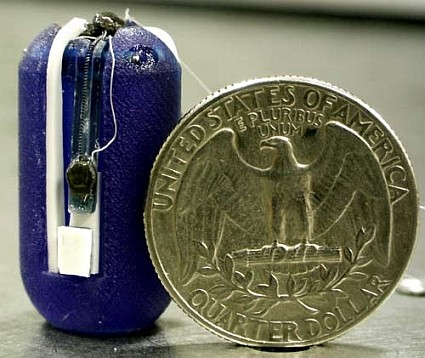
The NanoRobotics Lab at Carnegie Mellon University has come up with a medical robot that can be swallowed, and is then able to be controlled from outside the body. The device has small arms with adhesives that can attach to slippery internal surfaces, which has previously proven difficult. Once inside the body, it can be used to view damaged areas, deliver drugs, as well as biopsy questionable tissues, and possibly even be used to cauterize bleeding wounds with a small laser. The device could be stopped, and even reversed to get a better look at areas that may have gone unnoticed otherwise. This would be a major advancement in diagnosing intestinal problems, and could lead to potentially life saving treatments. Did we mention that it has lasers?

[via Neatorama]

More On GIFAR


[pdp] provides some perspective on the news regarding the GIFAR attack developed by researchers at NGS Software. As he explains, the idea behind the attack, which basically relies on combining a JAR with other files is not new. Combining JAR/ZIP files with GIF/JPG files will create hybrid files with headers at both the top and bottom of the file and allow them to bypass any image manipulation library as valid files. While tightened security and more stringent file validation practices are advisable, the problem is larger than just a vulnerability in browser security. ZIP is an incredibly generic packing technology used everywhere, from Microsoft files to Open Office documents, and of course, in JAR files. He closes with, “any file format that is based on ZIP, you allow your users to upload on your server, can be used in an attack”

[photo: Jon Jacobsen]