[Scott] Made A Single-chip Hellschreiber On Earth

[Scott Harden] is drilling teeth by day and designing radios that send secret messages by night. He’s set his sights on the Hellschreiber protocol which was used by the Germans in World War II along with their Enigma encryption system. The protocol is a viable alternative for transmitting and receiving code in environments with too much background noise for other communication systems.

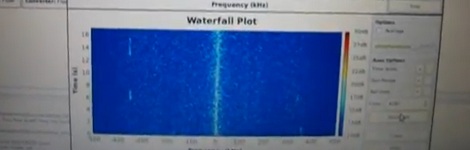
His goal was to develop his own transmitter using just one microcontroller. He picked an ATmega48 and coupled it with a 40 MHz crystal oscillator. [Scott] mentions that there is no other hardware necessary, but static messages stored in an array so you’d need some other hardware to push your own characters through via the chip’s UART or otherwise. The AVR sends messages by converting the data into audio using PWM. That signal is fed into the crystal oscillator, which produces an amplitude modulated signal (AM) that can then be transmitted.

Check out his video after the break for a demonstration. He’s decoding the transmitted data using a free program called Ham Radio Deluxe.

Continue reading “[Scott] Made A Single-chip Hellschreiber On Earth”

AM Singer: A Tiny AM Transmitter


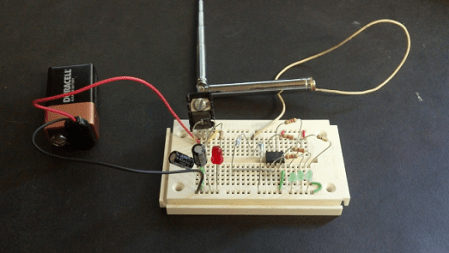
[Simon Orr] wrote in to tell us about his AM transmitter prototype that he plans to put into production in a few months. The build is based on an “Easy AM Transmitter” featured in this Instructables article.

Interestingly enough, this device is capable of transmitting in the 100KHz to 480KHz frequencies. The AM band goes from 520 KHz to 1610KHz, so in order to hear this signal, one must actually tune the radio to twice the emitted frequency. This allows one to tune into the harmonic frequency and receive a signal in this range.

Using the harmonic frequency to transmit is an interesting concept by itself. Additionally, the idea that one could build this device with or without the kit in the future should appeal to experienced hackers and those just starting out alike. Check out the “AM Singer” prototype video after the break. Continue reading “AM Singer: A Tiny AM Transmitter”

Arduino Powered 2.4 GHz Spectrum Analyzer

[Fred] dropped a note in our tip line to let us know about arduino forum user [bilbo]’s latest project: A 3-in-one spectrum analyzer, oscilloscope, volt-meter combo. The build consists of an Arduino, radio board and Nokia 5110 LCD breakout board.  The (thin) video after the jump shows the rig in action. Though soldered to a full sized perf-board we can see later, smaller, battery powered versions prove useful in rooting out wayward bluetooth signals, or just finding that lost microwave oven. Although [bilbo] uses the same radio board as similar builds  his creation boasts several different display modes, as well as doubling as a volt meter and miniature-oscilloscope. There is no shortage of previous spectrum analyzer builds, but this one is the first one we have seen running on an Arduino.

Thanks for the tip [Fred]! If you feel like wedging some frequency scanning capabilities into your next project don’t forget to check out [bilbo]’s forum posts for source code!

Continue reading “Arduino Powered 2.4 GHz Spectrum Analyzer”

RC Transmitter Does Everything

[Demetris] sent in a tip about a project he’s working on: an Open Source Remote Control transmitter. This is one of the most impressive looking RC transmitters we’ve ever seen. The OSRC could be great for a small UAV – just get the GPS position from the aircraft and map it with the transmitter’s screen. There’s also support for a video downlink so flying around New York City is possible with a single device.

Continue reading “RC Transmitter Does Everything”

[Jeri Ellsworth] Builds A Software Radio

[Jeri Ellsworth] has been working on a direct conversion receiver using an FPGA as an oscillator and a PC sound card DSP. Being the excellent presenter she is, she first goes through the history and theory of radio reception (fast forward to 1:30), before digging into the meat of the build (parts 2 and 3 are also available).

Continue reading “[Jeri Ellsworth] Builds A Software Radio”

Building A Simple FM Transmitter Bug

simple_fim_transmitter_hack_a_week

[Dino] got his hands on an FM transmitter “bug” kit via a friend, and thought it would make for an easy and fun Hack a Week project. The kit is simple two transistor half-wave FM transmitter, which the manufacturer suggests could be used to bug a room, hence the name. After poking a bit of fun at the instructions, [Dino] gets to work building the transmitter, wrapping things up in a little less than an hour.

Once he finished soldering everything together, he takes a few moments to test out the bug and to explain how various parts of the board work together in order to transmit the FM signal. He mentions that adding a dipole antenna would make it easy to extend the range of the transmitter, and briefly teases next week’s episode, where he plans on constructing a similar dual-stage transmitter.

This sort of FM circuit is one of the first few simple projects you would see in a beginner’s electronics class, so if you know anyone that is just starting to get their feet wet, be sure to pass this Hack a Week episode along.

Continue reading to see [Dino] explain the ins and outs of his FM bug transmitter.

Continue reading “Building A Simple FM Transmitter Bug”

Waterfall Signal Visualizer From Arduino And Cellphone LCD

[Leigh] is a HAM operator (you may know him as wa5znu). He is familiar with a signal visualization tool called a waterfall which plots signal strength and frequency over time. He wanted to build his own waterfall and ended up with this Arduino-based version which he calls Cascata. Cascata means waterfall in Italian which meshes nicely with Arduino’s country of origin

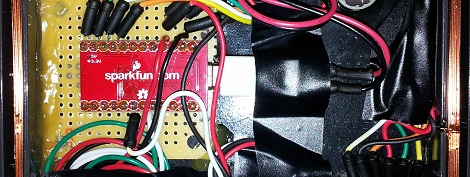
The display he chose is a Nokia LCD shield from SparkFun. It’s easy to plug in and there were already libraries available to drive the display. The audio input just connects to a headphone plug (you can just make it out at the bottom right in the image above) using some electrical tape. A free-formed resistor divider ensures that the signal is within a measurable range. [Leigh] found that signal noise was a bit of a problem but was able to improve his results by adding a capacitor to the Arduino headers between the VREF and GND pins.

See it in action after the break.

Continue reading “Waterfall Signal Visualizer From Arduino And Cellphone LCD”