PIC-based Ham Radio Autotuner

cw_autotuner

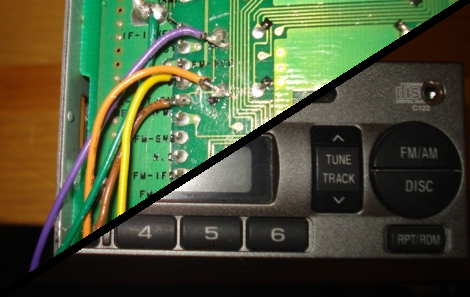
A few years back, [Floyd, K8AC] built a high frequency autotuner as an addition to his Ham radio setup. Based off a design he saw in QST magazine back in the early ’90s, he has been using the tuner almost daily for the last few years, on both the 3.5 MHz and 7 MHz bands.

Built into the wall in his radio room, it is a pretty impressive sight. His “L” circuit is controlled by a pair of mechanically coupled inductors which are driven in concert by a pair of two-way motors. The positioning of the C and L components are monitored by a PIC controller which stores the tuning data for up to 30 predefined frequencies. A couple of button presses on his controller’s front end sends the tuner into action, dialing in his unit’s inductors and capacitor to their proper settings. The PIC monitors the tuner’s progress, informing him when the proper frequency has been tuned in, or if the frequency can not be set, indicating issues with the equipment.

His setup has undergone several revisions over the years, with the most recent iteration being the most automated of the bunch. Check out his site for plenty more details, or keep an ear out for [K8AC] on 40 or 80 meters.

[Thanks, Rich V]

RC Override For Autonomous Hardware

[Simon Inns] developed this board to act as a radio controlled override for autonomous hardware. It sits between some servo motors and two different sets of controllers for those motors. One set of hardware that can control the motors is a microcontroller programmed for autonomous tasks. In [Simon’s] case this enables a sailboat to navigate open water with out human intervention. But if that board fails, or if you just need to call the boat back to port, this module allows for a traditional RF vehicle controller to take command.

The board seen above, dubbed the Servo Switcher, uses a PIC 12F683 to monitor the incoming signal from the RF receiver. If that signal is not present it switches control of the motors over to a separate microcontroller board. This means that the override control is established simply by turning the handheld controller on. This will save you a swim to retrieve your boat, which is a nice convenience. But if you modify this for a plane or helicopter, it can save your aircraft from certain destruction. Check out the video walk through after the break.

Continue reading “RC Override For Autonomous Hardware”

RF Range Finder Doesn’t Need To See To Calculate Distance

radio_rangefinder

Instructables user [Jones Electric] has been quite busy lately, building a radio-frequency range finder. Built as part of a German youth science competition, he and his partner built a pair of transmitter/receiver modules that can be used to measure distances of up to a mile (~1.5km). Their argument for radio-based rangefinders is that laser rangefinders are obviously limited to line of sight, whereas their range finders are not.

To determine the distance between the two stations, the base station is triggered, which starts a counter and sends a 433 MHz signal to the second station. When the second station receives the signal, it in turn broadcasts an 868 MHz signal, which is received by the base station. The total distance between the points is then calculated based upon the round trip time of the two radio signals.

[Jones Electric] claims that the range finder is relatively accurate, with a deviation of up to 5 meters per measurement, and that the accuracy could be increased by adding a higher frequency crystal to the timing circuit.

We are pretty sure using these two frequencies in the US without a license is not allowed, though we are unsure of the usage laws in Germany, where this was constructed.

Frequency Counter For $10 Worth Of Parts

[Scott] built this frequency counter using less than $10 in parts. It’s set up to meter frequencies in megahertz which is fitting since he’s planning to use it with his radio hardware experimentation. But we would find it useful too because our cheap multimeter only reads up to around 4 MHz.

He’s using an ATmega16 that he had on hand but it has features way beyond the specs for the device. He speculates that an ATtiny2313 would easily work in its place. The microcontroller is mostly used to drive the multiplexed 7-segment display after reading the frequency values from the 74LV8154 counter chip that he is using. He doesn’t have a full schematic for the device, but there is a hand drawn diagram for using the frequency counter; the rest should be easy to piece together. Looking at that circuit we don’t think it would be too hard to make this a manual-ranging frequency counter to give you more use out of the dedicated device. Check out [Scott’s] demonstration video which is embedded below the fold.

Continue reading “Frequency Counter For $10 Worth Of Parts”

Building Your Internet Radio Empire

It all starts with one station in your home office but who knows where it can go from there? If you’ve got dreams of being an Internet radio jockey you can get some ideas about equipment startup from this setup that [Viktor’s] built for a friend.

He started out with a plan to have a station that offers twenty-four hour streaming but also supports live broadcast. Two computers are used in the setup. The first handles automated music broadcast and live mixing. This box has two sound cards, one is used for the automated music by feeding the output into a sound mixer that is a separate piece of hardware. The output of that mixer feeds back into the second sound card on the box. This secondary card outputs the final mix to the computer speakers.

The second computer is where a lot of the live broadcast work is done. Any steaming guest (using VOIP or Skype, etc.) come in through this box as well as jingles and sound effects used during the feed. Its sound card is also connected through the external mixer and joins the final feed headed into one of the sound cards on the primary computer.

In the end the Internet connection for the system isn’t beefy enough to reliably support a streaming station. For this a dedicated streaming service is used. It receives the live feed and then uses its increase bandwidth to propagate the signal to listeners anywhere in the world.

Want to listen to this radio station? Build your own streaming radio module, or outfit classic hardware to work with your computer.

Minty FM Transmitter

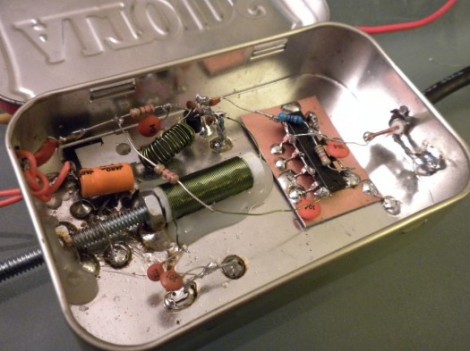
[Chis] wanted an FM transmitter bug device packed in a mint tin, and that is just what he made. Featuring only 17 discrete parts, running off of a 3volt coin cell battery, and small enough to fit inside of a plastic mint box and still have plenty of room for the mints.

Using a simple design the audio enters the device through a electret microphone and hits a transistor for amplification, the signal is then passed to the oscillator section of the circuit which features an LC tank type design which generates the carrier frequency and mixes that with the signal for a range of about 100 feet indoors.

Each section is broken down into steps where it is thoroughly explained with animations, theory, and simulation, if you are wondering how a transistor, wire, and capacitors make an FM transmitter, or if you would like to just make the final project, schematics, pcb files, and assembly instructions are provided as well.

Join us after the break for a short video and be sure to check out the other radio transmitters we have featured as well.

Continue reading “Minty FM Transmitter”

Reverse Engineering Shopping Cart Security

All this talk about 555 timers is causing projects to pop out of the woodwork like this one that reverse engineers a shopping cart security mechanism. The wheel seen above listens for a particular magnetic signal and when encountered it locks down the yellow cowl, preventing the wheel from touching the ground and making the cart very hard to move.

[Nolan Blender] acquired one of these wheels for testing purposes and he’s posted some details about the hardware inside. But the first thing he did was to put together some test equipment to help find out details about the signal that trips the mechanism. He connected a coil to an audio amplifier and walked around the market looking for strong signals. Once he found a few strong bursts with that equipment he grabbed an oscilloscope, hooked it to the coil, and made some measurements. He found an 8 kHz signal at a 50% duty cycle at 30 ms intervals (it would be hard to make a better case for why you need an oscilloscope).

With the specs in hand, [Nolan] grabbed two 555 timers, an audio amplifier, and a 200 turn antenna around a ferrite core to build his own locking mechanism. If you’re ever stopped short in the middle of the market, just look for the hacker at the end of the aisle holding the homemade electronics.

[Photo source]

[Thanks Colin]