FauxTRS Is Definitely Not A Trash 80

Among the 8-bit home micro boom from the late 1970s through early 1980s, the introduction to computing for many wasn’t a pricey Apple or Commodore, instead it was the slightly lower budget machine from Radio Shack. The TRS-80 series of computers live on and have a loyal following among retro computing enthusiasts. But like all such machines the original hardware is harder to find in 2024, so how about the TRS-80 experience without the failing vintage parts? The FauxTRS from [Jpasqua] is just that, the feel of a Model 3 or Model 4, powered by a Raspberry Pi.

In a sense then, this is a very well-designed case for a Raspberry Pi that looks a lot like the Tandy of old. With a modern LCD and keyboard it could just as easily be a normal desktop machine, but when the emulator fires up it does indeed look very much like a small version of the real thing. You can download the STL files from Printables, and for the cost of a few extra parts you can have one too.

Alternatively, if a faux TRS doesn’t do it for you, there’s always the chance of making a more real one.

This Vintage Computing Device Is No Baby Food

Today, if you want a computer for a particular task, you go shopping. But in the early days of computing, exotic applications needed custom computers. What’s more is that with the expense of computers, you likely got one made that fit exactly what you needed and no more. That led to many oddball one-off or nearly one-off computers during that time frame. Same for peripheral devices — you built what you had to and you left the rest on the drafting table. [Vintage Geek] got his hands on what appears to be one of them: the Gerber Scientific 6200.

While Gerber Scientific is still around, we’ve never heard of the 6200. Based on the serial number, we would guess at least 62 of them were made and this one has an interesting backstory of living in someone’s home who worked at the Pentagon. We presume the tapes were erased before it was sold!

Design-wise, it is pretty standard stuff. A 19-inch rack, a standard tape drive from Kennedy, a power supply, and some cards. The box takes 240 V, so the computer didn’t get powered up, but an examination of the inside looked like this really was a one-off with handwritten labels on masking tape.

We couldn’t tell for sure if the device was a computer itself, or just a tape drive and maybe plotter interface for another computer. If you know anything about this device, we are sure [Vintage Geek] would like to hear from you.

If this does turn out to have a CPU onboard, we’d bet it is bit sliced. If you have a 9-track tape machine, you may have to make your own tapes soon.

Continue reading “This Vintage Computing Device Is No Baby Food”

Modern In-Circuit Emulator For The 6809

The Motorola 6809, released in 1978, was the follow-up to their 6800 from four years earlier. It’s a powerful little chip with many 16-bit features, although it’s an 8-bit micro at heart. Despite its great improvements over the 6800, and even technical superiority over the Z80 and 6502 (hardware multiply, for example!), it never reached the same levels of success that those chips did. However, there are still some famous systems, such as the TRS-80 Colour Computer, which utilized the chip and are still being hacked on today. [Ted] is clearly a fan of the 6809, as he used a Teensy 4.1 to create a cycle-exact, drop-in 6809 emulator!

A small interposer board rearranges the Teensy pinout to match the 6809, as well as translating voltage levels from 3.3V to 5V. With careful design, the Teensy matches the cycle diagrams in the Motorola datasheet precisely, and so should be able to run any applications written for the chip! A great test was booting Extended Colour BASIC for the TRS-80 CoCo 2 and running some test BASIC programs. Any issues with opcode decoding or timing would certainly be exposed while running an interpreted language like BASIC. After this successful test, it was time to let the Teensy’s ARM Cortex-M7 rip and see what it could do.

Continue reading “Modern In-Circuit Emulator For The 6809”

Retro Calculator Panders To Trekkies… Or Trekkers

Back in 1976, when calculators were not common or cheap, a company named MEGO made the Star Trekulator: a calculator sporting a Star Trek theme. However, it was a bit odd since the calculator didn’t correspond to anything you ever saw on the TV show. It was essentially a very simple calculator with a Star Trek picture and some blinking LEDs. [Computer History Archives Project] has two examples of the rare calculator and shows them off, including the insides, in the video below. We’ve also included a vintage commercial for the device a little farther down.

Inside the 5-inch by 9.5-inch cabinet was an unremarkable printed circuit board. The main component was a TI calculator chip, but there were a surprising amount of other components, including three that [Computer History Archives Project] could not identify.

MEGO was known for making Star Trek toys, including a cassette player that (sorta) looked like a tricorder and communicator walkie-talkies. We wish they’d made the calculator look like some sort of prop from the show, although the beeping noises, we suppose, were supposed to sound like the Star Trek computers.

Honestly, we want to 3D print a case to replicate this with modern insides that can drive a display to put different Trek clips and sound effects out. Now, that would be something. Maybe [Michael Gardi] can take a look at it when he’s got a spare minute. If anything, the calculator looks too advanced to be on the original series. They should have gone VFD. Although Mr. Spock has been seen with a flight slide rule (an E6-B, if we recall). We prefer our props to look like the real ones, thank you.

Continue reading “Retro Calculator Panders To Trekkies… Or Trekkers”

A Look At The DEC VT220, A Proper Serial Terminal

If you’re reading Hackaday, we’re willing to bet that if somebody asked you about a serial terminal, you’d immediately think about a piece of software — a tool you run on the computer to communicate with some hardware gadget over UART. You might even have a favorite one, perhaps minicom or tio. You’d be technically correct (which we all know is the best kind of correct), but if you wind back the clock a bit, there’s a little more to the story.

You see, the programs we use these days to talk to microcontrollers and routers are more accurately referred to as serial terminal emulators, because they are doing in software what used to be the job of hardware. What kind of hardware? Why beauties like this DEC VT220 for example.

Continue reading “A Look At The DEC VT220, A Proper Serial Terminal”

Remembering Seymour Cray

If you think of supercomputers, it is hard not to think of Seymour Cray. He built giant computers at Control Data Corporation and went on to build the famous Cray supercomputers. While those computers aren’t especially amazing today, for their time, they were modern marvels. [Asianometry] has a great history of Cray, starting with his work at ERA, which would, of course, eventually produce the computer known as the Univac 1103.

ERA was bought up by Remington Rand, which eventually became Sperry Rand. Due to conflict, some of the ERA staff left to form Control Data Corporation, and Cray went with them. The new company decided to focus on computers to do simulations for things like nuclear test simulations.

Continue reading “Remembering Seymour Cray”

Wrap Your Keyboard With A Vacuum Former

Coloured keycaps are a common customisation when it comes to making your input device special. If you are working with modern tech it’s easy, there are plenty of vendors who can sell you keycaps for any purpose. With retro tech it’s never so simple, if a keycap hasn’t been made for decades you’re out of luck. This doesn’t faze [Drygol] though, who has solved the coloured retro keycap in a unique and non-destructive way. Wrap them in vinyl film using a vacuum former.

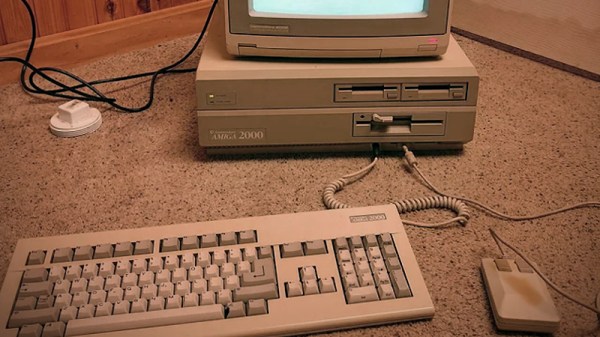
Vacuum formers are an often-underrated tool in the hardware arsenal, but as this project shows, they can produce startlingly good results. Original keycaps are placed on a 3D-printed scaffold before the vinyl is formed over them, then they are carefully cut out and a triangular edge on both sides is folded underneath, The result is an Amiga with a striking orange keyboard, and for us the best bit is that the original key is safely preserved under the vinyl.

[Drygol]’s exceptional work in the retrocomputing sphere has delighted us many times on these pages. There are too many examples to link here, but one we particularly liked was this nearly-all-new Amiga 2000.