Tree Climber Takes A Page From The Inchworm Book

Sharp talons and a strong torso let this robot climb trees, even while carrying a heavy payload. It uses a simple principle, two gripping units allow it to grab onto the tree. These modules alternate, one grips while the torso moves the other up the tree.

You can make out the trio of rods which connect the front and back half of the robot in the image above. Watch the video after the break to see how the motors move these rods with the dexterity of an inchworm, allowing it not only to climb upwards, but to bend and flex to match the contours encountered in the wild.

This was presented at International Conference on Robotics and Automation a few weeks ago. Unfortunately we can only find an abstract for the paper so please leave a link in the comments if you know where to find the full monty.

Continue reading “Tree Climber Takes A Page From The Inchworm Book”

Aquabot Gets Around More Than You’d Think

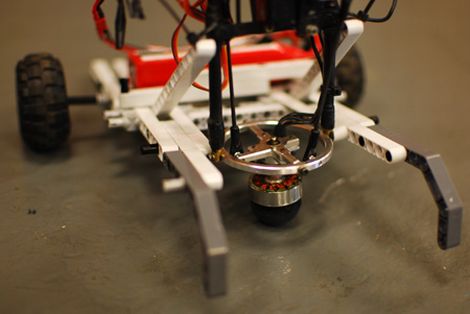
This doesn’t have the flashy futuristic appeal that we’d like to see from high-tech robots, but this amphibious wanderer is well suited for it’s intended purpose. It was developed by researchers at the University of Minnesota to navigate mostly wet environments, collecting data about water quality as part of a distributed army of sensor bots.

The two little arms sticking out in front of it are made of carbon fiber and attached to servo motors inside. The video below the fold shows the trapezoidal body tumbling end-over end to get around. But the awkward, baby-turtle-like locomotion isn’t the only thing in its bag of movement tricks. It can also adjust its buoyancy to float, sink, or hover somewhere in the wet stuff.

To get a better look at what went into developing this, take a look at the Adelopod developed at UMN a couple of years back. We also embedded a video of that tumbling robot because they share the build details we’re always on the lookout for.

Continue reading “Aquabot Gets Around More Than You’d Think”

This Robot Can Beat You At Pointless Games

We already know that robots can be smarter than us as evidenced by Watson beating [Ken Jennings] at Jeopardy, or Deep Blue beating [Garry Kasparov] at chess. Now [E024576] is striving to build a bot to compete at physical games.

For the challenge, he’s chosen one of the games from a television game show called Minute to Win It. This challenge is called Mad Dog, and lends its name to this robot. The goal is to pick up a ruler with two tic tac containers glued to it, then shake it until all of the candies are ejected from those containers. Check out what he’s come up with in the clip after the break. The machine is driven by a PIXAXE microcontroller, with input from an IR remote control. It reaches out, grips the ruler tightly, and shakes like there’s no tomorrow. Quite impressive, even if there’s very little purpose in its operation. That makes it the perfect task for robot, right?

Continue reading “This Robot Can Beat You At Pointless Games”

Robot Juggler Sure Handles A Lot Of Balls

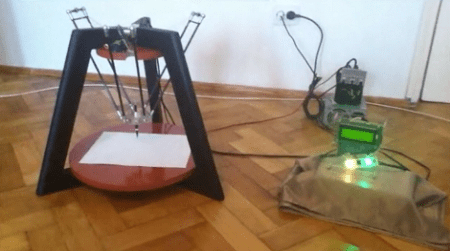
This robot juggler, pictured above during its appearance at Amper 2010, can keep five balls in the air at once. It was designed by the Department of Control Engineering at the Czech Technical Institute in Prague. We know it doesn’t look like much in that still image, but the two videos embedded after the break are pure gold.

To arms on vertical tracks do the juggling. They can move up and down on said tracks, and circular grippers attached to each can pivot horizontally. A third actuator resides at the bottom of the machine, collecting any balls that might drop, and launching them back into the realm of the juggling hands. A high-speed camera facilitates object tracking in much the same ways that it’s been used for quadcopter control.

The objects being thrown around in that protective enclosure are billiards balls. We guess the added mass helps to dampen any small irregularities in the throw or the catch.

Continue reading “Robot Juggler Sure Handles A Lot Of Balls”

Wall Climbing Robot Uses Supersonic Grippers

supersonic_wall_gripper

Watch out Spidey, there’s a new wall climber in town!

Researchers [Matthew Journee, XiaoQi Chen, James Robertson, Mark Jermy, and Mathieu Sellier] recently unveiled their wall climbing wonder bot at the 2011 IEEE International Conference on Robotics and Automation. Like most other wall climbing bots, theirs operates on the Bernoulli principle to keep it stuck to the surface, but that’s where the similarities end.

Unlike other Bernoulli-based climbers, this robot’s gripper never actually touches the surface it is climbing. The researchers were able to accomplish this feat by designing a specialized gripper which forces air through a 25 μm gap, creating a very powerful low pressure vortex. The gripper’s design compresses the air by shape alone, causing the air flow to reach speeds of Mach 3, without relying on powerful pumps or increased air volume.

The researchers state that their supersonic gripper can support about five times the weight of a conventional Bernoulli gripper, and as you can see in the video below it also has no problem climbing a wide variety of surfaces.

Window-washing Roomba, here we come!

[via Make]

Continue reading “Wall Climbing Robot Uses Supersonic Grippers”

Wireless Rover Has Two Guns…one For Each Of Ya

texas_ranger_airsoft_rover

We never really get bored with remote-controlled rovers around here, especially when they involve reusing some old hardware as well as lasers. [Tycoon] wrote in to share his creation, which he has dubbed “Texas Ranger”.

Texas Ranger is built around an old Linksys WRT54GL router, which provides the rover’s WiFi connectivity as well as the serial interface through which everything else is controlled. The rover features a pair of PIC microcontrollers, which handle all of the servo control as well as telemetry calculations.

An onboard camera gives the operator a driver’s seat view of the action, allowing for precise control of the vehicle. Laser triangulation is used to help measure object distance, and a pair of airsoft pellet guns straddle the camera for whenever [Tycoon] feels like making his presence known. One feature we are especially fond of is the pair of Wii nunchucks which the rover uses to monitor its position. Always aware of its operating angle, it auto-adjusts the camera to compensate for uneven surfaces, guaranteeing that [Tycoon] doesn’t have to tilt his head to see straight.

Keep reading to see a quick demo video he shot of Texas Ranger in action.

Continue reading “Wireless Rover Has Two Guns…one For Each Of Ya”

Sound Localization And A Treaded Rover

soundlocalization_and_a_robot

[Jad] recently wrote in to share a pair of projects that have been keeping him busy as of late.

The first is a sound localization system not unlike one we showed you a few weeks ago. The difference is that his system displays the sound source via a set of LEDs rather than by motion, making it far less prone to interference by things like servo noise. His system uses four identical circuits, each of which are wired to a separate analog input on the Arduino. Each channel is adjustable, making it easy to tweak how the system responds to a particular sound.

His second project is a sizable robot built on the Motoruino platform. His contraption features several stacked control boards that handle the bots locomotion as well as camera control. It connects to his computer via a Bluetooth module that boasts a 1 mile range, allowing him to control everything from his PC. [Jad] is using the robot as a prototype for a much larger scale creation, and he says that his current focus is getting the robot to track and follow objects automatically using the on-board camera.

Continue reading to see a small preview of his bot’s progress so far.

Continue reading “Sound Localization And A Treaded Rover”