LEGO Hand Controller


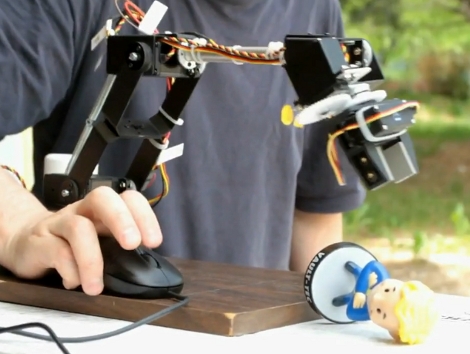
[David Hyman] built this device to control a LEGO claw. One one end of things is the part you wear, that measures movement of two fingers and your thumb. On the other end of things is a LEGO claw with three opposing digits. You move, it moves. The claw uses light sensors and a gradient strip for position feedback. There is also an up-down wrist action that uses a touch sensor as the input. This is impressive enough to give the sniper rifle a run for its money.

[via Make]

Cockroach Pimps A Sweet Ride

This giant Madagascar hissing cockroach rides proudly atop his three-wheeled robotic platform. This project from several years ago is new to us and our reaction to the video after the break is mixed. We find ourselves creeped out, delighted, amazed, and saddened.

The cockroach controlled robot uses a trackball type input. A ping-pong ball is spun by a cockroach perched on top. The lucky or tortured (depending on how you look at it) little bug has an array of lights in front of it that illuminate when obstacles are in front of the robot. The roach’s natural aversion to light should make it move its legs away from that part of the display, thereby moving the robot away from the obstruction.

We’ve seen some bio-hacking in the past. There were robots that run off of rat brain cells and remote controlled beetles. But none of these projects make us want to get into this type of experimentation. How about you?

Continue reading “Cockroach Pimps A Sweet Ride”

Baxter The ButlerBot And RoboFridge

[youtube=http://www.youtube.com/watch?v=HvOGwylZOM4]

[Steve Norris] has been devoting his time, effort, and knowledge to the most noble of causes; cool beverage acquisition. Baxter the ButlerBot and RoboFridge work in tandem to deliver cold ones when needed. As you can see in the video, this possibly over engineered system works quite smooth. Though the details on his site are pretty limited, browsing his Flickr stream will get you all those delicious construction photos you crave.

[via Flickr]

Distributed Flight Array

[youtube=http://www.youtube.com/watch?v=7iHZKMDvdNI&w=470]

Though it is in the beginning stages of development, the Distributed Flight Array is already looking very interesting. Each unit can scuttle across the ground using the down force from its prop, but when 4 or more join forces, they can take off and fly. The documentation shows that they should be smart enough to fly in random configurations, though in the video we only see the standard 4 prop layout. This is being worked on by the same people who produced the balancing cube.

[via BoingBoing]

Compound Eyes For Your Robot

[youtube=http://www.youtube.com/watch?v=iKYCob7getU]

In this writeup, you can see how to build a cheap compound eye system for your robot.  Using 4 IR LEDs and 4 phototransistors, [oddbot] gave “Mr General” the ability to follow movement in objects fairly well, assuming that they are within 200 mm. Being IR, it has the typical drawbacks such as sensitivity to light or overly reflective surfaces, but we like the idea. It is perfect for a nocturnal or low light robot.

[via Hacked Gadgets]

Did That Table Just Move?

[vimeo=http://vimeo.com/11674851]

A table and chair that can move around by themselves? What’s next, suicide boothsself-replicating robots, and Star Trek styled tablet computers? It seems that [Adam Lassy] is moving in that direction. He took this furniture from Ikea and made some neat modifications to give it mobility. Each of the four legs has wheels on them and the legs themselves rotate in unison to change the direction of travel. We could see the table as a more practical drink delivery system than the Bar2d2. It certainly would make for some great late-night pranks but the chair motors need to be silenced before that can happen.

[Thanks Balbor via Ikea Hacker]

Intelligent Ground Vehicle Competition 2010 Day Two Report

Culture Shock II, a robot by the Lawrence Tech team, first caught our eye due to its unique drive train. Upon further investigation we found a very well built robot with a ton of unique features.

The first thing we noticed about CultureShockII are the giant 36″ wheels. The wheel assemblies are actually unicycles modified to be driven by the geared motors on the bottom. The reason such large wheels were chosen was to keep the center of gravity well below the axle, providing a very self stabilizing robot. The robot also has two casters with a suspension system to act as dampers and stabilizers in the case of shocks and inclines. Pictured Below. Continue reading “Intelligent Ground Vehicle Competition 2010 Day Two Report”