The humble 555 timer has its origins back in the early 1970s as the NE555, a bipolar integrated circuit. Over the years it has spawned a range of derivatives, including dual versions, and ones using CMOS technology. Have these enhancements improved the performance of the chip significantly? [MagicWolfi] has been pushing the envelope in an effort to see just how fast an astable 555 can be.
The Microchip MIC1555 may be the newest of the bunch, a 5-pin CMOS SOT-23 which has lost the frequency control and discharge pins of the original. It’s scarcely less versatile though, and it’s a fine candidate for an oscillator to push. We see it at a range of values for the capacitor and resistor in an astable configuration, each of which is tested across the supply voltage range. It’s rated as having a maximum frequency of 5 MHz, but with a zero Ohm resistor and only the parasitic capacitance of an open circuit, it reaches the giddy heights of 9.75 MHz. If we’re honest we find this surprising, but on reflection the chip would never be a first choice for super-fast operation.
We like it that someone’s managed to tie in the 555 to the contest, and given that it still has a few days to run at the time of writing, we’re hoping some of you might be inspired to enter one of your own.
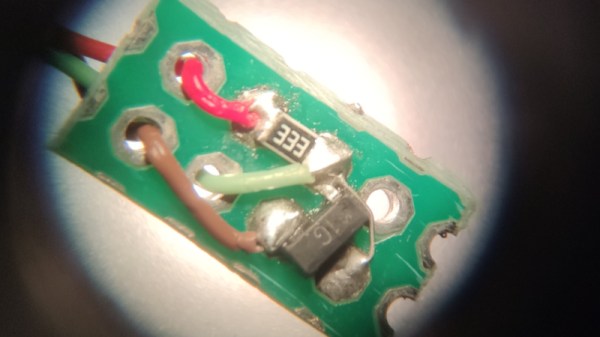
One of the joys of writing up the entries for the 2025 Component Abuse Challenge has come in finding all the different alternative uses for the humble transistor. This building block of all modern electronics does a lot more than simply performing as a switch, for as [Aleksei Tertychnyi] tells us, it can also function as a temperature sensor.
How does this work? Simple enough, the base-emitter junction of a transistor can function as a diode, and like other diodes, it shows a roughly 0.2 volt per degree voltage shift with temperature (for a silicon transistor anyway). Taking a transistor and forward biasing the junction with a 33 K resistor, he can read the resulting voltage directly with an analogue to digital converter and derive a temperature reading.
The transistor features rarely as anything but a power device in the projects we bring you in 2025. Maybe you can find inspiration to experiment for yourself, and if you do, you still have a few days in which to make your own competition entry.
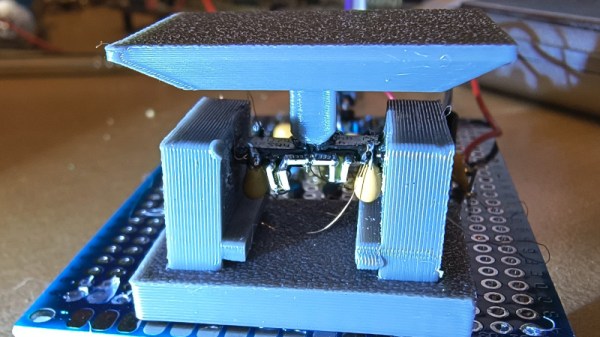
The late and lamented [Bob Pease] was one of a select band of engineers, each of whose authority in the field of analogue integrated circuit design was at the peak of the art. So when he remarks on something in his books, it’s worth taking notice. It was just such an observation that caught the eye of [Trashtronic]; that the pressure on a precision op-amp from curing resin could be enough to change the device’s offset voltage. Could this property be used for something? The op-amp as a load cell was born!
The result is something of an op-amp torture device, resembling a small weighing machine with a couple of DIP-8 packages bearing the load. Surprisingly modest weights will change the offset voltage, though it was found that the value will drift over time.
This is clearly an experimental project and not a practical load cell, but it captures the essence of the 2025 Component Abuse Challenge of which it forms a part. Finding completely unexpected properties of components doesn’t always have to lead to useful results, and we’re glad someone had done this one just to find out whether or not it works. You still just about have time for an entry yourself if you fancy giving it a go.
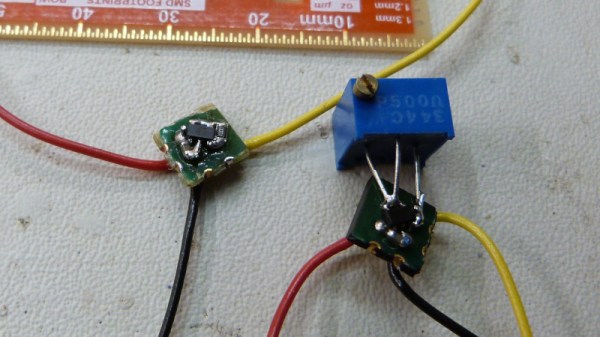
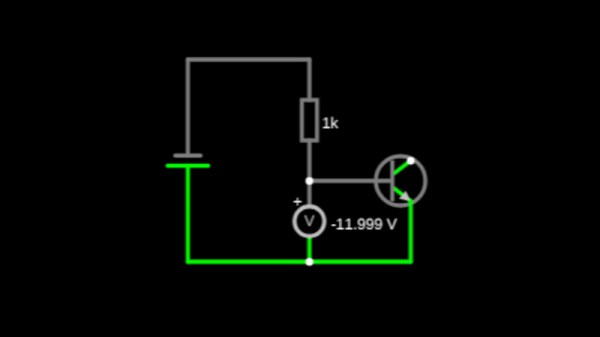
For our 2025 Component Abuse Challenge there have been a set of entries which merely use a component for a purpose it wasn’t quite intended, and another which push misuse of a part into definite abuse territory, which damages or fundamentally changes it. [Ken Yap]’s use of a transistor base-emitter junction as a voltage reference certainly fits into the latter category.
If you forward bias a base-emitter junction, it will behave as a diode, which could be used as a roughly 0.7 volt reference. But this project is far more fun than that, because it runs the junctions in reverse biased breakdown mode. Using one of those cheap grab bags of transistor seconds, he finds that devices of the same type maintain the same voltage, which for the NPN devices he has works out at 9.5 volts and the PNP at 6.5. We’re told it damages their operation as transistors, but with a grab bag, that’s not quite the issue.
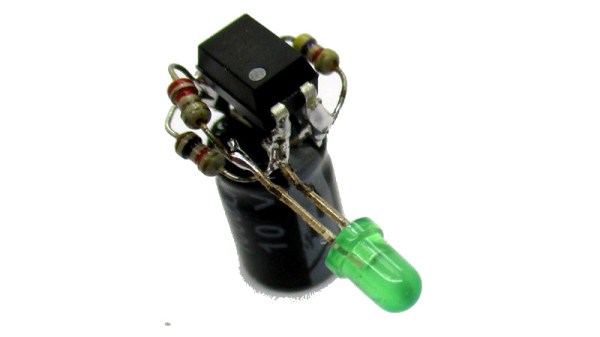
There’s a part you’ll find in almost every mains powered switch mode power supply that might at first appear to have only one application. An optocoupler sits between the low voltage and the high voltage sides, providing a safely isolated feedback. Can it be used for anything else? [b.kainka] thinks so, and has proved it by making an optocoupler powered LED flasher.
If a part can be made to act as an amplifier with a gain greater than one, then it should also be possible to make it oscillate. We’re reminded of the old joke about it being very easy to make an oscillator except when you want to make one, but in this case when an optocoupler is wired up as an inverting amplifier with appropriate feedback, it will oscillate. In this case the rather large capacitor leading to a longish period, enough to flash an LED.
We like this circuit, combining as it does an unexpected use for a part, and a circuit in which the unusual choice might just be practical. It’s part of our 2025 Component Abuse Challenge, for which you just about still have time to make an entry yourself if you have one.
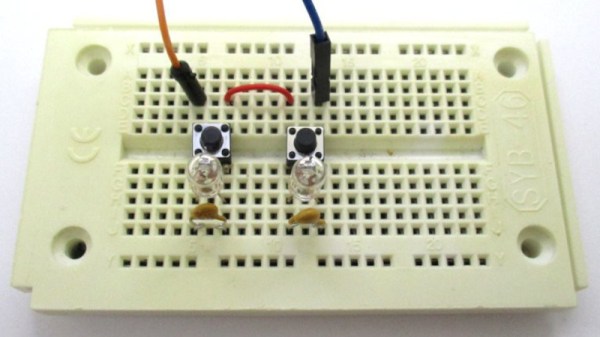
The flip-flop, in whichever of its several forms you encounter it, is a staple of logic design. Any time that you need to hold onto something, count, or shift bits, out it comes. We expect a flip-flop to be an integrated circuit if we use one, but most of us could knock one together with a couple of transistors.
The circuit is simplicity itself, a pair of incandescent bulbs in series, each in turn in parallel with a momentary action switch and a PTC fuse. On start-up both fuses are conducting, so one or other of them will do its job as a fuse and go high impedance. At that point its bulb will light and the other fuse will remain low impedance so its bulb will stay dark. Press the switch across the lit bulb for a few seconds however, and the circuit resets itself. The other fuse goes high impedance while the first fuse returns to low impedance, and the other bulb lights.
We’re not sure we can see much in the way of practical application for this circuit, but sometimes merely because you can is reason enough. It’s part of our 2025 Component Abuse Challenge, for which you just about still have time to make an entry yourself if you have one.
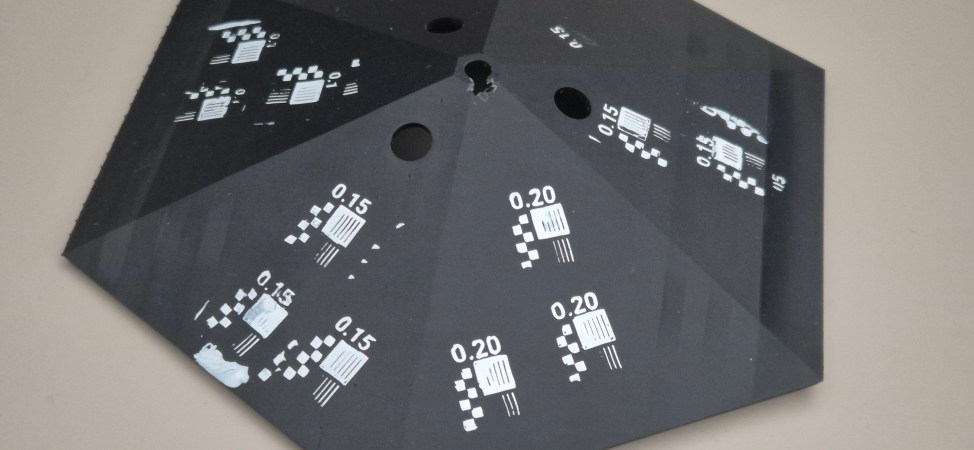
One of the hardest parts of a project — assuming it makes it that far — is finishing it up in an aesthetically pleasing manner. As they say, the devil is in the details, wearing Prada. Apparently the devil also has an excellent manicure, because [Tamas Feher] has come up with a way to introduce incredibly detailed decals (down to 0.1 mm) in cheap, repeatable fashion, using a technique borrowed from the local nail salon.
The end result can look quite a bit better than the test piece above.
For those who aren’t in to nail art (which, statistically speaking, is likely to be most of you) there is a common “stamping” technique for putting details onto human fingernails. Nail polish is first applied to voids on a stencil-like plate, then picked up by a smooth silicone stamper, which is then pressed against the nail, reproducing the image that was on the stencil. If that’s clear as mud, there’s a quick demo video embedded bellow.
There’s a common industrial technique that works the same way, which is actually where [Tamas] got the idea. For nail salons and at-home use, there are a huge variety of these stencils commercially available for nail art, but that doesn’t mean you’re likely to find what you want for your project’s front panel.
[Tamas] points out that by using a resin printer to produce the stencil plate, any arbitrary text or symbol can be used. Your logo, labels, whatever. By printing flat to the build plate, you can take advantage of the full resolution of the resin printer — even an older 2 K model would more than suffice here, while higher res like the new 16 K models become the definition of overkill. The prints go quick, as they don’t need any structural thickness: just enough to hold together coming off of the plate, plus enough extra to hold your designs at a 0.15 mm inset. That doesn’t seem very thick, but remember that this only has to hold enough nail polish to be picked up by the stamper.
[Tamas] cautions you have to work fast, as the thin layer of nail polish picked up by the stamper can dry in seconds. You’ll want plenty of nail polish remover (or plain acetone) on hand to clean the stamper once you’ve finished, as well as your stencil. [Tamas] cautions you’ll want to clean it immediately if you ever want to use it again. Good to know.
While this is going outside of the nail art kit’s comfort zone, it might not quite be abuse. It is however a very useful technique to add to our ever-growing quiver of how to make front panels. Besides, we don’t specify you have to literally make components suffer; we just want to see what wild and wonderful substitutions and improvisations you all come up with.