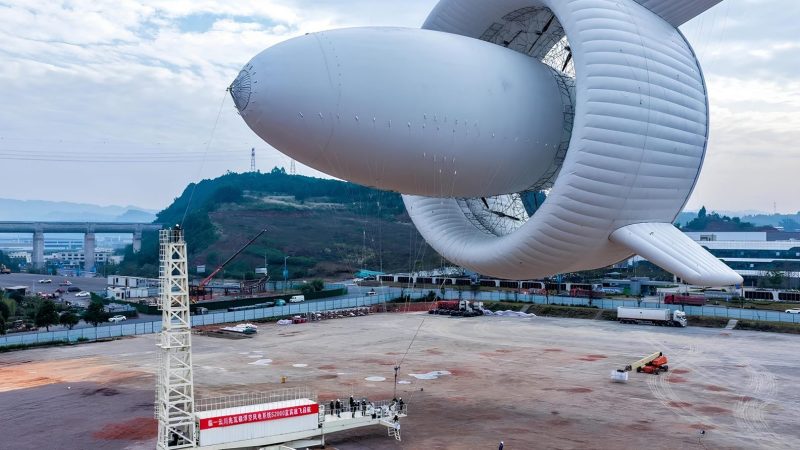
The S2000 at a much lower altitude than 2000 m.

Wind Power Is Taking Off In China– All The Way To 2000 M AGL

2000 m above ground level (AGL), winds are stronger and much, much more consistent than they are at surface. Even if the Earth were a perfect sphere, there’d be a sluggish boundry layer at the surface, but since it’s got all these interesting bumps and bits and bobs, it’s not just sluggish but horribly turbulent, too. Getting above that, as much as possible, is why wind turbines are on big towers. Rather than build really big tower, Beijing Lanyi Yunchuan Energy Technology Co. has gone for a more ambitious approach: an aerostat to take power from the steady winds found at high altitude. Ambitiously called the Stratosphere Airborne Wind Energy System (SAWES), the megawatt-scale prototype has recently begun feeding into the grid in Yibin, Sichuan Province.

The name might be a bit ambitious, since its 2000 m test flight is only one tenth of the way to the stratosphere, but Yibin isn’t a bad choice for testing: as it is well inland, the S2000 prototype won’t have to contend with typhoons or other ocean storms. The prototype is arguably as ambitious as the name: its 12 flying turbines have a peak capacity of three megawatts. True, there are larger turbines in wind farms right now, but at 60 m in length and 40 m in diameter, the S2000 has a lot of room to grow before hitting any kind of limit or even record for aerostats. We’re particularly interested in the double-hull construction– it would seem the ring of the outer gas bag would do a good job funneling and accelerating air into those turbines, but we’d love to see some wind tunnel testing or even CFD renderings of what’s going on in there.
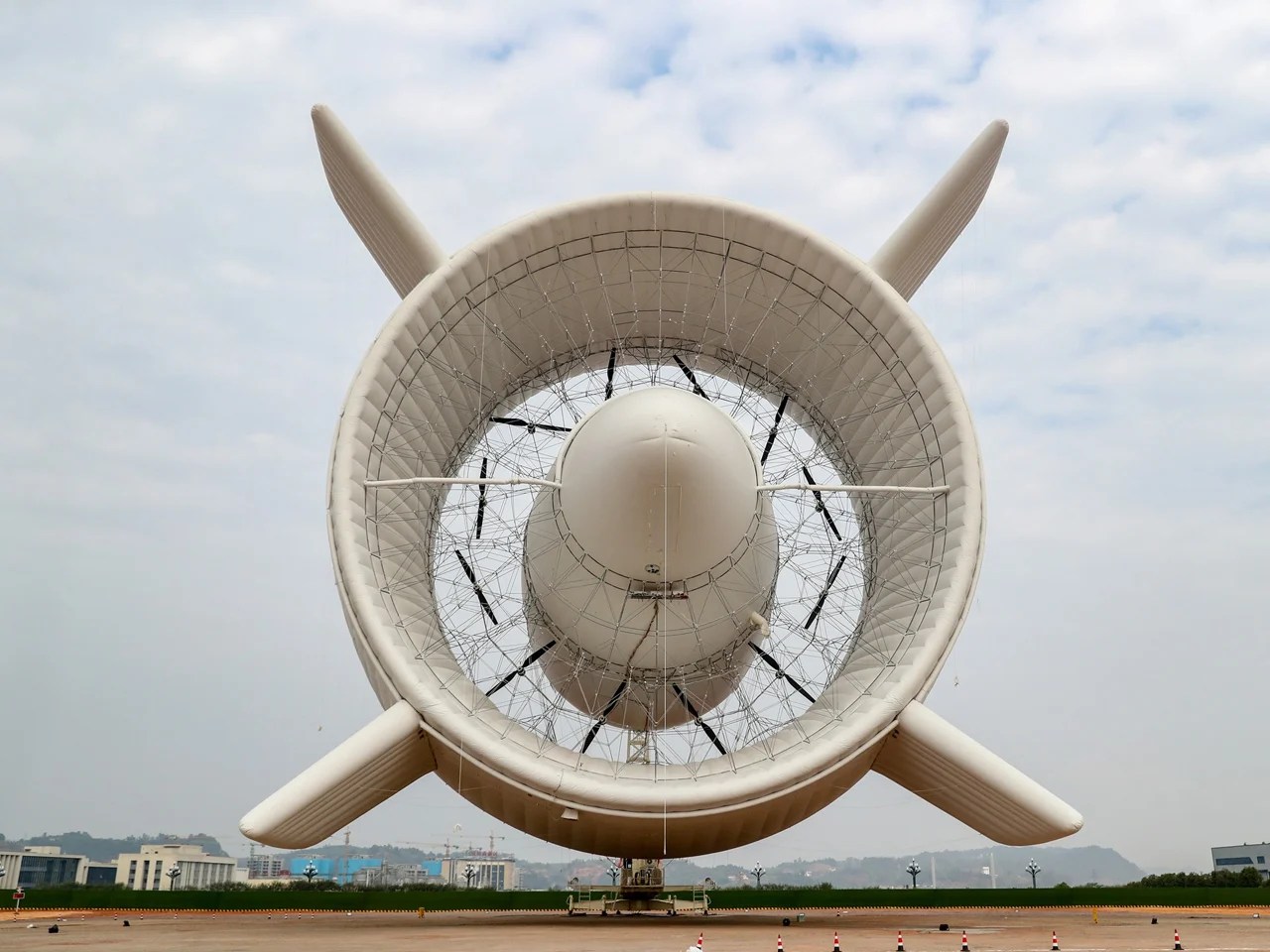
A rear view shows the 12 turbines inside the double hull. It should guide air into the gap, but we wonder how much turbulence the trusses in there are making.

During its first test flight in January 2026, the system generated generated 385 kilowatt-hours of electricity over the course of 30 minutes. That means it averaged about 25% capacity for the test, which is a good safe start. Doubtless the engineers have a full suite of test flights planned to demonstrate the endurance and power production capabilities of this prototype. Longer flights at higher capacity may have already happened by the time you read this.

Flying wind turbines isn’t a new idea by any means; a few years ago we featured this homemade kite generator, and the pros have been in on it too. Using helium instead represents an interesting design choice–on the plus side, its probably easier to control, and obviously allowing large structures, but the downside is the added cost of the gas. It will be interesting to see how it develops.

We’re willing to bet it catches on faster than harvesting wind energy from trees.

All images from Beijing Lanyi Yunchuan Energy Technology Co., Ltd.
 

Remotely Controlling A Not-So-Miniature Hot Air Balloon

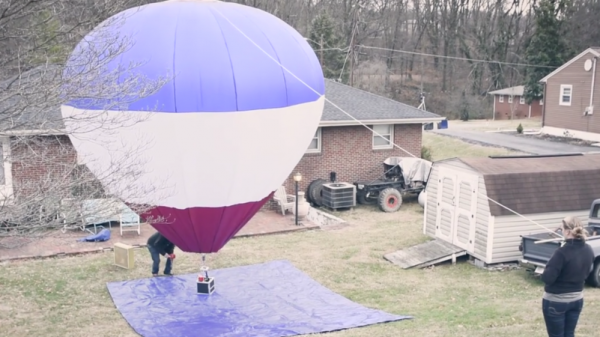
Calling [Matt Barr]’s remote controlled hot air balloon a miniature is a bit misleading. Sure, it’s small compared with the balloons that ply cold morning skies with paying passengers and a bottle of champagne for the landing. Having been in on a few of those landings, we can attest to the size of the real thing. They’re impressively big when you’re up close to them.

While [Matt]’s balloon is certainly smaller, it’s not something you’d just whip together in an afternoon. Most of [Matt]’s build log concentrates mainly on the gondola and its goodies — the twin one-pound camp stove-style propane tanks, their associated plumbing, and the burner, a re-tasked propane weed torch from Harbor Freight. Remote control is minimal; just as in a full-size balloon, all the pilot can really do is turn the burner on or off. [Matt]’s approach is a high-torque RC servo to control the burner valve, which is driven by an Arduino talking to the ground over a 2.4-GHz RF link. The balloon is big enough to lift 30 pounds and appears to be at least 12 feet tall; we’d think such a craft would run afoul of some civil aviation rules, so perhaps it’s best that the test flight below was a tethered one.

Sadly, no instructions are included for making the envelope, which would be a great excuse for anyone to learn a little about sewing. And knowing how to roll your own hot air balloon might come in handy someday.

Continue reading “Remotely Controlling A Not-So-Miniature Hot Air Balloon”

Look, It’s A Helicopter! It’s A Plane! It’s A Rolling Robot!

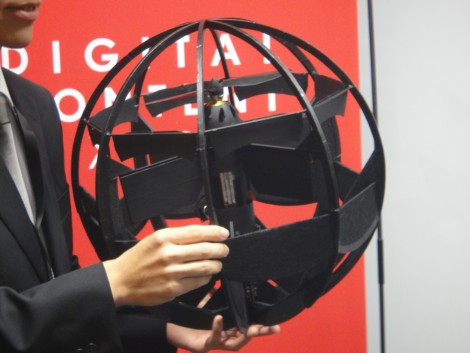
The helicopter-plane-ball-bot sounds like a creation [Homer Simpson] would come up with, but it’s a fairly accurate description of what this machine can do. It was developed by researches at Japan’s ministry of defense. The single propeller lets it operate much like a helicopter. But when it needs to get somewhere quick, the body repositions itself with the propeller at the front, while those black panels function as wings. Finally, the spherical body lets it travel along surfaces, vertical or horizontal. It can even roll along the ground.

After the break you can see a flight demo video from the 2011 Digital Contents Expo. It makes us wonder about the control interface. Which part of this is the front side, and how does it know which direction the operator intends to steer it? Perhaps there is feedback on the cardinal orientation of the control unit? We don’t have the answers to these queries, but we think there’s something very Sci-Fi about it. It brings to mind the Dog Pod aerostatic defensive grid from Neal Stephenson’s novel The Diamond Age.

Continue reading “Look, It’s A Helicopter! It’s A Plane! It’s A Rolling Robot!”