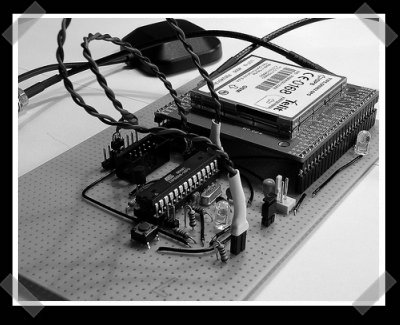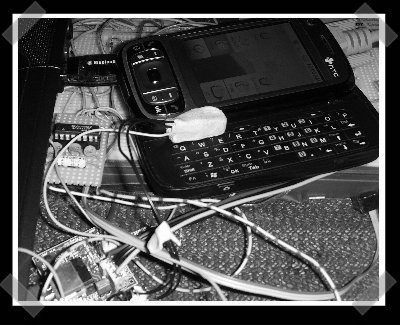
[Barry] needed some way to get serial output to help debug his efforts to port Linux to the HTC TytnII (Windows mobile Pocket PC phone). He wrote some code to send serial output via one of the LEDs on the phone and rigged up an AVR to pic up the output and provide a USB interface to the computer. It runs at about 200bps – perfect for the quick debug session.
AVR335 Articles
How-To: Binary Clock Using A Freeduino SB 2.1
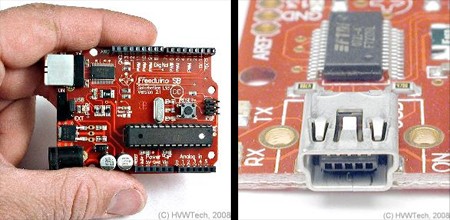
Solarbotics recently released its own version of the Arduino microcontroller development board. They based their board on the Freeduino design. We thought this would be a good opportunity to review the new board as well as present a How-To about building a simple binary clock. Along the way we’ll cover some basics on attaching LEDs and switches to a microcontroller.
Continue reading “How-To: Binary Clock Using A Freeduino SB 2.1”
Maker Faire 2008: Schwag

As our final Maker Faire post, we thought we’d talk about some of the curious items that were handed us during the event.
While checking out Evil Mad Scientist Laboratories‘ latest generation CandyFab were given their AVR business card breakout board.
[Garrett] gave us a handful of ShiftBrites to play with in a future project.
We donated to the EFF, as we’re wont to do, and received a super bright blue flashlight for spotting the yellow tracking dots on color laser printouts. If you’re not familiar with this topic, you should check out bunnie’s blue light scanner.
Our final stop was at ifixit to pick up a free set of spatulas (spudgers?) for popping open iPods. All around a decent haul.
Notacon 2008: Circuit Bending Intro
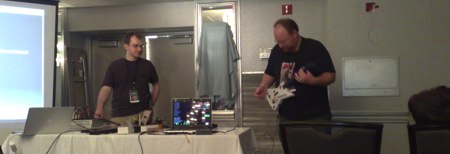
The first talk we went to at Notacon was [Sam Harmon]’s great introduction to circuit bending, the process of modifying sound generating electronics to create new musical instruments. Reed Ghazala is considered the father of circuit bending for his pioneering work starting in 1966. Sam pointed out that a “prepared piano” could be considered the non-electric precursor to circuit bending. It involves the musician placing different types of material on the piano’s components. Sam presented many different examples of where to start with circuit bending: the Casio PT-10, PAiA Theremax, Atari Punk Console. He also mentioned a couple AVR projects: AVRSYN and todbot’s Arduino work.
The session ended with [Thom Robertson] showing off the Weird Sound Generator he built and his GHX software for playing real music with a Guitar Hero controller.
Serial Output For Your Weather Station
I spent part of my weekend with some sort of stomach virus, so Eliot stepped in for me yesterday. I’m taking next week off, so we’ll have a special guest starting Friday – but I’m not revealing who just yet.
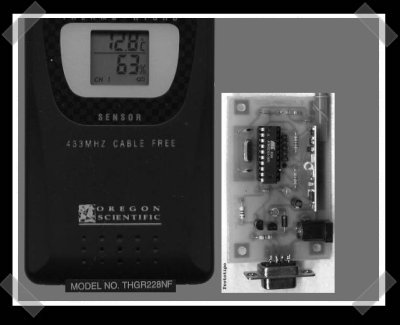
[Fickara] sent in his AVR interface(in Italian) for an Oregon Scientific remote weather station. Thanks to the AVR, data is output via RS232. There are quite a few less expensive weather stations – usually PC output models are over $100, so this could be pretty handy. His page has several other projects including an oscope clock, POV on a stick, etc.