Playstation Tank Controller

[stuart] wanted a more intuitive way to control his rover platform than the software solution he had been using. He settled on using a Playstation controller with an AVR to operate the rover wirelessly. He found a couple references for talking to the controller using SPI on a PIC and adapted that for his ATMega88. The code is available on his site. He removed the rumble motors from the controller and stuffed the chip plus the transmitter package inside. The Linx TX/RX pair are mounted to pluggable boards so he can use them on other projects. A video of the tank in motion is after the jump. Continue reading “Playstation Tank Controller”
Accelerometer Controlled Pong

[youtube=http://www.youtube.com/watch?v=jYVgXYtxk4E]

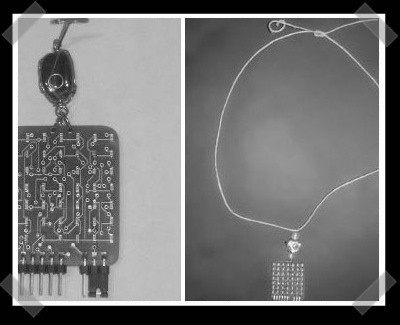
[Perry’s] awesome AcceLED Pong project gives new life to a classic game by adding acceleration-based control. The pong paddles are moved by tilting the circuit left or right. Motion is measured by an ADXL203 dual axis accelerometer, and an ATMEGA32 microcontroller converts acceleration into ball and paddle movement. The game display is a three-color SparkFun 8×8 LED matrix with serial interface.

[Perry] also used a similar setup to make a USB LED spectrum analyzer fed by the Linux XMMS media player.

SMD Soldering Practice Kit


Here’s an interesting kit put together just to help you work on your SMD soldering skills. It’s got 49 SMD LEDs on the front with a programming header and switch jumper. The back has an ATtiny26L and a coin cell. At only 3V, power management is essential; all of the example programs are only addressing one LED at a time (imperceptible to the human eye). If you turn on too many LEDs at the same time, the voltage drop could cause the AVR to reset. Included example programs are a scrolling marque, bouncing balls, and Conway’s game of life. SparkFun has tutorials for regular SMD soldering and using a reflow skillet. The video below shows the kit builder attaching just one LED using the heat and slide method.

Continue reading “SMD Soldering Practice Kit”

Deogen, Tiny Monitor Tester


Deogen is a small, self contained device for testing monitors. It was designed back in 2000 to reduce the amount of space and effort required to test monitors in a computer shop. The initial design used an AT90S1200 microcontroller to generate test patterns for the monitors. Being about the size of a portable CD player, it was much easier to take to any monitor and plug in for testing.

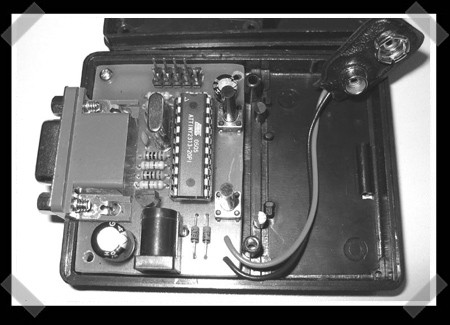
Version two of the device, pictured above, is much smaller, being about the width and height of a credit card. The depth is slightly larger than a 9 volt battery. Compared to the last vga test project we ran, this one is tiny. The unit boasts a decent set of features, such as; eight test patterns at four different resolutions, battery or DC power, and small form factor.

The processor of version two is an ATtiny2313 at 20MHz, and controls the H sync and V sync signals directly. The RGB is converted to analog using a resister network. The power circuit is custom made for low power consumption, though they note that a 78L05 equivalent unit could be used in its place.

The plans for the PCB and the software are available from their site. Head on over and check out some pictures of it in action.

[Thanks, Philip Fitzgerald]

ATmega88 Webserver

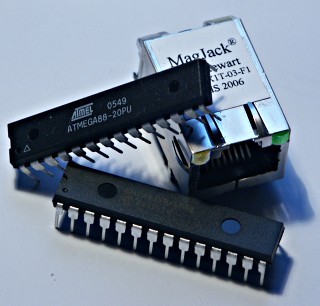
If you are an Atmel fan, you may enjoy this webserver built around the ATmega88. Since it has full TCP and HTTP support, communication can be done using a standard web browser on any system. We also noticed that the code uses AVR Libc and the processor can be replaced with an ATmega168, both used on the Arduino platform. Honestly, we think the most interesting part about this project is the firmware. The author has assumed that the webserver will only be sending one packet per request and the code is optimized for this setup. This leaves around 50% of the memory for the web application.

[via YourITronics]

HandUSB Data Gloves Interface

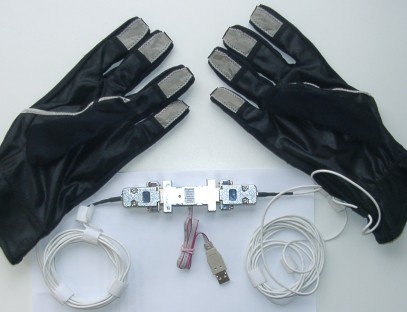
Following today’s earlier post on data gloves, HandUSB is a glove interface designed to relay fingertip touch data to a computer via USB. Although the gloves themselves are not extremely interesting or useful for your average hacker, the project has some good documentation. The electronics are all open source and he has links to the EAGLE files and the AVR Libc code. You can also find a demo program written for DOS. This project uses AVR-USB by Objective Development so if you are looking to move on from your USB-serial chips, this project would be a good resource to study.

[via YourlTronics]