Double Dose Of IPhone Camera Hacks

Why take an iPhone, a slim device that already takes decent photographs and add several macro magnifying lenses? For [Mathijs], simply because he could, But now he can take some awesome macro pictures.

[Bhautik] (maker of the tilt-shift Plungercam) took the concept further. With some more trademark plumbing supplies and a lot of duct tape, secured an interchangeable SLR lense assembly to the back of his iPhone.

Check out some photos from both setups after the break. Continue reading “Double Dose Of IPhone Camera Hacks”

Build A Camera Boom At Less Than A Grand

The folks at The Geek Group built a camera crane for less than $1000. In the video embedded after the break a presenter takes you through the different parts that make up the boom and how it is operated. This feels like something from a Junkyard Wars challenge as most of the parts are scavenged or from an industrial surplus store. Don’t let that sour your opinion, what they’ve ended up with is amazingly functional.

The base of the unit is a rolling tripod used for television cameras from around the 1960’s. The aluminum boom attaches to the base with a few large bearings and features a fine tuning balance system. The camera mount is motorized and can be moved using a joystick or set to scan automatically. It’s nice to see more examples of custom camera mounts. Obviously this isn’t a build for everyone, but as cameras and camera equipment become more readily available it makes high quality video production available for the masses, not just the networks.

Continue reading “Build A Camera Boom At Less Than A Grand”

Axe Your Camera (again!)

[Maurice] let us know that his latest photography tool for hackers, the Camera Axe 3.0, is now available. The original allowed you to trigger a high-speed flash and camera from a multitude of sensors, including light and sound. The new one does all that, but also: allows multiple cameras or multiple flashes, clean up of software to make it more user adaptable, and the best (arguably the most important) part – cheaper components! All that and more under the Creative Commons that we do love so much. Keep up the amazingly detailed and just pure awesome work [Maurice].

Medium Format Camera, From Scratch

title_image_t

[Peter Johansson] has taken it upon himself to build a medium format camera, from scratch. We know this is a shock to some of you, but this camera uses traditional medium. There is no sensor. He will be loading it with (gasps) film. He bought the lenses pre made, but everything else is being constructed by himself. Probably the most notable parts are the aperture and the shutter. The project is about 80% complete right now. We can’t wait to see it finished.

[via Makezine]

A Different Breed Of Camera Controllers?

FPV6BBUG0KQOYC3.MEDIUM

We’ve covered almost every way possible to remotely control a camera setup, from lasers, to Lego, to doorbells, and even having a Nintendo DS run the show. But at the end of the day, what if you want something that’s small, simple, has amazing flexibility for future additions, and most importantly doesn’t take away your favorite game system. [Whiternoise] wrote up an extremely detailed guide on getting an AVR to control your camera. We like the clean look the final product has, and the large amount of possible add-ons is a major plus. What do you look for in a cheap multi-function wireless camera controller?

Cheap And Easy Top-down Camera Quadpod

camera-quad-pod

We keep waiting for evolution to give us that third arm but in the mean time, this may be the solution for holding the camera while you document your projects. [DHagen] has made a four legged tripod (quadpod) for his camera in order to use it as a digital copy machine. We’ve spent many a night trying to get a steady and sharp video of an LCD or array of LEDs in action to document our weekend tinkering and this will make that all a lot easier.

His build uses materials that will total between $10-$20 at the hardware store down the street. A chunk of scrap wood is connected to the camera using a bolt in the threaded tripod hole of the camera. Two L-brackets are attached to the wood so that one is on either side of the camera lens. This leaves two mounting holes on either side of the lens to attach threaded rod using nuts. The assembly is capped off with a square of acrylic (plexiglas).

Quick and clean. It’s not the cheapest camera mounting solution we’ve seen, but it sure does a good job.

Multi-camera Rig Makes Trees Say Cheese

redwood_camera_rig

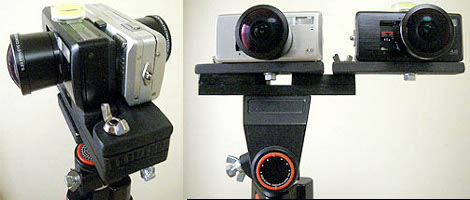
[Nick Nichols] set out to take a photograph of a full redwood tree. Here’s the catch, these redwoods are over 300 feet tall and they’re not just standing in the middle of a vast desert. If the photo is taken from a distance, you will only capture the top part of these majestic beauties. How can you take the shot from close up? Build a custom rig to take multiple shots and stitch them together for a composite photo.

[Nichols] built the rig to hold three cameras focused to the left, middle, and right of the tree. The frame includes a gyroscope to keep the cameras steady. By lowering the cameras from the top to the bottom of the redwood they were able to capture 84 pictures to assemble the final shot. The result is featured in the October edition of National Geographic magazine. We’ve included the final picture and embedded a video of the rig in action after the break. Continue reading “Multi-camera Rig Makes Trees Say Cheese”