Who Needs Mecanum Wheels?

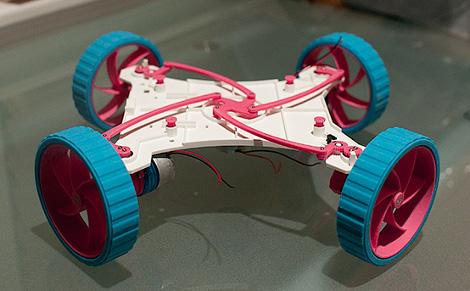
Skills are all that’s needed to solve a problem. Take this four-wheeled robot as an example. [Michal Zalewski] wanted it to be omnidirectional but wasn’t very satisfied with the concept of mecanum wheels and the like. So he designed a chassis with wheels at each corner that can pivot as one to change orientation. The image may look like a rendering at first glance, but this is actually the physical prototype. See what we mean about skills?

Okay, so the robot design is pretty cool. But we’re more excited about the build process. We’ve looked at [Michal’s] work before. He wrote a thorough guide about CNC mold making. These parts are all cast from epoxy. This starts with a rough milled mold, which is given a second pass for the fine details before being painted with a release agent and used to make a silicone mold. From this the parts are produced. Check out the Flickr set showing the casting process for the planetary gear box on each motor. If only these results were as easy to achieve as he makes it look.

[via Reddit]

An Open-Source Rotational Casting Machine

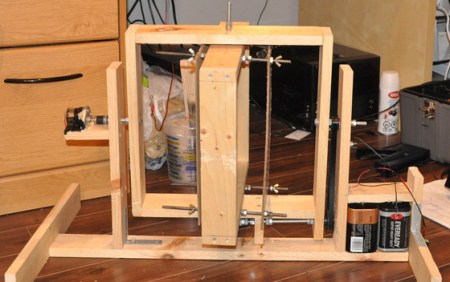
[Aurelio] wrote in to tell us about the smartCaster, an “Open source automatic roto-casting machine.”  For those of you not familiar with roto-casting, or rotational molding, it’s a process whereby something to be formed is placed into a mold and then melted while spinning.  This item is often plastic, but it can be another material such as plaster of Paris or even chocolate.

Naturally, having something made using this process is generally very expensive and generally requires a high volume of parts to be made. The smartCaster Kickstarter project aims to change this. Although in the prototype stage currently, [Aurelio] claims to need only $1571 to finish his project and make it ready for the prospective at-home rotational molder.

Although it’s a much different tool than we see here most of the time, for the right project (custom Easter Bunnies anyone?) it could be quite useful. Check out a video of the prototype in action after the break. Continue reading “An Open-Source Rotational Casting Machine”

DIY Aluminum Heat Sink Casting

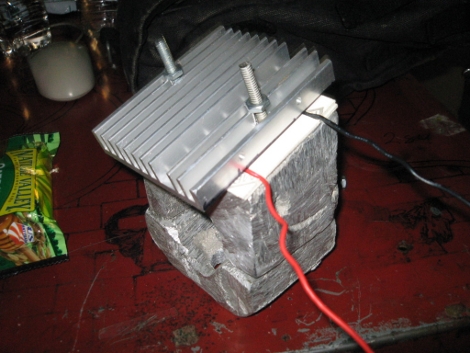
[Peter Wirasnik] has been casting his own aluminum heat sinks. He’s working on capturing the heat from a car’s exhaust system and turning it into electricity, kind of like the candle generator. In the photo above a standard heat sink is bolted to one side of a Peltier cooler with [Peter’s] own casting on the bottom. That casting will connect to the exhaust pipe and transfer heat to the Peltier while the other heat sink keeps the opposite side relatively cool. What results is a voltage between 600mV and 1V.

We’re not quite sure what the end product will be but the casting process is fascinating. He carves the shape of the piece he wants to cast from Styrofoam and embeds it in a box of sand. He then melts salvaged aluminum in a cast iron frying pan using what looks like a propane torch. Once molten, he pours the aluminum into the mold and it burns away the Styrofoam as it fills the void. A little cleanup and he’s got the heat conductive mounting bracket he was after.