The Chinese New Year is something we keep in mind at least half of the year, and probably still don’t plan for properly. In case you’re new to the situation: The Chinese New Year celebration empties out Shenzhen of its more than 12 million residents for the better part of a month. It’s the one time of year that manufacturing sector workers (and everyone that supports that ecosystem) travels home to visit family.
For those involved in manufacturing goods in Shenzhen, this part of the year leaves us cut off from one of our vices and we count the days until our tracking numbers and order confirmations start to show signs of life. It’s an inconvenience of an entirely different nature if you are one of the lonely few that stays in the city during the holiday. [Ian] over at Dangerous Prototypes wrote a blog post from his office in Huaqiangbei which is a sub-district of Shenzhen, China to share the experience with us.
Shenzhen is uniquely a migrant-worker city, and when emptied of the factory employees there are not enough people to patronize local services like markets and restaurants so they also shut down. But an empty city offers its own interesting entertainment like wicked fireworks sessions. As always, [Ian] does a great job of sharing this peculiar part of Shenzhen culture. He also kindly points out some of the offensive offers that come through the inter-webs from desperate customers who have poorly planned around the holiday.
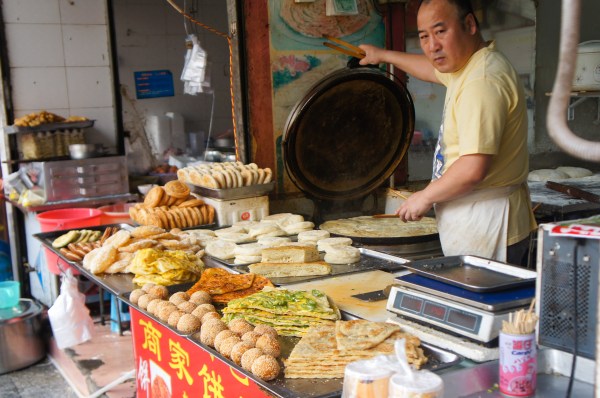
When you mention Shenzhen, many people think about electronic gadgets, cheap components, manufacturing, and technology. I’m there quite often and find that all of the technology and manufacturing related stress can be overwhelming at times. Sometimes I feel the need to escape it all so I go to markets and places that aren’t traditionally associated with technology so I can clear my head as well as expose myself to something different. It provides me with a constant source of new design ideas and also allows me to escape the persistent tech treadmill that Shenzhen runs on. There are a lot of places in Shenzhen that I consider hidden gems that don’t get a lot of press since mainstream media associates Shenzhen with either factories or technology. Here are my favorite places to window shop and de-stress in Shenzhen.
A while ago, a few journalists from China visited the Metalab hackerspace in Vienna. They wanted to do a story on ‘fablabs’ and ‘makerspaces’, despite the objections to the residents of the Metalab hackerspace. Apparently, mentioning ‘hacking’ on China Central Television (yes, it’s called CCTV) is a big no-no.
Wanting to send a message to at least a few people in China, the members of the hackerspace had to think laterally. Metalab member [amir] came up with a way to encode data that could be printed on t-shirts. These bright, colorful squares featured in all of the interviews with Metalab members carried messages like, “free tibet!”, “remember tian’anmen 1989” and “question the government. dont trust the propaganda”
All the videos are available in this playlist, and [amir]’s code to generate the colorful rectangles of political activism can be found here.
In a related note, we’d like to say ‘hi’ to our one reader in North Korea. Yes, according to the stats and analytics, we have one reader in North Korea.
The two largest manufacturers of FPGAs are, by far, Altera and Xilinx. They control over 80% of the market share, with Lattice and others picking up the tail end. The impact of this can be seen in EE labs and alibaba; nearly every FPGA dev board, every instructional, and every bit of coursework is based on Altera or Xilinx chips.
There’s a new contender from the east. Gowin Semiconductor has released two lines of FPGAs (Google translate) in just under two years. That’s incredibly fast for a company that appears to be gearing up to take on the Altera and Xilinx monolith.
The FPGA line released last week, the GW1N family, is comprised of two devices with 1,152 and 8,640 LUTs. These FPGAs are built on a 55nm process, and are meant to compete with the low end of Altera’s and Xilinx’ offerings. This adds to Gowin’s portfolio introduced last May with the GW2A (Google translate) family, featuring devices ranging from 18,000 to 55,000 LUTs and DSP blocks. Packages will range from easily solderable QFN32 and LQFP100, to BGA packages with more pins than an eighteenth century seamstress at the royal ball.
For comparison, Xilinx’ Spartan-6 LX family begins with devices featuring 3,840 LUTs and 216kb of block RAM, with larger devices featuring 147,443 LUTs and up to 268kb of block RAM. Altera’s Cyclone IV E devices are similarly equipped, with devices ranging from 6,272 to 114,480 LUTs. Between the two device families introduced by Gowin recently, nearly the entire market of low-end FPGAs is covered, and they’re improving on the current offerings: the GW1N chips feature random access on-chip Flash memory. Neither the low-end devices from Altera nor devices from Lattice provide random-access Flash.
The toolchain for Gowin’s new FPGAs is based nearly entirely on Synopsys’ Synplify Pro, with dedicated tools from Gowin for transforming HDL into a bitstream for the chip. This deal was inked last year. As for when these devices will make it to market, Gowin is hoping to send out kits to well-qualified devs soon, and the devices may soon show up in the warehouses of distributors.
Gowin’s FPGAs, in contrast to the vast, vast majority of FPGAs, are designed and fabbed in China. This gives Gowin a unique home-field advantage in the land where everything is made. With LVDS, DSP, and other peripherals these FPGAs can handle, Gowin’s offerings open up a wide variety of options to developers and product engineers a few miles away from the Gowin plant.
The GW1N and GW2A families of FPGAs are fairly small when it comes to the world of FPGAs. This limitation is by capability though, and not number of units shipped. It’s nearly tautological that the largest market for FPGAs would be consumer goods, and Gowin is focusing on what will sell well before digging in to higher end designs. We will be seeing these chips show up in devices shortly, and with that comes a new platform to tinker around with.
If you’re looking to make your mark on the world of open source hardware and software, you could do worse than to start digging into the synthesis and bitstream of these Gowin chips. Just months ago, Lattice’s iCE40 bitstream was reverse engineered, and already there are a few boards capitalizing on a fully open source toolchain for programmable logic. With more capable FPGAs coming out of China that could be stuffed into every imaginable product, it’s a golden opportunity for hardware hackers and developers alike.
When it comes to manufacturing, no place in the world has the same kind of allure as the Pearl River Delta region of China. Within just an hour-long train ride, two vastly different cultures co-exist, each with its unique appeal that keeps attracting engineers, entrepreneurs, and hustlers alike. On the mainland side, cities like Shenzhen and Guangzhou bring the promise of cheap components, low-cost contract work, and the street cred of “having done the Shenzhen thing.” And on the island, the capitalist utopia called Hong Kong glows with all of its high finance and stories of lavish expat lifestyles.
As the “new” China evolves, it seems like it’s exactly the convergence of these two cultures that will bring the biggest change—and not just to the area but to the whole world. Still, understanding what exactly is going on and what the place is really all about remains a mystery to many. So, this June, we jumped on the bandwagon and headed east, trying to get our own feel for the whole thing.
Just getting to Shenzhen is an adventure for a different post, but the Hackaday crew made it and spent our first full day in the city last Thursday.
Unlike Wednesday’s experience in Hong Kong, most people you run into do not speak English and the signs generally don’t have English words on them. This makes getting around hard in that it’s difficult to figure out where it is you’re going. It’s equally tough to convey the destination to a taxi driver or translate it into public transportation. I was able to get to the Software Industrial Base via taxi because I had saved the Chinese character address on my phone and showed it to the cab driver. But when the trip ended I had trouble figuring out how much to pay… the meter reads 10 Yuan but there is an additional charge of a few Yuan which I only realized in retrospect. But my driver was very nice about this and helped me with change and a smile.
Visiting Seeed Studio
Seeed Studio sign as you walk in
Shenzhen Industrial Software Base
Huge Makerfaire Banners
You might think finding the correct building would be simple. But the Shenzhen Industrial Software Base is a huge complex of similar buildings. A friendly security guard looked at my saved address and used the squares in the sidewalk as a map to non-verbally get me headed the right way. Seeed Studio, our hosts for SZMF, have a beautiful new office which is industrial-modern in its decor. There are glass-walled conference rooms but the majority of the space is open in design as it wraps around the exterior of half a floor in the six or seven story building.
Hitting the Markets
After doing some planning for the Hackaday workshop the next day, [Chris] from Seeed offered to take us to the electronics markets. How do you pass up that offer? We first stopped off at a Korean restaurant for lunch, then hopped a slightly-crowded cab to meet [Matt] and [Alek] who were already at the market.
Many floors
Booth after booth
after booth
after booth
Rice Ice Cream (purple flavor… yum!)
Triangle LED modules form pyramid displays
mmmmm… binoc-scopes
The Huaqiangbei markets are multi-story buildings filled with booths. We first went into the wrong one, which turned out to be the used equipment building. Vendors specialize in refurbishing electronics. There were floors and floors of booths filled with equipment — often three tiers or more of laptop computers (open and running) wrapping each booth which were about the footprint of a king-sized bed.
Back on track we made it to a brand new building which was seemingly built already completely packed with booths. The place has everything, generally divided up by floor. The top two floors are mostly LEDs of every kind, or drivers for them. We were on the hunt for addressable LEDs, but there didn’t seem to be any legendary bargains available. This may have been an issue of volume because I later heard from a friend that he acquired 25-meters of 12V WS2812 strips for a song.
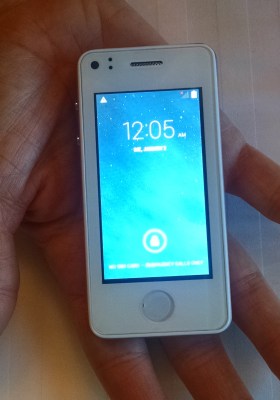
Next it was the hunt for the “baby phone”. This is an Android phone built to look like a miniature iPhone. They’re cute. The blocks, and blocks, and blocks of walking, backtracking, running into acquaintances who joined the hunt, and finally ascending shady stairs and dingy aisles did pay off. Ta-da, [Sophi’s] new phone!
We hopped the subway to get back from the markets. I love trying out public transportation in different cities and this didn’t disappoint. The stations are so clean, and after 85 degrees F and 80 percent humidity all day the air conditioning is heavenly.
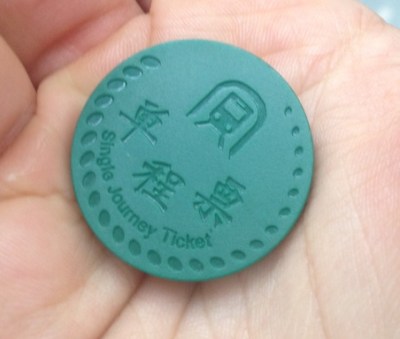
You purchase a token which is a green plastic disc about the size of two american quarters stacked on top of one another. Very light weight and very tech-oriented. Each is an RFID (or some other non-contact) tag. Tap it on your way in, drop it in the slot on your way out. Midway during our return trip we realized we were changing the location for Hackaday’s Saturday Shenzhen Meetup. We got off the train, rode the other way, switched lines, and popped out in a beautiful part of Shenzhen. Everything in this city seems to be new and under construction. NYPD Pizza is in the middle of a very partially completed complex but has the hip, trendy, divebar-neveau that made for an awesome meetup. Check back on that yarn which deserves it’s own post.
A bit exhausted, we made it back to the hotel for a bit of dinner and relaxation. But who could pass up the opportunity to head to an outdoor BBQ party marking the end of Hacker Camp? This creation, started by Hackaday Alumni and Dangerous Prototypes founder [Ian Lesnet], invites engineers and hardware creators to come tour Shenzhen and pick up as much manufacturing knowledge as possible in between epic evenings of socializing.
Dripping wet BBQ Party
Again, figuring out where to go is really hard! We jumped on the subway and made it to the correct stop, but getting to the BBQ alley in what feels like a residential neighborhood required a aimless wandering, and bumping into two different people who had already been to the party.
Party in an Alley
Hot hot hot
Showing off hardware
Soldering station lets you program your own features
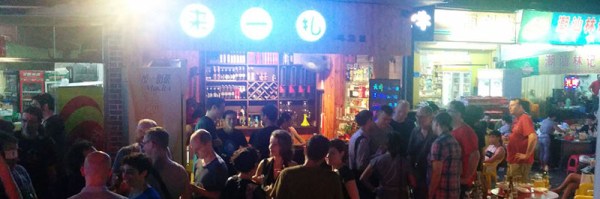
The atmosphere was sticky and blazing hot. Everyone was dripping with sweat and drinking a very large beverage. Check out this hi-res album for the proof. There were a few restaurants, an open-air bar, and a bodega with bombers of Tsingtao for under a buck (USD). To me it seemed to be a dead end street, but every few minutes a honking motorbike was waddled through the shoulder-to-shoulder crush of sweaty bodies. Hardened ex-pats and locals drank beer from glasses, but the foreign visitors seemed to stick with bottles.
This definitely registered as one of the most exciting days of my life. I love the adventure. The city feels safe and friendly — but travel (especially at night) adds a thrill.
This Saturday we’ll be in Shenzhen hosting a meetup at Bionic Brew at 19:00. Join us there and bring along your own hardware projects to show around. Everyone loves hearing about that latest build!
Even if you’re not in the area you can help us out by spreading the word. Tell your friends, share on your social media, and let us know about anyone in town who you think we should reach out to. Here’ s a poster if you want to print it out and hang it at your hackerspace, workplace, or other area where awesome people congregate.
The things you can do at this meetup: Laugh, drink, eat, and be happy. Talk excitedly about datasheets and timing diagrams. Pretend you hate talking about timing diagrams while being secretly giddy that someone wants to hear what you think of them. Recount your epic battles to meet production deadlines. Show off that latest blinky LED project you just got working. Meet a ton of awesome people. You can RSVP here to tell us you’re coming. See you soon!

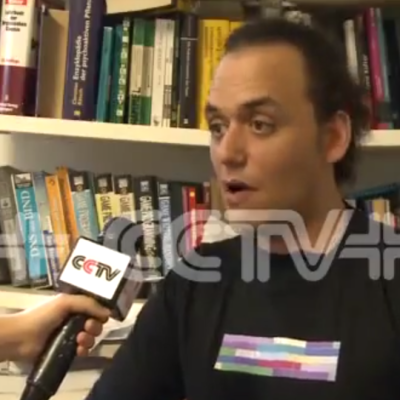 Wanting to send a message to at least a few people in China, the members of the hackerspace had to think laterally. Metalab member [amir] came up with a way to encode data that could be printed on t-shirts. These bright, colorful squares featured in all of the interviews with Metalab members carried messages like, “free tibet!”, “remember tian’anmen 1989” and “question the government. dont trust the propaganda”


 Back on track we made it to a brand new building which was seemingly built already completely packed with booths. The place has everything, generally divided up by floor. The top two floors are mostly LEDs of every kind, or drivers for them. We were on the hunt for addressable LEDs, but there didn’t seem to be any legendary bargains available. This may have been an issue of volume because I later heard from a friend that he acquired 25-meters of 12V WS2812 strips for a song.