
A Train Departure Board For The Home

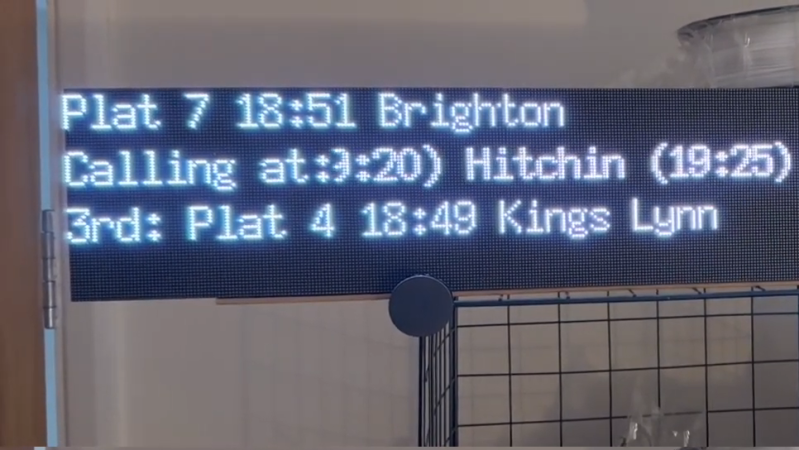
Trains are a great way to get around. You just have to make sure you’re across the schedule if you intend to get where you’re going in a timely manner. Train departure boards exist for that very purpose. As a train fan, [Jon] always wanted such a thing, so decided to build one for himself. 

The build started, as so many do, with a Raspberry Pi 4, with [Jon] deciding on the 1GB model. Hooked up to either an Adafruit RGB Matrix Bonnet, or an Electrodragon 3-port RGB Matrix board, it’s then possible to get the Pi running three to four HUB75E LED matrixes. Each matrix consists of 128 x 64 pixels, so stacking up a bunch of them can make a nicely-sized departure board that’s easily readable. [Jon] was sure to hook up a nice, juicy 5-amp 5-volt power supply to ensure there wouldn’t be any surprise brownouts under normal usage conditions. From there, it’s simply a matter of having the Pi query the Rail Data Marketplace in order to get the relevant schedule data to display on the board.

If you want to get information on your local rail services at a glance, or just want to impress your fellow foamers at your next railfan gathering, a build like this is a great way to go. We’ve seen similar builds before, too. Video after the break.
Continue reading “A Train Departure Board For The Home”

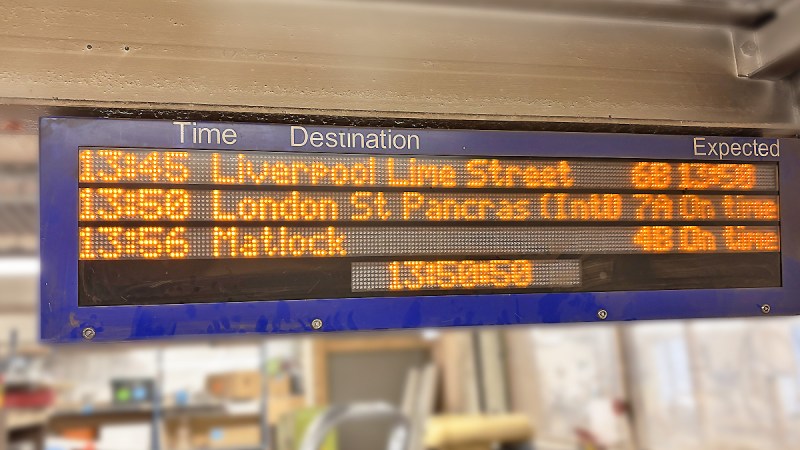
Nottingham Railway departure board in Hackspace

All Aboard The Hack Train: Nottingham’s LED Revival

Hackerspaces are no strangers to repurposing outdated tech, and Nottingham Hackspace happens to own one of those oddities one rarely gets their hands on: a railway departure board. Left idle for over a decade, it was brought back to life by [asjackson]. Originally salvaged around 2012, it remained unused until mid-2024, when [asjackson] decided to reverse-engineer it. The board now cycles between displaying Discord messages and actual train departures from Nottingham Railway Station every few minutes. The full build story can be found in this blog post.

The technical nitty-gritty is fascinating. Each side of the board contains 4,480 LEDs driven as two parallel chains. [asjackson] dove into its guts, decoding circuits, fixing misaligned logic levels, and designing custom circuit boards in KiCAD. The latest version swaps WiFi for a WizNet W5500 ethernet module and even integrates the Arduino Uno R4 directly into the board’s design. Beyond cool tech, the display connects to MQTT, pulling real-time train data and Discord messages via scripts that bridge APIs and custom Arduino code.

This board is a true gem for any hackerspace, even more so now it’s working. It waited for the exact mix of ingredients why hackerspaces exist in the first place: curiosity, persistence, and problem-solving. Nottingham Hackspace is home to a lot more, as we once wrote in this introductory article.If you don’t have room for the real thing, maybe set your sights a bit smaller.

Do you have a statement piece this cool in your hackerspace or your home? Tip us!

Continue reading “All Aboard The Hack Train: Nottingham’s LED Revival”

A Tiny Train Departure Board, Just Like The Real Thing

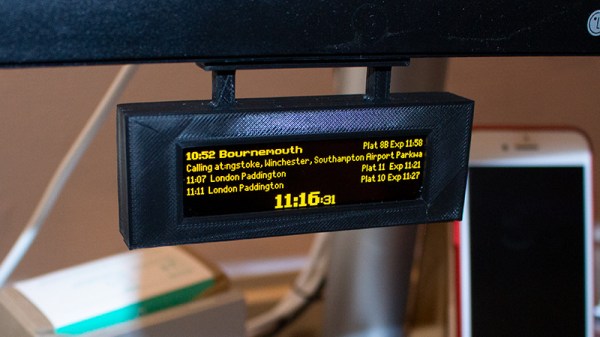
If you travel on the British rail system, you’ll be familiar with the ubiquitous orange dot-matrix departure display boards. At a glance they tell you the expected arrival times of the next few trains, where they are headed, and at the bottom the current time.  [Chris Crocker-White] was inspired by a Tweet to recreate one of these displays in miniature and hang it under his monitor.

The hardware is a Raspberry Pi Zero with an OLED screen, in a custom 3D-printed case. A soldered USB cable takes power from the monitor’s USB ports. Software wise it’s a demonstration vehicle for the Balena cloud service that pulls its data from their transport API, but the choice of dot matrix typeface is perfect and absolutely looks the part.

There is some question as to whether a project such as this one should need a cloud service as its backend, and of course it serves as a demonstration piece rather than a definitive way to enact a departure board. It does however bring a ready-packaged API for transport data, which given that many data sources can be opaque, is a useful feature.

Train time displays seem to be a popular choice on the Eastern side of the Atlantic, here’s another British one, and one from Ireland.

Thanks [Pyrofer] for the tip.









