
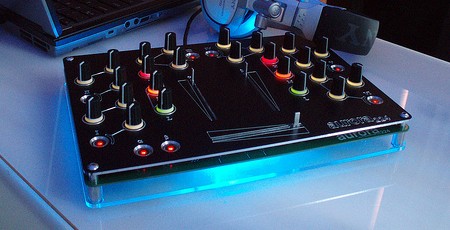
Aurora Open Source Hardware Mixer


We’ve seen some fairly impressive mixer projects this year, and the Aurora mixer is no exception. It is a dual channel USB-powered mixer with two linear faders, one crossfader, eight backlit buttons and 24 potentiometers, all built around a PIC 18LF4525 microcontroller. That’s all pretty typical for a mixer, but this one is very visually attractive, featuring a clean and stylish form factor and controllable lighting both under the board and in the LEDs backlighting the buttons and knobs.

Whether you want to buy one now or build one yourself, the Aurora team has made both possible. You can contact them for pricing if you are ready to buy. If you prefer to build, this is an open source project with full assembly instructions, schematics, drivers, patches and all other source code and information you should need available here. See more photos of the Aurora mixer here, or see it in action after the break.
Continue reading “Aurora Open Source Hardware Mixer” →

Physical Value Of Sound


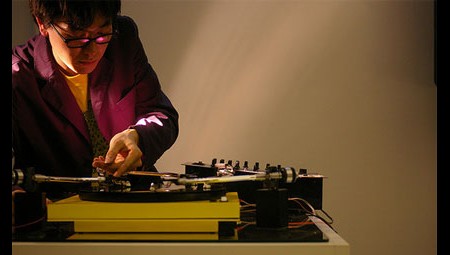
The Royal College of Art in London recently hosted its annual graduate summer show, where postgrad students exhibit some of their artistic and musical projects. Among those featured this year were several vinyl record and turntable mods by [Yuri Suzuki].

Continue reading “Physical Value Of Sound” →

AudioCubes By Percussa

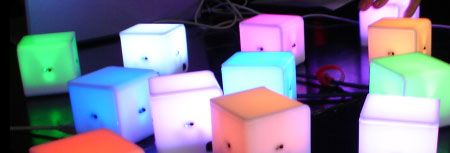
[Peter Nyboer] has written an extensive post about his experience with AudioCubes from Percussa. Aside from their unique glowing exterior, these cubes are an innovative way to control and even produce audio tracks. Four faces of each cube are equipped with IR sensors to detect distance and communicate with other cubes. The cubes also have USB, a rechargeable battery, and audio in/out. Moving your hands around the sensors changes the MIDI output of the cube. Changing the cubes’ orientation and distance from each other also changes the signal. Max/MSP and Live are both supported out of the box, but that doesn’t mean it’ll be easy to get started. [Peter] makes an important point: unlike traditional instruments, there’s no obvious way to get started. At 400euro for 2 cubes and 650euro for 4 cubes, these devices aren’t exactly being given away, but it’s great to see new interfaces being imagined. A video of [Peter]’s first experiments with the cubes is embedded below; read his full post to see more footage of the cubes in action… and naturally we’d love to see any DIY versions of this you can come up with.

Continue reading “AudioCubes By Percussa” →









