Hacking A Reverse Osmosis Water Filter Through Its Smart Faucet

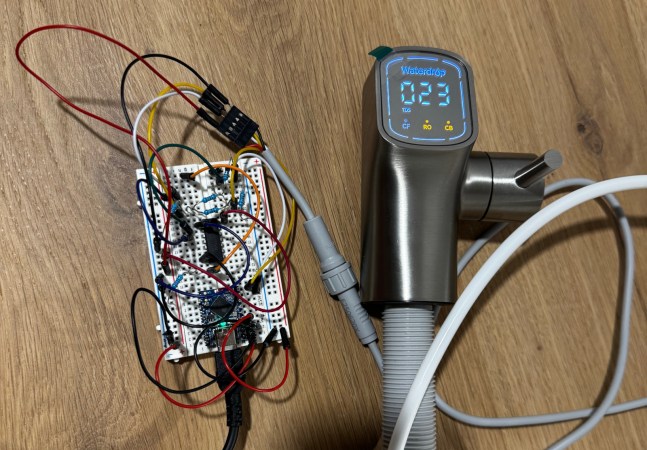
Reverse-osmosis (RO) systems are one way to ensure that you get very clean drinking water. The Waterdrop G3P600 variety that [Tomasz Wasilczyk] recently purchased is definitely among the fanciest and ‘smartest’, with the faucet having its own 7-segment display and gaggle of LEDs connected to the actual RO unit with a four-pin connector. This naturally meant that whatever protocol runs on this cable had to be reverse-engineered for science.
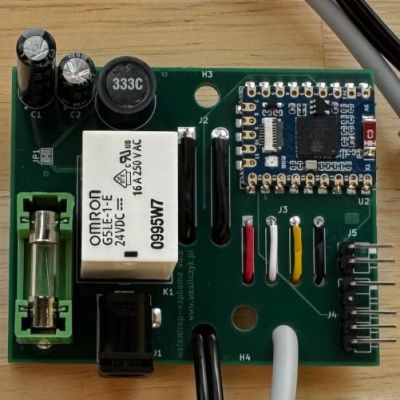
Now with more custom PCB. (Credit: Tomasz Wasilczyk)
Now with more custom PCB.

The main practical benefit here is to make the system smarter — such as plugging it into a home automation system with ESPHome support, as well as make it play nice with refrigerator lines.

What automation and monitoring options exist here thus depend on what data gets sent between the RO unit and the faucet. Fortunately this turned out to be quite extensive, ranging from filter health, the water quality and pump status as well as air temperature and faucet state.

Unsurprisingly the four-pin connector turned out to be a basic serial link, with 5 V, ground and a 9,600 baud connection. From this it was easy enough to deduce the protocol, and by looking at what lit up on the faucet, a custom PCB wasn’t far behind.

After one blown-up fuse later due to getting 24 V instead of 12 V on the RO unit when tapping off power, the unit popped to life and was able to be connected to Home Assistant, from where the entire functionality and what triggered what could be mapped out. Of course, there’s still more to be discovered and reverse-engineered in the unit, but this seems like a good place to start.

Automated Faucet Keeps Your Cat Watered

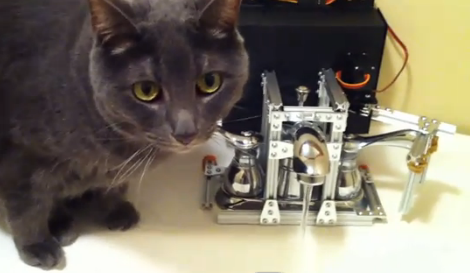
Like many of us [Chris Dillon]’s cat prefers to drink cold fresh water directly from the tap. However, unlike us, [Chris]’s feline buddy is too preoccupied with cat stuff to bother flipping off the faucet after its use. As it turns out, this was an excellent opportunity not only for [Chris] to flex his project muscles, but also to lay the groundwork for future home automation projects.  While most of us may go for a simple solenoid [Chris] had to make the rig completely reversible. The result is an automated  faucet control which involves an infrared sensor, Arduino,  and tight fitting rail system with a servo to operate the sink handle.

After getting all of the hardware and the sensor sorted [Chris] went on to add a data logging PC to the mix. The faucet setup communicates with a Linux server via Xbee modules, and populates a MongoDB database. The setup even allows [Chris] to flag false positives (human sink use for example) and produce charts of his feline friend’s water usage. We suspect the cat will be none too pleased when it gets its water bill.

Don’t forget to check out [Chris Dillon]’s site for details on the project including code and a list of lessons learned. Also, since this is the internet after all, we have several other cat related projects for your viewing pleasure.

[Thanks Chris Burrows (and nephew)]

Check out a video of the setup in action after the jump.

Continue reading “Automated Faucet Keeps Your Cat Watered”