So How Do You Make A Self-Destructing Flash Drive?

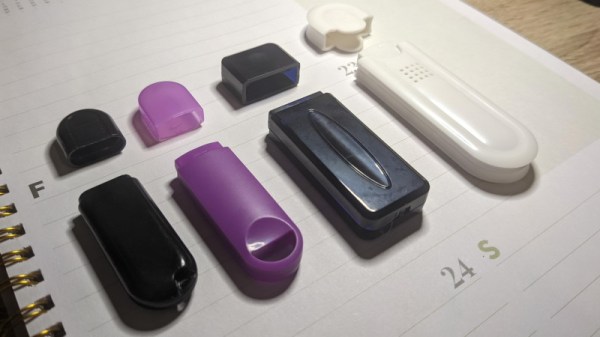
A self-destructing storage device that vaporizes its contents at the first sign of trouble would be an invaluable tool for many people, but good luck getting your hands on such a thing if you don’t work for a three-letter agency. Or at least, that’s what we would have said before [Walker] got on the case. He’s working on an open source self-destructing USB flash drive for journalists, security researchers, whistleblowers, or anyone else who really values their privacy.

When we previously covered this project in July, [Walker] had only planned to make the flash drive hide its contents unless you knew to wet your fingers before plugging it in. We admit it sounds a little weird, but as far as clandestine methods of activating something goes, it’s pretty clever. But based on the feedback he received, he decided to go all-in and make the USB drive literally trash itself should it be accessed by somebody who doesn’t know the secret.

An elegant weapon for a more civilized age.

But how exactly do you pull that off? Sure we’d love to see a small thermite charge or vial of acid packed in there, but obviously that’s not very practical. It needs to be safe to carry around, and just as importantly, unlikely to get you into even more trouble with whoever is searching through your belongings. To that end, [Walker] thinks he’s come up with an elegant solution.

The datasheet for his flash memory chip says the maximum voltage it can handle before releasing the Magic Smoke is a meager 4.6 V. So he figures running a voltage doubler on the nominal 5 V coming from a USB port should disable the chip nicely with a minimum of external drama. Will it be enough to prevent the data from being recovered forensically? We don’t know, but we’re eager to find out.

In the write-up, [Walker] takes readers through the circuit designs he’s come up so far, and shows off the source code that will run on the ATtiny25 to determine when it’s time to toast the flash. He says by the next post he should have the entire flash drive built and documented, so stay tuned.
Killer USB Drive Is Designed To Fry Laptops

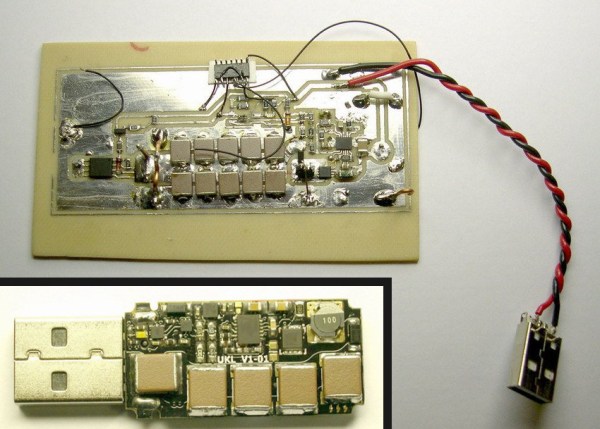
[Dark Purple] recently heard a story about how someone stole a flash drive from a passenger on the subway. The thief plugged the flash drive into his computer and discovered that instead of containing any valuable data, it completely fried his computer. The fake flash drive apparently contained circuitry designed to break whatever computer it was plugged into. Since the concept sounded pretty amazing, [Dark Purple] set out to make his own computer-frying USB drive.

While any electrical port on a computer is a great entry point for potentially hazardous signals, USB is pretty well protected. If you short power and ground together, the port simply shuts off. Pass through a few kV of static electricity and TVS diodes safely shunt the power. Feed in an RF signal and the inline filtering beads dissipate most of the energy.

To get around or break through these protections, [Dark Purple]’s design uses an inverting DC-DC converter. The converter takes power from the USB port to charge a capacitor bank up to -110VDC. After the caps are charged, the converter shuts down and a transistor shunts the capacitor voltage to the data pins of the port. Once the caps are discharged, the supply fires back up and the cycle repeats until the computer is fried (typically as long as bus voltage is present). The combination of high voltage and high current is enough to defeat the small TVS diodes on the bus lines and successfully fry some sensitive components—and often the CPU. USB is typically integrated with the CPU in most modern laptops, which makes this attack very effective.

Thanks for the tip, [Pinner].

Repairing Dead USB Flash Drives

Over the last few years, [Tobias] has repaired a number of USB Flash drives. This strikes us as a little odd, given small capacity Flash drives are effectively free in the form of conference handouts and swag, but we’re guessing [Tobias] has had a few too many friends lose their thesis to a broken Flash drive.

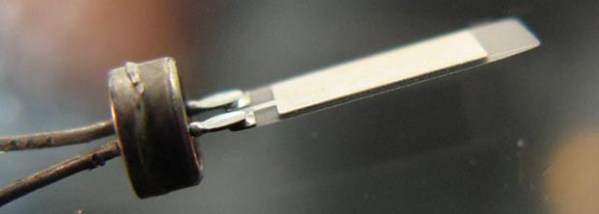
In all his repairs, [Tobias] found one thing in common The crystal responsible for communicating with the USB controller is always broken. In a way, this makes a lot of sense; everything else on a Flash drive is silicon encased in an epoxy package, where the crystal is a somewhat fragile piece of quartz. Breaking even a small part of this crystal will drastically change the frequency it resonates at making the USB controller throw a fit.

[Tobias]’ solution for all his Flash drive repairs is to desolder and change out the crystal, bringing the drive back to life. Some of the USB Flash drives even have multiple pads for different crystal packages, making it easy to kludge together a solution should you need to repair a Flash drive five minutes ago.

This Is A Peer-to-peer Filesharing Network

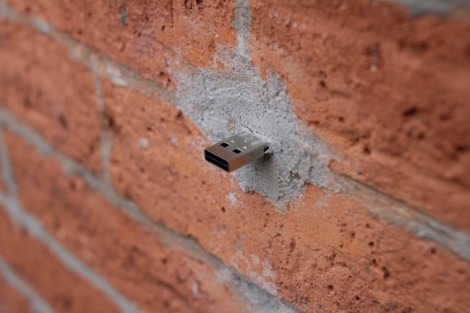
[Aram Bartholl] is building his own filesharing network that screws those fat cats who want to control your freedom. He’s added file cache devices throughout NYC (five so far but more to come) that are anonymous and free to use. Upload what you want, download what you want. They’re completely offline which means monitoring who’s doing what gets a lot harder and quite possibly requires a warrant from a Judge (we’re obviously not legal experts, your mileage may vary).

As for the slew of comments that are sure to point out the dangers of malicious USB device; We think everyone knows they’re taking on some risk when connecting to a USB plug protruding from a brick wall.

[Thanks Neckbeard]