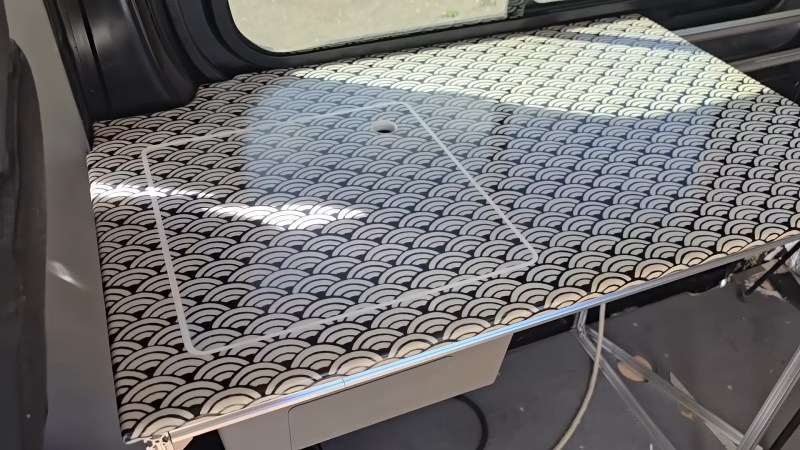
You’ve seen fiber-reinforced-plastic before, no doubt, but perhaps never quite like in this video by [Whitburn Studio]: it’s still got the usual resin, but instead of glass or carbon fibers, he’s using printed Japanese cotton to create strong, lightweight and good looking parts for the interior of his RV– specifically the countertops.
The technique is very similar to the sort of moldless composite work Burt Rutan pioneered in aircraft use. The fiber-reinforced plastic is formed around a positive ‘buck’ that remains inside the final part, adding stiffness and some backing. Unlike Rutan’s designs, which used pure Styrofoam inside, [Whitburn] is using a sandwhich of two layers of thin ply (3.6 mm) with XPS foam in between. Adding plywood means you don’t need many layers of fiber– again, that’s a decorative cotton, here– to get a surface that won’t dent into the styrofoam when you drop a coffee cup on it.
Indeed, with the plywood providing much of the strength, he’s only using a single layer of cotton and a second of fiberglass– though the glass fibers are really there to protect the pretty print from oopsies while sanding, rather than for their mechanical properties, by the sounds of it. Everything is held together with clear epoxy resin, which also fills the weave of the fabrics. Multiple coats of that are required to get the smooth, shiny surface he shows off at the end, but all that sanding and buffing really pays off. That’s also where you have to be really careful to avoid oopsies– go through the cotton and you have to start over.
Aside from the aesthetics, since this is going in a vehicle the weight is an important consideration– the bigger of the two counters he makes, pictured here, weighs in at only 2.4 kg or 5.2 lb including the cutout covering the sink. That’s pretty good all things considered– a lot lighter than a cement countertop, or even one made of DIY resin tiles.
Continue reading “Cotton-Fiberglass Composite Makes Lightweight RV Countertops”