Are Hackers The Future Of Amateur Radio?

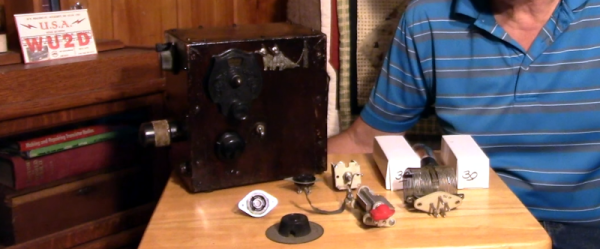
If amateur radio has a problem, it’s that shaking off an image of being the exclusive preserve of old men with shiny radios talking about old times remains a challenge. Especially, considering that so many amateurs are old men who like to talk a lot about old times. It’s difficult to attract new radio amateurs in the age of the Internet, so some in the hobby are trying new avenues. [Dan, KB6NU] went to the recent HOPE conference to evangelise amateur radio, and came away having had some success. We agree with him, hackers can be the future of amateur radio.

He’s put up the slides from his talk, and in them he goes through all the crossovers between the two communities from Arduinos to GNU Radio. We don’t need persuading, in fact we’d have added UHF and microwave RF circuitry and pushing the limits of the atmosphere with digital modes such as WSPR to the list as our personal favourites. It seems he found willing converts, and it’s certainly a theme we’ve featured before here at Hackaday. After all, unless it retains its interest, amateur radio could just die away.

VHF/UHF Antennas, The Bad, The Ugly, And The Even Worse

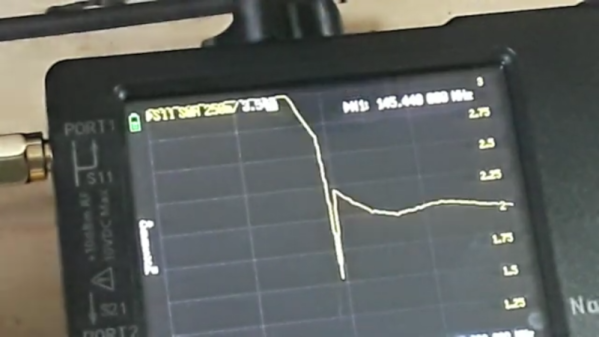
When you buy a cheap ham radio handy-talkie, you usually get a little “rubber ducky” antenna with it. You can also buy many replacement ones that are at least longer. But how good are they? [Learnelectronics] wanted to know, too, so he broke out his NanoVNA and found out that they were all bad, although some were worse than others. You can see the results in the — sometimes fuzzy — video below.

Of course, bad is in the eye of the beholder and you probably suspected that most of them weren’t super great, but they do seem especially bad. So much so, that, at first, he suspected he was doing something wrong. The SWR was high all across the bands the antennas targeted.

Continue reading “VHF/UHF Antennas, The Bad, The Ugly, And The Even Worse”

Meccano-based Hellschreiber Machine

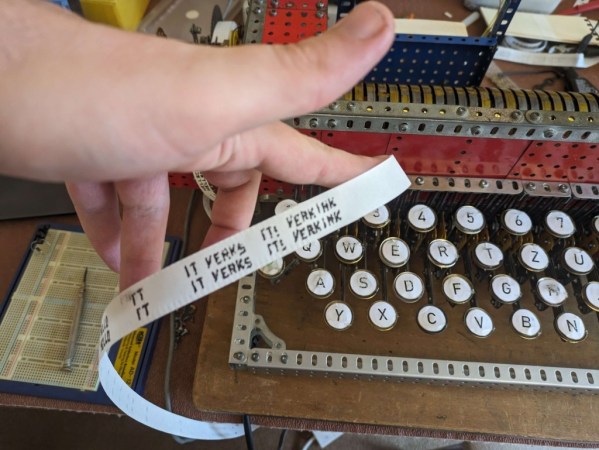
[ZXGuesser] has pulled off a true feat of Meccano engineering: building a Meccano Hellschreiber machine. The design is a close replica of the original Siemens Feld-Hell machine as documented here. What is Hellschreiber, you might ask? It’s a very neat method of sending written messages over the air by synchronizing a printing wheel on the receiving end with pulses generated on the transmitter. By quickly moving the print wheel up and down, arbitrary figures can be printed out. If you want to learn more about Hellschreiber, check out this excellent Hackaday post from almost a decade ago!

The Mastodon thread linked above goes into more detail about the difficulty in building this behemoth — and the slight regret of sticking with the authentic QWERTZ keyboard layout! In order to use the Hellschreiber mode, you have to keep up a steady rhythm of typing at about 2.5 characters per second, otherwise, the receiving end will see randomly spaced gaps between each letter. So while having to type at a steady speed [ZXGuesser] also had to work with a slightly different keyboard layout. Despite this difficulty, some very good quality output was generated!

Incredibly, the output looks just like the output from the original, century-old design. We think this is an absolutely incredible accomplishment, and we hope [ZXGuesser] doesn’t follow through on disassembling this amazing replica — or if they do, we hope it’s documented well enough for others to try their hand at it!

Thanks [BB] for the tip!

GitHub Hosts Ham Radio

[Alex R2AUK] has been busy creating version two of a homebrew all-band ham radio transceiver. The unit has a number of features you don’t always see in homebrew radios. It covers the 80, 40, 30, 20, 17, 15, 12, and 10 meter bands. The receiver is a single-IF design with AGC. The transmitter provides up to 10W for CW and 5W for single sideband operations. There’s a built-in keyer, too. A lot of the documentation is in Russian (including the video below, which is part of a playlist). But translation tools are everywhere, so if you don’t speak Russian, you can still probably figure it out.

The VFO for both transmit and receive is an Si5351. The transmit chain is straightforward. The receiver reuses many of the same filters.

Continue reading “GitHub Hosts Ham Radio”

Ham Radio Paddles Cost Virtually Nothing

If you don’t know Morse code, you probably think of a radio operator using a “key” to send Morse code. These were — and still are — used. They are little more than a switch built to be comfortable in your hand and spring loaded so the switch makes when you push down and breaks when you let up. Many modern operators prefer using paddles along with an electronic keyer, but paddles can be expensive. [N1JI] didn’t pay much for his, though. He took paperclips, a block of wood, and some other scrap bits and made his own paddles. You can see the results in the video below.

When you use a key, you are responsible for making the correct length of dits and dahs. Fast operators eventually moved to a “bug,” which is a type of paddle that lets you push one way or another to make a dash (still with your own sense of timing). However, if you push the other way, a mechanical oscillator sends a series of uniform dots for as long as you hold the paddle down.

Modern paddles tend to work with electronic “iambic” keyers. Like a bug, you push one way to make dots and the other way to make dashes. However, the dashes are also perfectly timed, and you can squeeze the paddle to make alternating dots and dashes. It takes a little practice, but it results in a more uniform code, and most people can send it faster with a “sideswiper” than with a straight key.

Continue reading “Ham Radio Paddles Cost Virtually Nothing”

Farewell MFJ

We were sad to hear that after 52 years in operation, iconic ham radio supplier MFJ will close next month. On the one hand, it is hard not to hear such news and think that it is another sign that ham radio isn’t in a healthy space. After all, in an ideal world, [Martin Jue] — the well-known founder of MFJ — would have found an anxious buyer. Not only is the MFJ line of ham radio gear well regarded, but [Martin] had bought other ham radio-related companies over the years, such as Ameritron, Hygain, Cushcraft, Mirage, and Vectronics. Now, they will all be gone, too.

However, on a deeper reflection, maybe we shouldn’t see it as another nail in ham radio’s coffin. It is this way in every industry. There was a time when it was hard to imagine ham radio without, say, Heathkit. Yet they left, and the hobby continued. We could name a slew of other iconic companies that had their day: Eico, Hammarlund, Hallicrafters, and more. They live on at hamfests, their product lines are frozen in time, and we’re sure we’ll see a used market for MFJ gear well into the next century.

Continue reading “Farewell MFJ”

FLOSS Weekly Episode 779: Errata Prevention Specialist

This week Jonathan Bennett and Dan Lynch sit down with Andy Stewart to talk about Andy’s Ham Radio Linux (AHRL)! It’s the Linux distro designed to give hams the tools they need to work with their radios. What’s it like to run a niche Linux distro? How has Andy managed to keep up with this for over a decade? And what’s the big announcement about the project breaking today?

Continue reading “FLOSS Weekly Episode 779: Errata Prevention Specialist”