Variable Frequency Laser Using Shaken Ball Bearings

Lasers normally emit only one color, or frequency of light. This is true for laser pointers or the laser diodes in a DVD player. [Kevin] caught wind of state-of-the-art research into making variable wavelength lasers using shaken grains of metal and decided to build his own.

When [Kevin] read a NewScientist blog post on building variable frequency lasers built with shaken metallic grains, he knew he had to build on. He dug up the arxiv article and realized the experimental setup was fairly simple and easily achievable with a bit of home engineering.

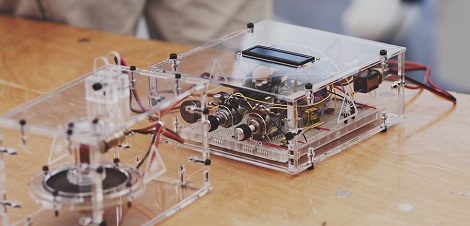
[Kevin]’s device works by taking thousands of small ball bearings and putting them in a small vial with Rodamine B laser dye. To vibrate the particles in the dye, [Kevin] mounted his container of dye and bearings on an audio speaker and used a frequency generator to shake the ball bearings.

When a small 30mW green laser shines through the vial of ball bearings and dye, the laser changes color to a very bright yellow. By vibrating the vial at 35 to 45 Hz, [Kevin] can change the frequency, or color of the laser.

[Kevin] can only alter the frequency of the laser by about 30 nm, or about the same color change as a reddish-orange and an orangish-yellow. Still, it’s pretty amazing that [Kevin] was able to do state-of-the-art physics research at home.

Sadly, we couldn’t find any videos of [Kevin]’s variable frequency laser. If you can find one send it in to the tip line and we’ll update this post.

Coilgun With Laser Sights Built In An Airsoft Rifle Housing

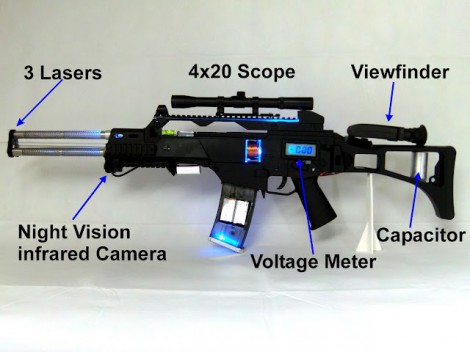
This coilgun started as a stock Airsoft rifle. The stock weapon cost about 40€ (just over $50), but we think it was well worth it since it provides plenty of room for all the coilgun components and solves most of the mechanical issues of the build like a body that is comfortable to hold, a trigger, etc.

The clear tube which serves as the barrel (the same setup as we saw in this coilgun guide) is protected by three stainless steel barrels which surround it. They each host a laser diode which results in a Predator-style aiming mechanism that is shown off in the video after the break. There’s even a night vision system that uses IR leds and a viewfinder attached to the stock.

A camera flash is scrapped for the transformer inside. This acts as the voltage generator, charging up a few capacitors. It seems to have no problem generating enough juice to work well, despite the fact that it’s only being powered from two AA batteries mounted in the magazine.

Continue reading “Coilgun With Laser Sights Built In An Airsoft Rifle Housing”

Control Your House By Moving Your Arms Like You’re Directing Traffic

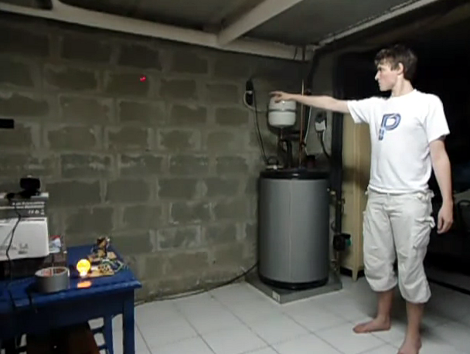
This home automation project lets you flap your arms to turn things on and off. [Toon] and [Jiang] have been working on the concept as part of their Master’s thesis at University. It uses a 3D camera with some custom software to pick up your gestures. What we really like is the laser pointer which provides feedback. You can see a red dot on the wall which followers where ever he points. Each controllable device has a special area to which the dot will snap when the user is pointing close to it. By raising his other arm the selected object can be turned on or off.

Take a look at the two videos after the break to get a good overview of the concept. We’d love to see some type of laser projector used instead of just a single dot. This way you could have a pop-up menu system. Imagine getting a virtual remote control on the wall for skipping to the next audio track, adjusting the volume, or changing the TV channel.

Continue reading “Control Your House By Moving Your Arms Like You’re Directing Traffic”

Making Sure A Baby Is Still Breathing With Lasers And A Wiimote

[Gjoci] just became a father, and to make up for not having to carry a baby to term he decided to make himself useful in another way. He developed a sensor to detect a baby’s breathing, allaying the fears of nervous parents who are wondering why their child is so quiet.

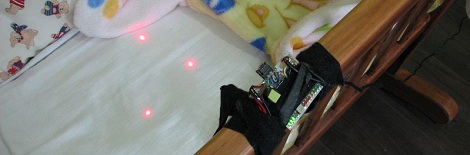
Unlike similar builds and products that rely on microphones or capacitive sensors, [Gjoci]’s build uses the camera from a wiimote to triangulate points of light and detect motion.

The build started off with infrared LEDs, but the batteries were big and there is always the possibility of the baby swallowing electrical components. [Gjoci] finally hit upon the idea of using small 1mW laser diodes to project points of light. This worked beautifully, and since newborns don’t move much there’s no danger of shining a laser into a baby’s eye.

The rest of the build is just querying the camera every few milliseconds and seeing if the position of the reflections captured by the wiimote camera have changed. In two weeks of operation, [Gjoci] only had to respond to a few false alarms, and the hardware hasn’t crashed at all.

After the break are three videos [Gjoci] put up for us that show a test of the breathing detection system, a demo of the alarm, and an example of the build in full operation. A very awesome build, and we look forward to this post being used as evidence of prior art in a patent dispute a few years down the line.

Continue reading “Making Sure A Baby Is Still Breathing With Lasers And A Wiimote”

Toorcamp: Hackerbot Labs’ Giant FAA Approved Laser

This is a big laser.

[3ric] from Hackerbot Labs gave me a run down of their BattleYurt laser installation at Toorcamp. It’s built with twenty-four 1 Watt lasers taken from a Casio DLP projector. The laser is housed on top of a yurt, which contains the controls and cooling system. It was built with the goal of measuring diffuse reflections of the atmosphere, but it also does the job of looking awesome when fired into the sky. Continue reading “Toorcamp: Hackerbot Labs’ Giant FAA Approved Laser”

Laser Diode Controller For A CNC Mill

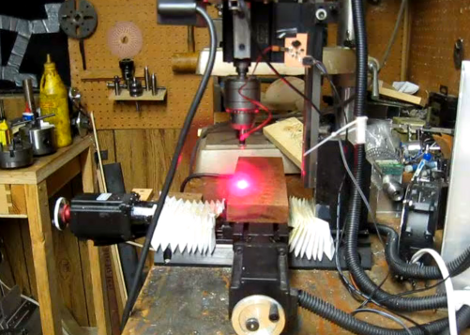
[Smells of Bikes] wanted to add laser etching to the list of tricks his home CNC setup is capable of. He has a diode which will work for the task, but he needed a driver that could be interfaced with the CNC system. He ended up designing a driver board based around the LM3402 chip.

Now driving one of these laser diodes isn’t all that different from driving a Light Emitting Diode. He chose to use the LM3402 chip because he’s the TI engineer who designed the official evaluation board for the part. It’s meant for high-power LED applications, and the 700 mA he needs for the laser is within spec. Since he’s soldering by hand, and this part has a ground pad on the bottom, he shares his soldering technique in detail. Once the driver board is ready, he uses a ‘sed’ command to replace the g-code Z axis commands with digital on/off commands to switch the diode.

Check out the demo video after the break. He uses a diffuse beam since the cutting beam is bright enough to damage his camera.

Continue reading “Laser Diode Controller For A CNC Mill”

Copper Vapor Laser Is Amazing

What better way to spend a few months in the workshop than by heating Copper chloride to 400° C, building rotary spark gaps and 30kV capacitors, playing with high vacuums and building a very powerful laser? It’s just a day in [Jon]’s life as he builds a DIY Copper vapor laser.

Copper vapor lasers require temperatures of about 1500° C, but this is only when using pure Copper. Compounds such as Copper chloride are able to bring the required temperatures for lasing down to about 400° C, a reasonable temperature for [Jon]’s home built laser tube furnace. The only problem with this setup is the requirement for two electrical pulses, one to disassociate the Copper and a second to make the Copper lase.

The professional way of creating these electrical pulses would be a Thyratron, but it seems [Jon] wanted something cooler. He built a rotary spark gap out of two 2 inch thick blocks of acrylic that allow him to perfectly time the frequency and separation of the electrical pulses needed for his laser.

There is no word on exactly how much power [Jon]’s Copper vapor laser will put out when it’s complete, but [Jon]’s build log is already an amazing display of awesome. You can check out a short video showing off [Jon]’s laser, spark gap, and huge home-made capacitor after the break.

Continue reading “Copper Vapor Laser Is Amazing”