Color Changing Bag Matches Clothing Color, Tells You What’s Inside

color-changing-shoulder-bag

Adding some lights to your everyday items will certainly give you a style leaning toward the world of Blade Runner. But if you can add functionality to control the blinky components you’ve actually got something. A great example of this is [Kathryn McElroy’s] Chameleon Bag. It’s a shoulder bag with a light-up flap. It can color match your clothing, but she also built some features that will let you know what is inside of the bag.

The project started by using a cardboard template in the size and shape of the bag’s flap. After adding an Arduino to control the LEDs and an RFID reader for an interactive element she sewed a replacement flap that also acts as a diffuser. In the video after the break she demonstrates matching the color of her scarf by reading a tag sewn in the end of it. She then starts loading up all the stuff needed for a day away from home. As the keys, phone, and computer are placed in the bag their tags are read, resulting in different combinations of color. Once everything she needs is inside, the flap turns green and she heads out the door.

This will go great with your illuminated umbrella.

Continue reading “Color Changing Bag Matches Clothing Color, Tells You What’s Inside”
Three Conceptual Approaches To Driving A WS2811 LED Pixel

driving-a-ws2811

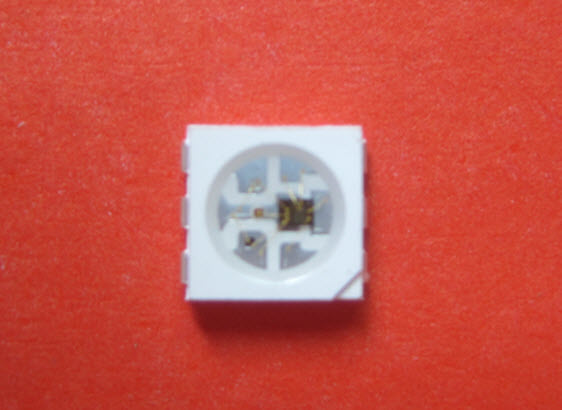
[Cunning_Fellow] published a post with three proof-of-concept approaches to driving a WS2811 LED pixel. We looked at a project early in December that used an AVR microcontroller to drive the RGB package. [Cunning_Fellow] saw this, and even though he doesn’t have any of these parts on hand he still spent the time hammering out ways to overcome the timing issues involved with address the device. His motto is “put up or shut up” when it comes to criticizing projects featured on Hackaday. We love seeing someone pick up an idea and run with it.

The approach in all three cases aims to conserve clock cycles when timing the communications. This leaves the developer as many cycles as possible to perform other tasks than simply telling the lights what to do. One approach is an assembly routine that is just a shade slower but groups all 14 free cycles into one block. The next looks at using external 7400 series hardware. The final technique is good old-fashioned bit banging.

[Photo Credit]

Animated Holiday Wreath From A String Of LED Lights

animated-holiday-wreath

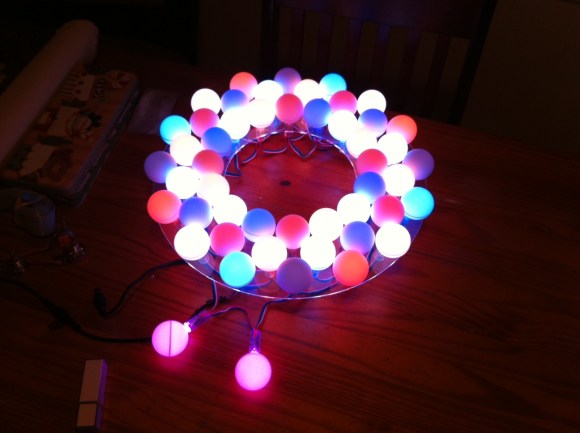
[Dennis Adams’] wreath lights project looks pretty good. But he did some amazing coding to produce a whole set of interesting animated patterns that really seal the deal for the project. Don’t miss the video after the break where he shows off all of his hard work.

He started with a string individually addressable LEDs. These are the 12mm variety like what Adafruit sells (we’ve seen them popping up in a number of projects). To mount each pixel he tried a several different prototypes before settling on a ring that was 14″ in diameter. The design was laser cut from acrylic, with sets of staggered holes to host each ring of LEDs. The final touch was to add ping-pong balls to diffuse the light.

As we mentioned earlier, the light patterns really add the finishing touch to the project, but there is more functionality there too. [Dennis] rolled in the ability to monitor a Twitter feed with the wreath. When he gets a new tweet, a different animation will let him know about it.

Continue reading “Animated Holiday Wreath From A String Of LED Lights”

O Christmas Tree Of Digital Logic

tree

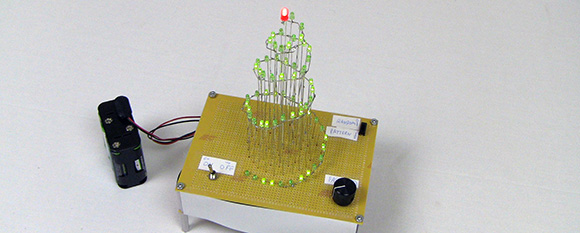
[Chris] over at PyroElectro is getting into the swing of the holidays with a LED Christmas tree build. Unlike the other electrical Christmas trees we’ve seen this holiday season, [Chris] designed his tree entirely with digital logic – no microcontrollers included.

The tree [Chris] constructed on a piece of perf board is a beautiful spiral arrangement of 64 green LEDs.While we’re sure getting all the LEDs soldered to the right height, [Chris] makes it look so easy to create 3D structures with circuits.

The LEDs are driven with a set of eight shift registers, themselves clocked by either a predictable 555 timer chip or a pseudo-random pattern generated with a circuit built from a few hex inverters. By setting the tree to the sequential mode, a pair of lights travel slowly down the spiral of the Christmas tree. If set to random mode, an random number of LEDs light up and walk down the array of LEDs.

Continue reading “O Christmas Tree Of Digital Logic”

ATTannenbaum

attiny

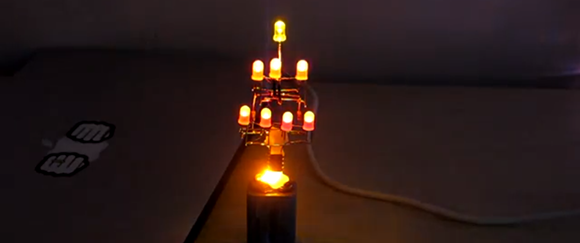
It’s that special time of year again where the smell of baking cookies fill the house and shopping mall parking lots are filled with idiots and very angry people. [Kevin] thought it would be a good idea to build an LED Christmas tree and ended up building a great looking tree that’s also very simple.

In the video, the imgur album, and the github, [Kevin] shows us the simplest way to make a color-changing LED Christmas tree. The circuit uses LEDs to drop the voltage and to provide a nice glow around the base of the tree. After that, it’s just an ATtiny13 and some LEDs in a very nice freeform circuit.

Of course, if LED Christmas trees aren’t your thing, [hb94] over on reddit created an LED menorah. Pretty nifty he used an 8-position DIP switch for the circuit. Let’s just hope someone gave him a soldering iron for the last night of Hanukkah.

Driving A WS2811 RGB LED Pixel

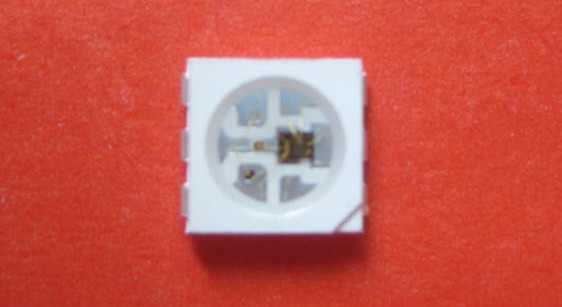
[Alan] has been working on driving this WS2811 LED module with an AVR microcontroller. It may look like a standard six-pin RGB LED but it actually contains both an LED module and a microcontroller to drive it. This makes it a very intriguing part. It’s not entirely simple to send commands to the module as the timing must be very precise. But once the communication has happened, the LED will remain the same color and intensity until you tell it otherwise. You can buy them attached to flexible strips, which can be cut down to as few as one module per segment. The one thing we haven’t figure out from our short look at the hardware is how each pixel is addressed. We think the color value cascades down the data line as new values are introduced, but we could be wrong. Feel free to discuss that in the comments.

The project focuses on whether or not it’s even possible to drive one of these pixels with a 16MHz AVR chip. They use single-wire communications at 800 kHz and this really puts a lot of demand on the microcontroller. He does manage to pull it off, but it requires careful crafting in assembly to achieve his timing constraints. You can see a quick clip of the LEDs fading between colors after the break.

Continue reading “Driving A WS2811 RGB LED Pixel”

Kick Off The Christmas Decorating With A Review Of 3 Types Of LED Strings

[Todd Harrison] has been on a quest to replace his incandescent Christmas lights with less power hungry LED lights. There are plenty of options out there, but so far he hasn’t found any have the appearance he’s looking for. Since last year he bought three different kinds to try out and has posted a review of each.

Check out the strand of Brite Star Symphony Lights he’s showing off above. There is a white ‘Try Me’ button that lights up the string while still in the package! This offers fifteen bulbs each twelve inches apart. The strand draws 8.4 Watts when in use, you can connect up to 30 strands in series, and they are RGB lights with several different blinking patterns. He spends nearly an hour on this strand in his video review.

Next on his list is a set of Brite Star Classic Style C7 lights. They are single color and are meant to look like traditional large-bulb incandescent strands. At 2.4 Watts per strand you can string together 87 sets of them. This video is much more concise at around twenty-five minutes.

Finally he looks at the Brite Star 50 Mini LED strings. These are the traditional white Christmas tree lights, except in LED. One bulb every four inches on the string adds up to a 2.4 Watt power draw. You can string 58 sets together for a 1000 foot long string. [Todd] spends less than eight minutes reviewing this set.

You can see an intro video after the break but the full reviews are linked in his article. He really liked the Symphony Lights but the other strands have some issues. He discusses what he sees as design flaws in those strands and has decided they’re not really usable because of flickering.

Continue reading “Kick Off The Christmas Decorating With A Review Of 3 Types Of LED Strings”