LED Wand For Light Painting Photography

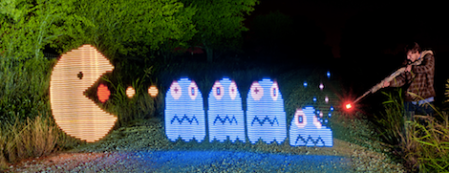
[Michael Ross] is a photographer who has been getting into light painting recently. He’s come up with his own RGB light wand to create some amazing images, and also written a very, very thorough tutorial (PDF warning) on how to build your own light wand.

The light wand is based on an Arduino Mega board and uses an RGB LED strip based on the HL1606 controller chip. We’ve covered these LED strips before, and they’re very easy to use with the requisite library. So far, [Michael] has built a 48-LED light wand and a 16-LED wand with a 6-position program selector, making it easy to do awesome single-exposure photos like this.

[Michael] creates his images in an Excel spreadsheet – rows are which LED to address and columns are units of time. The picture data is then copied and pasted straight from the Excel worksheet to the Arduino source code. This in itself is a pretty clever use of Excel.

Check out the how [Michael] creates one of his light paintings here.
Slick 16-segment POV Hard Drive Clock

pov_hdd_clock

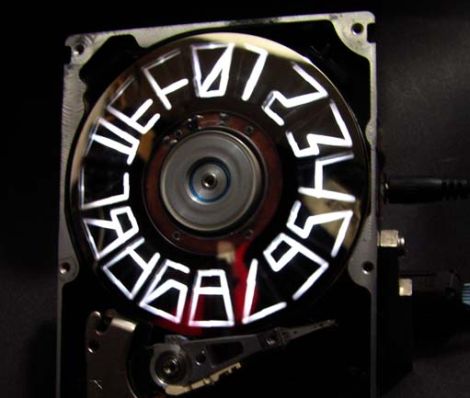
Hackaday reader [svofski] sent in a fantastic looking hard drive-based POV clock (Google Translation) created by a maker in the Sichuan province of China. The clock, like the one [svofski] built, relies on LEDs placed behind the spinning platter to create the POV effect.

Quite a few carefully placed cuts have been made to the platter, which make up the segments required to display both numbers and letters of the alphabet. This isn’t a simple 16-segment POV display however. The font uses a lot of sharp edges and odd segment lengths, so we’re guessing that quite a bit of care was taken in the production of this clock.

You can see a demonstration of the clock in the video embedded below, which shows off its ability to display numbers, text, as well as a handful of simple patterns. It looks like there are some details available on the designer’s site, however it is all in Chinese, and Google’s translation is questionable at best. If only we knew someone that could give us a hand with deciphering the inner-workings of this clock…

Continue reading “Slick 16-segment POV Hard Drive Clock”

VU Meter Scarf Lights Up The Night

vu_meter_scarf

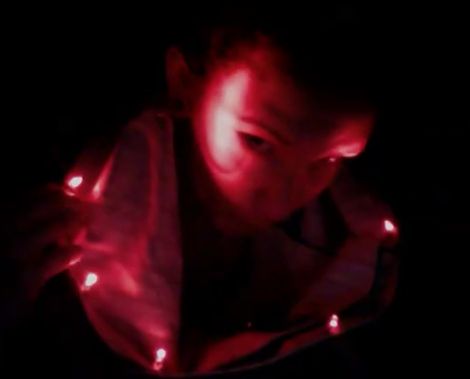
[Eli Skipp] wrote in to share a project she has been working on bit by bit, for over a year – an LED VU meter scarf. The project was originally going to be built using a custom PCB, but no matter how long she spent troubleshooting the piece, it just wouldn’t work right. She eventually broke down and purchased a VU meter kit, which worked out quite a bit better than the homebrew version.

The VU meter circuitry is tucked away inside the scarf as she shows in the video below. The LEDs are connected using conductive thread sourced from Lamé Lifesaver, which she says is far more durable than other threads she has tried. After originally testing the VU meter, she was unimpressed by the output of the LEDs, so she swapped them out for brighter ones, which look much better. It looks like it works quite well – we definitely dig the idea of a scarf with a built-in VU meter, even if it was partially built from a kit.

Continue reading to see [Eli] give a quick demonstration and a rundown of the scarf’s construction.

Continue reading “VU Meter Scarf Lights Up The Night”

Magic Locket

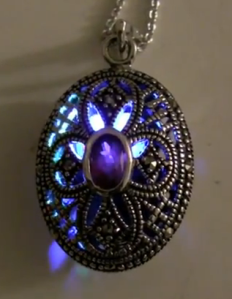
[Andrey] from RTFM has built himself a glowing LED pendant using only three parts and some simple code. The hack is not particularly complicated but [Andrey] provides some decent instructions on Pickaxe programming via an RS232 serial port and RGB LED control to produce the nice glowing effects. The pendant contains an RGB LED, a Pickaxe-08 microcontroller and a couple of button cell batteries. To cram everything inside the locket, [Andrey] had to grind down the LED and Pickaxe-08 to their minimum dimensions using a file.

All of the Basic code for the pendant is supplied on the project page and [Andrey] describes how he manages to PWM all three LED pins for the colour effects. The video after the break may be of interest to anyone who has not had a go at Picaxe programming before or for a beginner who wants to try out some new embedded devices without a big hit to the wallet.

Continue reading “Magic Locket”

Not Your Ordinary LED Book Light

diy_led_book_light

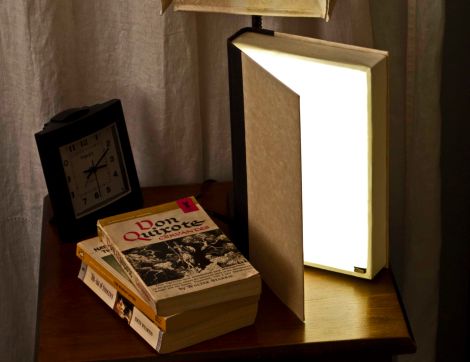
[Steve Hoefer] is not a huge fan of traditional table lamps, so he set off to build a reading light of his own that was more aesthetically pleasing than the standard fare. He thought it would be pretty appropriate to construct his reading lamp out of a book, and we’re inclined to agree.

He stripped the pages from an old book he found at the thrift store, then built a plywood frame to fill in the recently vacated area. A second frame was built inside the first to support the installation of some warm LED strips as well as the acrylic sheet he used to diffuse the light. A whisker switch was installed in the corner of the frame, which turns the lights on when the book is opened. The lamp puts out about the light equivalent of a 40W bulb, and can be “dimmed” by simply adjusting how far the cover is opened.

It looks great on his bedside table, and like some of his other book-related hacks, it’s quite useful as well!

Be sure to check out the video of the light’s construction we have embedded below.

Continue reading “Not Your Ordinary LED Book Light”

Automated LED Hallway Lighting

If normal hallway lighting just doesn’t live up to your standards, this hack may be for you. When [Sean] fitted his kitchen, he replaced the flooring leading up to it.  In true hacker form, he decided to forgo (supplement?) traditional lighting and came up with his own solution.

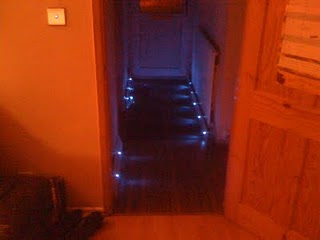
This solution involved embedding the skirting used around his hallway hardwood with blue LED lights. Unfortunately, these LEDs were actually longer than the skirting was thick, so some plaster carving was also necessary.  It is all hidden very well behind the skirting, so you can’t tell. These blue LEDs give a really cool effect, similar to what can be seen at some movie theaters.

Although impressive in itself, [Sean] decided to also hook his setup up to a “Home Easy” device for control. A passive infrared sensor for this system has also been ordered so the lights can turn on without human interaction. We can see this being fantastic for those late night trips to the kitchen for a drink. With this low light solution, you won’t be wondering back to the bedroom without your night vision.

The PixBoard

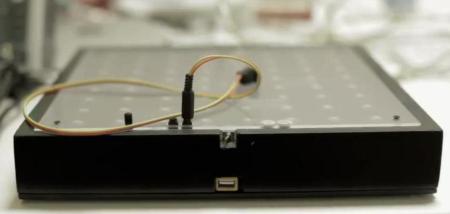
Many hacks are, of course, interesting in their own right. Hacks like this one, however, fulfill a much greater purpose by helping people overcome their disabilities. The PixBoard is “an illuminated board adapted for disabled people, especially for people with cerebral palsy, giving them access to games using shift technology.”

This device was developed for a girl that has cerebral palsy and can’t control her arms or legs effectively. In order to interact with the world more effectively to play board games and the like, this system was developed. The PixBoard scans an 8×8 matrix of LEDs allowing her to select the piece to be moved and where to move it. This is done using only simple buttons and the processor’s timer.

The system is controlled using an Arduino, so anyone is free to create their own games for this system depending on the situation. The following video is in Spanish, but shows this device in action around 1:20. Continue reading “The PixBoard”