
No-Drill Sailing Kit For A Canoe

The first known use of humans using wind to perform mechanical work with machines dates back to ninth-century Persian windmills. But if we count sailing vessels among those machines, the history goes back to sometime just before the invention of written language. Since then, humans have been sailing everything from the tiniest of Sunfish to the largest of shipping vessels, and even sailing boats like canoes that aren’t typically designed for efficient sailing. For those who already own a canoe, the conversions can be straightforward but often involve drilling into the hull. This homemade conversion kit, on the other hand, requires no drilling at all.

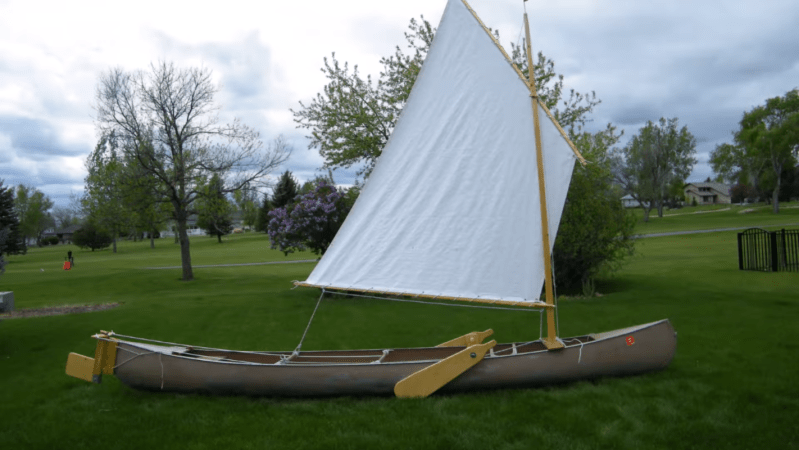
The first, and most obvious, part of the conversion is to add a mast and sail. [Tea]’s primary setup does involve drilling a mast thwart into the gunwales of the canoe, but he also built an alternative setup which clamps to the gunwales and the bow deck instead. The standing lug sail is then hoisted on an unstayed wooden mast. The next major component of the build are a pair of leeboards which also clamp to the gunwales and function like a centerboard, and can be adjusted for one’s preferred amount of weather helm. Rounding out the stern of the boat is a custom-built rudder with a pair of lines in lieu of a tiller which can be positioned anywhere along the length of the boat.

All of the wooden parts of this build were custom-built from common lumber with finishing touches from a router to soften all of the hard edges. Canoe sailing is fairly popular, although without the leeboards these common sailing kits are often meant for downwind sailing only. A complete setup like this turns it into a much more capable craft. Without a canoe as a base vessel to start with, though, a complete sailing vessel can be built from common lumber as well.

Continue reading “No-Drill Sailing Kit For A Canoe”

Paddling Help From Electric-Assisted Kayak

Electric-assisted bicycles, or ebikes, are fundamentally changing the way people get around cities and towns. What were once sweaty, hilly, or difficult rides have quickly turned into a low-impact and inexpensive ways around town without foregoing all of the benefits of exercise. [Braden] hoped to expand this idea to the open waters and is building what he calls the ebike of kayaking, using the principles of electric-assisted bicycles to build a kayak that helps you get where you’re paddling without removing you completely from the experience.

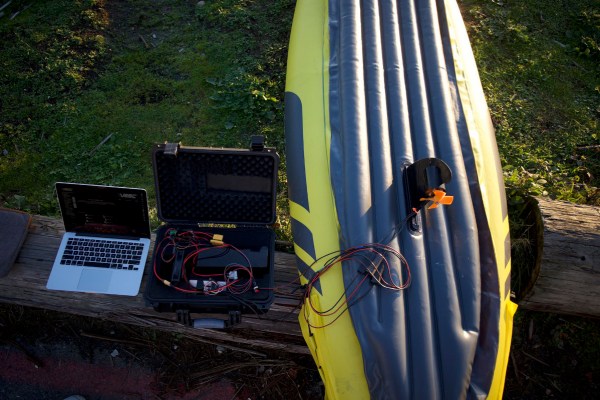
The core of the project is a brushless DC motor originally intended a hydrofoil which is capable of providing 11 pounds (about 5 kg) of thrust. [Braden] has integrated it into a 3D-printed fin which attaches to the bottom of his inflatable kayak. The design of the fin took a few iterations to get right, but with a working motor and fin combination he set about tuning the system’s PID controller in a tub before taking it out to the open water. With just himself, the battery, and the motor controller in the kayak he’s getting about 14 miles of range with plenty of charge left in the battery after the trips.

[Braden]’s plans for developing this project further will eventually include a machine learning algorithm to detect when the rider is paddling and assist them, rather than simply being a throttle-operated motor as it exists currently. On a bicycle, strapping a sensor to the pedals is pretty straightforward, but we expect detecting paddling to be a bit more of a challenge. There are even more details about this build on his personal project blog. We’re looking forward to seeing the next version of the project but if you really need to see more boat hacks in the meantime be sure to check out [saveitforparts]’s boat which foregoes sails in favor of solar panels.

Continue reading “Paddling Help From Electric-Assisted Kayak”







