It’s Full Steam Ahead For This Motorized Canoe

In some parts of Canada, you’ll rarely hear someone use the phrase “whatever paddles your canoe” instead of the more usual “whatever floats your boat”– and apparently, at least for one Swede, that’s steam power. The video, linked and embedded below, is a detailed tour of a canoe equipped with a small boiler and an outboard motor that has been converted to run using steam pressure by [Kenneth Karlsson].

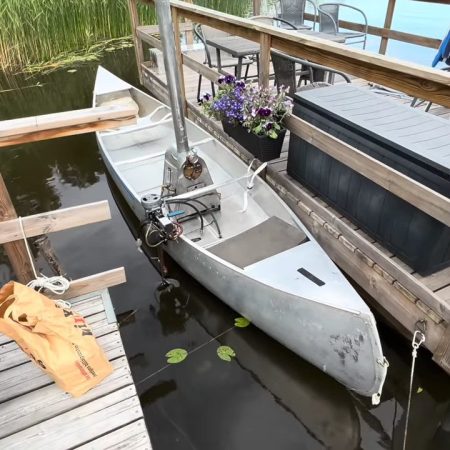
The canoe itself appears to be a Grumman of the “prospector” type, wide in body to hold all the gear you’d need for extended wilderness trips– or, in this case, a small boiler. Amidships is the ideal place, as it won’t affect the balance of the boat. Amidships is an odd place to put an outboard– in the North American homeland of the canoe, if you aren’t moving under your own power, it is more common to cut off the curved stern of the canoe and mount the outboard to the newly-made transom. [Karlsson]’s choice to put the outboard off one side will be less maneuverable than a stern mount, but saves the need to modify the canoe and makes for much shorter steam lines. Shorter steam lines means less hose to potentially leak and scald the occupants, as well as fewer losses, so we can’t really argue with the tradeoffs.

The engine is an old two-stroke outboard that has a single steam cylinder retrofitted to it, along with a heat exchanger to warm up lake water with exhaust steam before it heads the boiler. The water is filtered first, of course, but we do hope the new owner– who posts on YouTube with channel “Steam Canoe” is diligent about cleaning the boiler. It doesn’t look like super high pressure steam, but the vapour phase of water is always something to be respected.

If the potential of scalding steam leaks and boiler explosions put you off, but you still won’t pick up a paddle, canoes can be rigged with sails— or you can just hand the paddle to a robot arm. Though given this is Hackaday, maybe you’d rather skip the canoe and climb aboard the good ship Benchy instead. Continue reading “It’s Full Steam Ahead For This Motorized Canoe”

No-Drill Sailing Kit For A Canoe

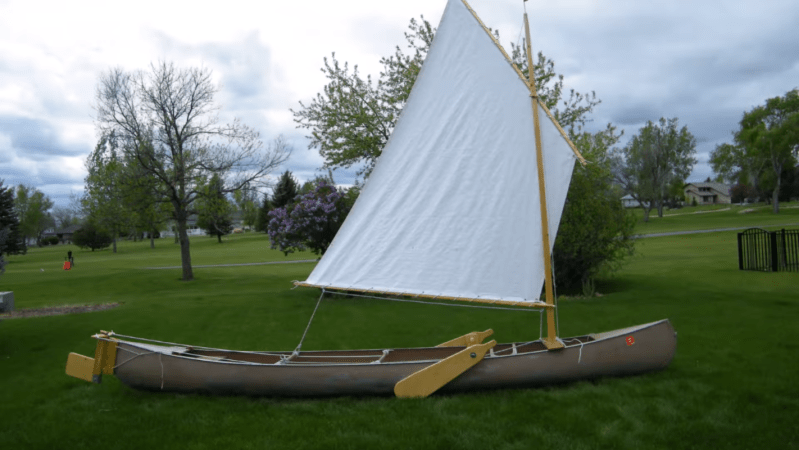
The first known use of humans using wind to perform mechanical work with machines dates back to ninth-century Persian windmills. But if we count sailing vessels among those machines, the history goes back to sometime just before the invention of written language. Since then, humans have been sailing everything from the tiniest of Sunfish to the largest of shipping vessels, and even sailing boats like canoes that aren’t typically designed for efficient sailing. For those who already own a canoe, the conversions can be straightforward but often involve drilling into the hull. This homemade conversion kit, on the other hand, requires no drilling at all.

The first, and most obvious, part of the conversion is to add a mast and sail. [Tea]’s primary setup does involve drilling a mast thwart into the gunwales of the canoe, but he also built an alternative setup which clamps to the gunwales and the bow deck instead. The standing lug sail is then hoisted on an unstayed wooden mast. The next major component of the build are a pair of leeboards which also clamp to the gunwales and function like a centerboard, and can be adjusted for one’s preferred amount of weather helm. Rounding out the stern of the boat is a custom-built rudder with a pair of lines in lieu of a tiller which can be positioned anywhere along the length of the boat.

All of the wooden parts of this build were custom-built from common lumber with finishing touches from a router to soften all of the hard edges. Canoe sailing is fairly popular, although without the leeboards these common sailing kits are often meant for downwind sailing only. A complete setup like this turns it into a much more capable craft. Without a canoe as a base vessel to start with, though, a complete sailing vessel can be built from common lumber as well.

Continue reading “No-Drill Sailing Kit For A Canoe”

Robotic Canoe Puts Robot Arms To Work

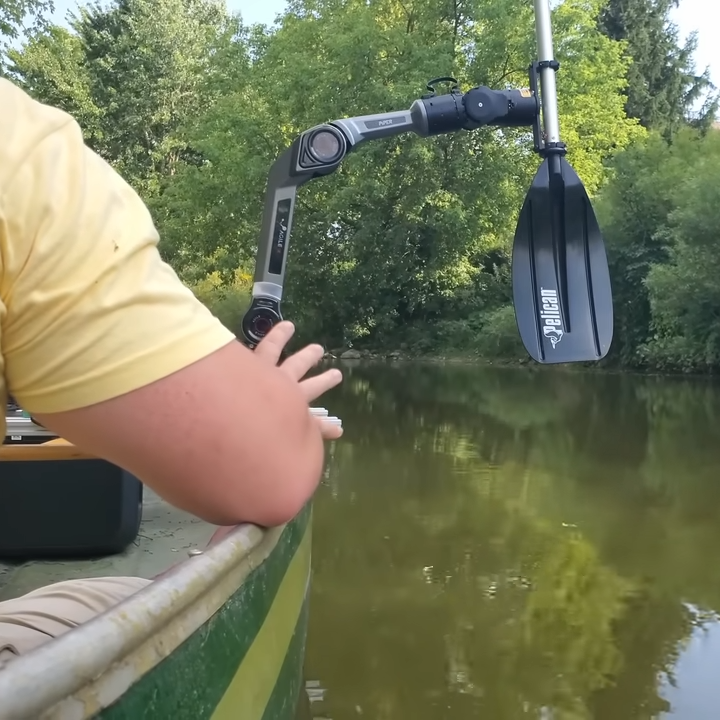
Most robots get around with tracks or wheels, but [Dave] had something different in mind. Sufficiently unbothered by the prospect of mixing electronics and water, [Dave] augmented a canoe with twin, paddle-bearing robotic arms to bring to life a concept he had: the RowboBoat. The result? A canoe that can paddle itself with robotic arms, leaving the operator free to take a deep breath, sit back, and concentrate on not capsizing.

There are a couple of things we really like about this build, one of which is the tidiness of the robotic platform that non-destructively attaches to the canoe itself with custom brackets. A combination of aluminum extrusion and custom brackets, [Dave] designed it with the help of 3D scanning the canoe as a design aid. A canoe, after all, has nary a straight edge nor a right angle in sight. Being able to pull a 3D model into CAD helps immensely in such cases; we have also seen this technique used in refitting a van into an off-grid camper.

The other thing we like is the way that [Dave] drives the arms. The two PiPER robotic arms are driven with ROS, the Robot Operating System on a nearby Jetson Orin Nano SBC. The clever part is the way [Dave] observed that padding and steering a canoe has a lot in common with a differential drive, which is akin to how a tank works. And so, for propulsion, ROS simply treats the paddle-bearing arms as though they were wheels in a differential drive. The arms don’t seem to mind a little water, and the rest of the electronics are protected by a pair of firmly-crossed fingers.

The canoe steers by joystick, but being driven by ROS it could be made autonomous with a little more work. [Dave] has his configuration and code for RowboBoat up on GitHub should anyone wish to take a closer look. Watch it in action in the video, embedded below.

Continue reading “Robotic Canoe Puts Robot Arms To Work”

Self-Portaging Canoe Is Part Bicycle

Normally when making a long voyage in a canoe, an adventurer would paddle the vessel as far as possible and then “portage”, or carry, the canoe over the short sections of land separating the bodies of water. Portaging is a lot of work, though, since canoes generally aren’t particularly light or designed for traveling over land. To solve this problem, [Ben] is modifying his home-built canoe with some interesting parts to make it into an amphibious vehicle which can much more easily traverse land.

The wheels for the amphibious craft come from BMX bicycles, which have much smaller wheels as well as more robust frames when compared to more traditional bicycles. The rear of the canoe was modified to use a go-kart axle with two driven wheels. An additional set of cranks mounted outboard drive a custom-built paddle to propel the boat when traveling on water. The frame borrows heavily from recumbent bicycle design and includes a similarly comfortable seat, with steering handled by a wheel at the front when traveling on land and a rudder at the rear when traveling over water.

[Ben] intends to take this unique vehicle on a cross-country trip across Scotland, with the first part of the adventure on water via the Caledonian Canal and the return trip on land via the Great Glen Way. Hopefully, there’s no actual portaging required for his trip as the bike components add a tremendous amount of weight to the boat. [Ben] he even added a sail that could theoretically be used in either mode. We’ll be keeping watch for his next videos showing his adventure, and in the meantime daydreaming about other unique bikes that let you travel where bikes normally can’t.

Continue reading “Self-Portaging Canoe Is Part Bicycle”

Party Canoe Lights Up The Water

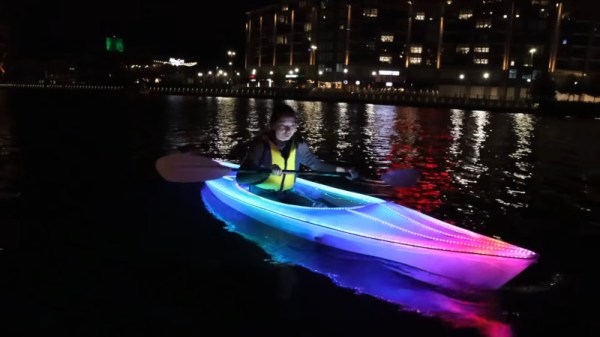
Generally, any activity out on the water is more dangerous when done at night. Hazards are less visible, and it can be easy to get into trouble. [Xyla Foxlin]’s party canoe can’t help with that, but it does look the business after dark.

The canoe is made out of fiberglass, directly formed onto an existing canoe to make getting the shape right easy. It was formed in two halves, with special care taken to make the final result as clear as possible. Obviously, fiberglass is never going to be perfectly transparent, but [Xyla] does a great job of getting a nice translucent frosted look. The final effect means that it’s the perfect canoe to stuff full of addressable LEDs. A string of WS2812Bs, hooked up to an Arduino, make for an appealing lightshow when boating at night.

The diffusive nature of the fiberglass really makes the difference here. We’ve talked about the topic before – it’s the key to making your glowy project really pop. Video after the break.

Continue reading “Party Canoe Lights Up The Water”

Mushroom Canoe Is Rooted In Nature

Mushrooms might be the most contested pizza topping after pineapple, but can you build a boat from pineapples? Probably not, but you can from mushrooms. Mushrooms, or rather their mycelium root systems, can be used for things like packaging, insulation, and furniture, and it could be the next thing in floatation, too. Just ask [Katy Ayers], a Nebraska college student who built an eight-foot canoe molded almost entirely of mycelium.

[Katy] got into mushrooms when she was tasked with researching solutions to climate change. She loves to fish and has always wanted a boat, so when she found out that mycelium are naturally buoyant and waterproof, she decided to try using it as a building material.

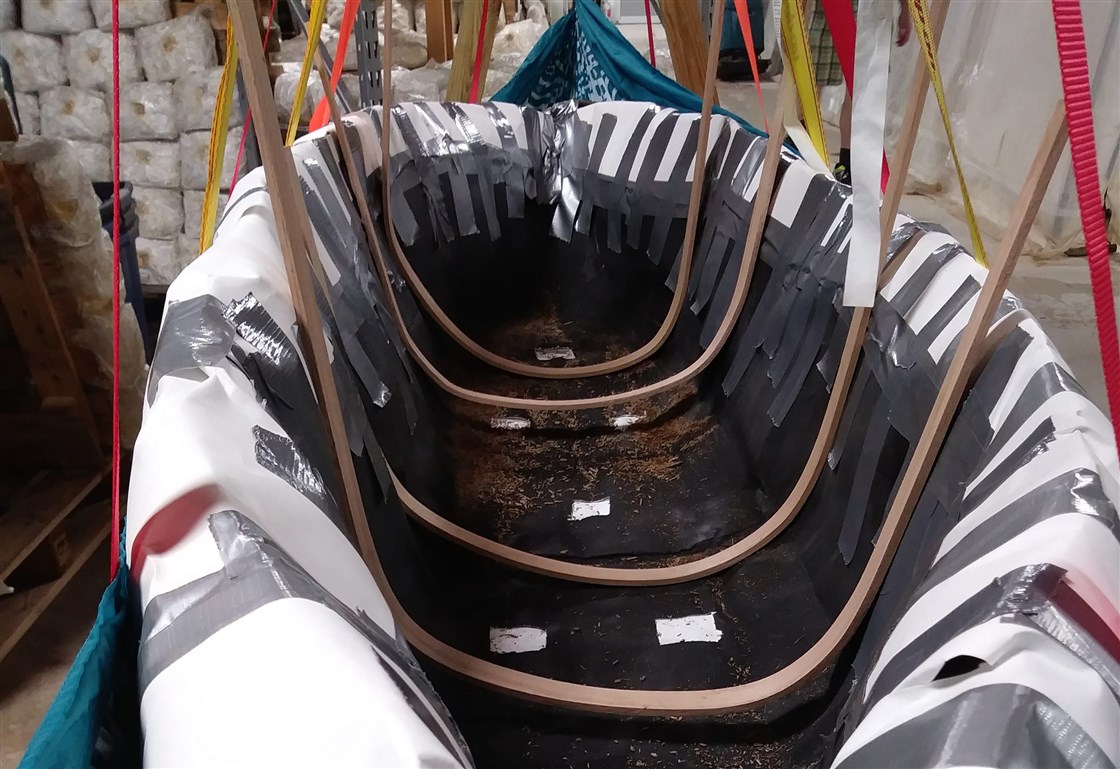
[Katy] floated the idea by the owner of a local mushroom company and they got to work, building a frame suspended in the air by a hammock-like structure. Then they covered the boat’s skeleton with spores and let it proliferate in a hot, humid growing room. Two weeks later, they had a boat made of live mycelium, which means that every time it goes out on the water, it spawns mushrooms. The total cost including tools was around $500. The boat experiment spawned even more mycelium projects. [Katy] has since experimented with making lawn chairs and landscaping bricks from mycelium.

Don’t want to wait to grow your own mycelium boat? You can build one out of stretch wrap, packing tape, and tree branches.

Thanks for the tip, [ykr300]!

Main image by Katy Ayers via NBC News

The Illuminated Waterways Of The United States

A recent convert to the ways of the laser cutter, redditor [i-made-a-thing] was in want of a project and — stumbling on some waterways maps on Etsy — launched into fabricating an illuminated map of all the waterways in the United States.

The map itself was laser-cut out of 1/4 inch plywood at his local makerspace. Thing is, smaller rivers and tributaries were too narrow at the scale [i-made-a-thing] wanted, so he ended up spending several hours in Photoshop preparing the image so larger rivers would be laser-cut — and not break off– while the rest would be etched onto the surface. After testing the process by making a few coasters, he was ready to get started on the real deal.

Continue reading “The Illuminated Waterways Of The United States”