Printed Sleeve Gives Keys Some Grip

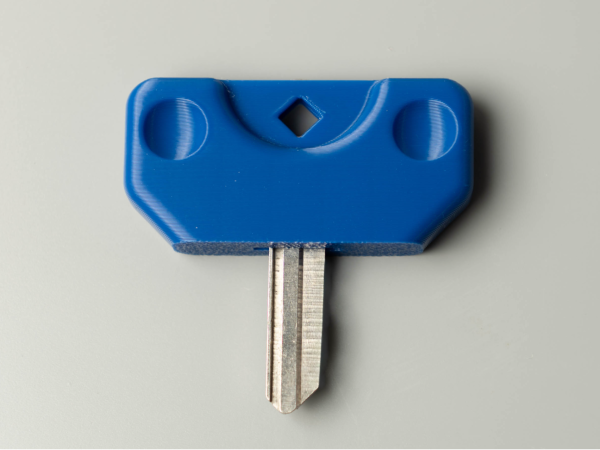
[Enginerd]’s chonky key handle is a beautiful use of 3D printing that helps people help themselves. The large wings, indented faces, and beefed-up grip make a typical house key much easier for someone with arthritis or difficulty gripping those brass slivers. Bright filaments in different colors can also help someone with vision limitations. The thing that will not improve is the space in your pocket or purse.

The design only requires a tiny bit of plastic, prints without supports, and what sets it apart from similar models is that you do not need any double-sided tape or bolts, only a keyring, so someone may have to assemble it for the user. The author is clever enough to use an uncut blank in the project photo so that no one will be decoding and copying their house key. We would wager they have read Hackaday if they are so prepared.

Some of the people who purchased early consumer 3D printers already need these kinds of builds, and there is no shortage of intelligent people creating remarkable open-source designs.

Continue reading “Printed Sleeve Gives Keys Some Grip”

Rock-A-Bye Baby, On The Mechatronic Crib Shaker

While an engineering mindset is a valuable tool most of the time, there are some situations where it just seems to be a bad fit. Solving problems within the family unit would seem to be one such area, but then again, this self-rocking mechatronic crib seems to be just the cure for sleepytime woes.

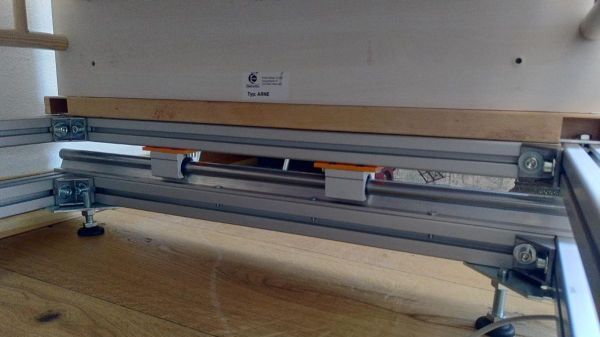
From the look of [Peter]’s creation, this has less of a rocking motion and more of a gentle back-and-forth swaying. Its purpose is plainly evident to anyone who has ever had to rock a child to sleep: putting a little gentle motion into the mix can help settle down a restless infant pretty quickly. Keeping the right rhythm can be a problem, though, as can endurance when a particularly truculent toddler is fighting the urge to sleep. [Peter]’s solution is a frame of aluminum extrusion with some nice linear bearings oriented across the short axis of the crib, which sits atop the whole thing.

A recirculating ball lead screw — nothing but the best for [Junior] — and a stepper drive the crib back and forth. [Peter] took care to mechanically isolate the drivetrain from the bed, and with the selection of the drive electronics and power supply, to make sure that noise would be minimal. Although thinking about it, we’ve been lulled to sleep by the whining steppers of our 3D printer more than once. Or perhaps it was the fumes.

Hats off to [Peter] for a setup that’s sure to win back a little of the new parent’s most precious and elusive commodity: sleep.