A Radio Power Amplifier For Not A Lot

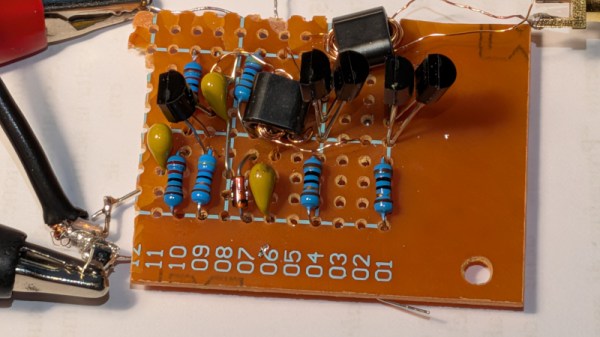
When building a radio transmitter, unless it’s a very small one indeed, there’s a need for an amplifier before the antenna. This is usually referred to as the power amplifier, or PA. How big your PA is depends on your idea of power, but at the lower end of the power scale a PA can be quite modest. QRP, as lowe power radio is referred to, has a transmit power in the miliwatts or single figure watts. [Guido] is here with a QRP PA that delivers about a watt from 1 to 30 MHz, is made from readily available parts, and costs very little.

Inspired by a circuit from [Harry Lythall], the prototype is built on a piece of stripboard. It’s getting away with using those cheap transistors without heatsinking because it’s a class C design. In other words, it’s in no way linear; instead it’s efficient, but creates harmonics and can’t be used for all modes of transmission. This PA will need a low-pass filter to avoid spraying the airwaves with spurious emissions, and on the bands it’s designed for, is for CW, or Morse, only.

We like it though, as it’s proof that building radios can still be done without a large bank balance. Meanwhile if the world of QRP interests you, it’s something we have explored in the past.
SDR Transmitting Gets The Power

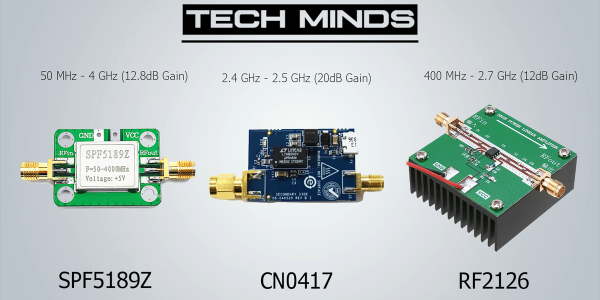
Most hobby-grade software defined radio setups don’t transmit. Of the few that do, most of them put out anemic levels around one milliwatt or so. If you want to do something outside of the lab, you’ll need an amplifier and that’s what [Tech Minds] shows how to do in a recent video. (Embedded below.)

The video covers LimeSDR, HackRF, and the Pluto SDR, although the amplifiers should work with any transmitter. The SPF5189Z module is quite cheap and covers 50 MHz to 4 GHz, amplifying everything you throw at it. The downside is that it will amplify everything you throw at it, even parts of the signal you don’t want, such as spurs and harmonics.

Continue reading “SDR Transmitting Gets The Power”

Tiny Raspberry Pi Shield For High-Quality RF Signals

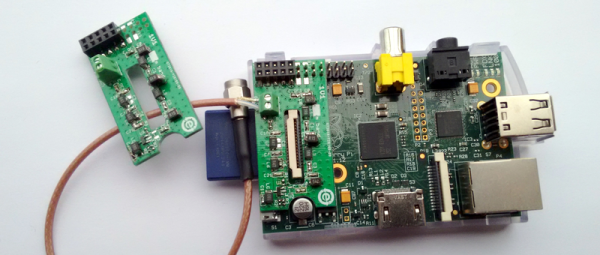
Among its many tricks, the Raspberry Pi is capable of putting clock signals signal out on its GPIO pins, and that turns out to be just the thing for synthesizing RF signals in the amateur radio bands. What [Zoltan] realized, though, is that the resulting signals are pretty dirty, so he came up with a clever Pi shield for RF signal conditioning that turns a Pi into a quality low-power transmitter.

[Zoltan] stuffed a bandpass filter for broadband noise, a low-pass filter for harmonics, and a power amplifier to beef up the signal a bit into a tiny shield that is cleverly engineered to fit any version of the Pi. Even with the power amplifier, the resulting transmitter is still squarely in the realm of QRP, and the shield is optimized for use as a WSPR beacon on the 20-meter band. But there’s plenty of Pi software available to let hams try other modes, including CW, FM, SSB, and even SSTV, and other signal conditioning hardware for different bands.

Yes, these are commercially available products, but even if you’re not in the market for a shield like this, or if you want to roll your own, there’s a lot to learn from [Zoltan]’s presentation at the 2015 TAPR Digital Communications Conference (long video below). He discusses the difficulties encountered getting a low-profile shield to be compatible with every version of the Pi, and the design constraints that led to the decision to use SMT components.

Continue reading “Tiny Raspberry Pi Shield For High-Quality RF Signals”