Going Full Fruity With Apple’s 1999 High-End Power Mac G3

Back in the late 90s, Apple was definitely a pretty fruity company, with its aggressively translucent shades of colored plastic that often got described in terms of such fruit variants. Although the iMac steals a lot of the glory here, the Power Mac series and associated hardware deserves that spot in the limelight as well. Recently [Dan Wood] put together a full Power Mac G3-based setup, including the appropriate LCD monitor and other peripherals as someone with some serious disposable income back in 1999 might have owned.
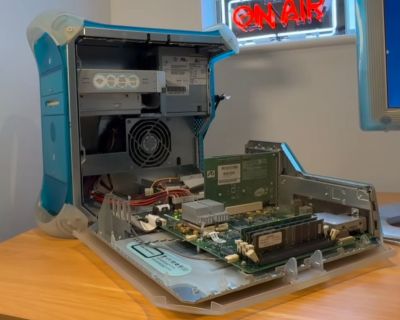
Why Macs are better than PCs. (Credit: Dan Wood, YouTube)

Part of Steve Jobs’ return to Apple, the Power Macintosh G3 debuted first in basically recycled beige enclosures from previous Macintosh systems before its second generation introduced the Blue and White version, as it was officially called. This dazzling style was carried through in the peripherals, with pin stripes, translucent plastic and a distinct absence of sharp corners or edges.

As for what you get in these colorful Power Mac G3s, a 300 to 450 MHz CPU, an official memory limit of 192 MB and perhaps the most user-friendly way to access the logic board to upgrade and install components with the folding lid. Something which had PC users with sharp edged cases and plentiful blood sacrifices to the PC gods somewhat steaming in jealousy.

For the time these Power Mac G3s didn’t just look fetching, they also were quite powerful. Something which came at a pretty hefty price tag, of course. The 400 MHz model that [Dan] got his paws on would have cost around $2,000 back in 1999, or closer to $4,000 clams today. The active-matrix TFT LCD screen would have been cutting edge as well, with a similar cutting edge price tag.

Released before OS X this system runs Mac OS 8.6, though it can run OS X 10.4 (Tiger) which unlocks more software options and of course the transition to a proper multi-tasking OS. This particular system was apparently used for graphics design until 2010 based on the files on the HDD. As demonstrated in the video, the system is still quite usable, even in 2026, thanks to all the software available online.

Continue reading “Going Full Fruity With Apple’s 1999 High-End Power Mac G3”

Changing System Architectures And The Complexities Of Apple’s Butterfly Approach To ISAs

Apple computers will be moving away from Intel chips to its own ARM-based design. An interesting thing about Apple as a company is that it has never felt the need to tie itself to a particular system architecture or ISA. Whereas a company like Microsoft mostly tied its fortunes to Intel’s x86 architecture, and IBM, Sun, HP and other giants preferred vertical integration, Apple is currently moving towards its fifth system architecture for its computers since the company was formed.

What makes this latest change possibly unique, however, is that instead of Apple relying on an external supplier for CPUs and peripheral ICs, they are now targeting a vertical integration approach. Although the ARM ISA is licensed to Apple by Arm Holdings, the ‘Apple Silicon’ design that is used in Apple’s ARM processors is their own, produced by Apple’s own engineers and produced by foundries at the behest of Apple.

In this article I would like to take a look back at Apple’s architectural decisions over the decades and how they made Apple’s move towards vertical integration practically a certainty.

Continue reading “Changing System Architectures And The Complexities Of Apple’s Butterfly Approach To ISAs”

A Third Scale Mini PowerMac

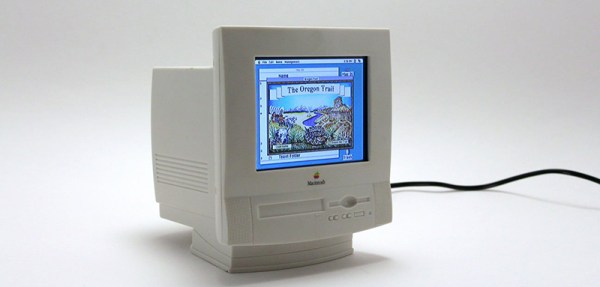
We’re surrounded by tiny ARM boards running Linux, and one of the most popular things to do with these tiny yet powerful computers is case modding. We’ve seen Raspberry Pis in Game Boys, old Ataris, and even in books. [Aaron] decided it was time to fit a tiny computer inside an officially licensed bit of miniature Apple hardware and came up with the Mini PowerMac. It’s a 1/3rd scale model of an all-in-one Mac from 1996, and [Aaron] made its new hardware fit like a glove.

Instead of an old Mac modified with an LCD, or even a tiny 3D printed model like Adafruit’s Mini Mac Pi, [Aaron] is using an accessory for American Girl dolls released in 1996. This third-scale model of an all-in-one PowerPC Mac is surprisingly advanced for something that would go in a doll house. When used by American Girl dolls, it has a 3.25″ monochrome LCD that simulates the MacOS responding to mouse clicks and keypresses. If you want to see the stock tiny Mac in action, here’s a video.

The American Girl Mini Macintosh is hollow, and there’s a lot of space in this lump of plastic. [Aaron] tried to fit a Raspberry Pi in the case. A Pi wouldn’t fit. An ODROID-W did, and with a little bit of soldering, [Aaron] had a computer far more powerful than an actual PowerMac 5200. Added to this is a 3.5″ automotive rearview display, carefully mounted to the 1/3rd size screen bezel of the mini Mac.

The rest of the build is exactly what you would expect – a DC/DC step down converter, a USB hub, and a pair of dongles for WiFi and a wireless keyboard. The software for the ODROID-W is fully compatible with the Raspberry Pi, and a quick install of the Basilisk II Macintosh emulator and an installation of Mac OS 7.5.3 completed the build.

Hackaday Retro Roundup, This Time With A PowerPC And A PET

Thought we forgot about this, didn’t you? Well, the Hackaday Retro Edition is still going strong, and this time we have a few more retro successes that were able to load our retro site with ancient hardware.

First up is a submission by [rusbus]. He had a Power Macintosh 6100/60 lying around – the first Macintosh with a PowerPC processor instead of the Motorola 68k – and loaded up our retro site. There are some weird quirks about the 6100, notably the AAUI Ethernet tranceiver connected to a 10BASE-T network.

Although some browsers are available for the 6100, notably iCab (it’s not great, but it also works on 68k machines), [rusbus] had to settle for Internet Explorer 3.01. He eventually got it working and has a picture to prove it.

On the subject of finding a proper web browser, [azog] loaded up the retro site with a Commodore PET. There aren’t any web browsers for a PET, you say? Well, [azog] had to make one.

The network adapter is a Retroswitch Flyer Internet Modem, and after finding some network-aware projects on the Retroswitch site such as an IRC and Telnet client, [azog] put together an extremely crude web browser. In BASIC. Old BASIC. We’re impressed.

With [azog]’s browser, the PET opens up a channel to a URL, reads the text coming in, and processes it. There’s only 1kb of video RAM and 32kb of system RAM, so small luxuries like scrolling are nearly impossible. An amazing piece of work, really.

Finally, [Bob] from Portugal sent in a neat Flickr gallery of a Schneider euro XT he found in his basement. It’s based on the IBM PC/XT running an Intel 8088 processor, but is enclosed in a ‘the keyboard is the computer’ form factor reminiscent of a C64 or TRS-80. He hasn’t gotten it on the Internet yet, but it’s still a cool piece of kit.