Yellow YAG Produces Powerful Pulses In Les’ Leftover Laser

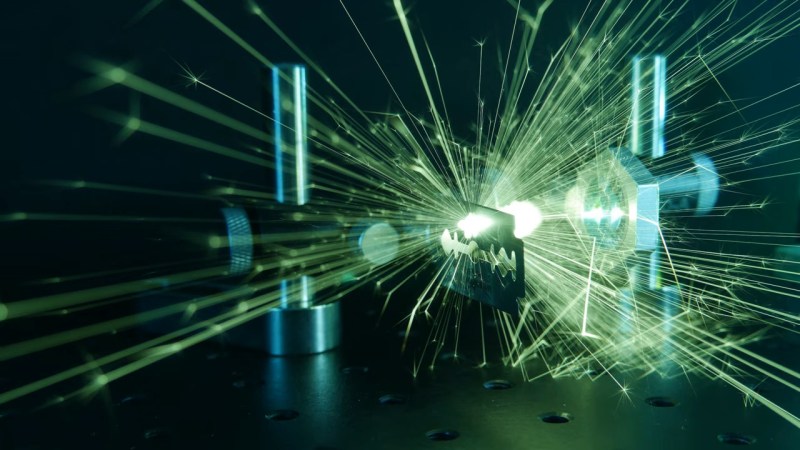
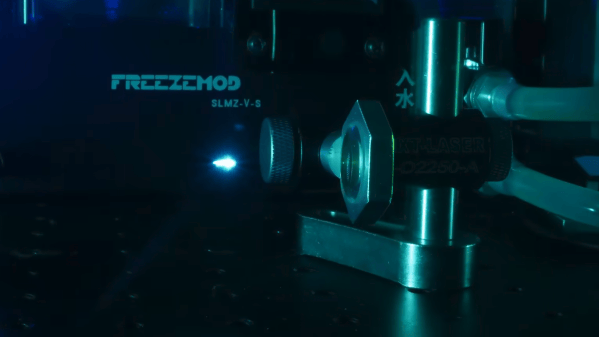
[Les] likes lasing lasers, and who doesn’t? [Les] likes larger lasers than lots of folks, with his current project being an Nd:YAG (that’s Neodymium:Yttrium Aluminum Garnet) flash pumped laser intended for tattoo removal. Like most of its ilk, the YAG crystal at the heart of that device is a rosy purple color, so when [Les] spotted a Yellow YAG with different doping promising powerful pulses, he purchased it promptly.

Specifically, the retailer was claiming a 30-50% efficiency increase for this yellow rod, thanks to cerium doping. It’s still considered an Nd:YAG, though you can label it as an Nd:Ce:YAG for clarity. The efficiency gain comes from the cerium atom taking unused energy from the flashbulb pulse — which is much broader-wavelength than the thin absorption line of the Nd ions in the rod — and giving that energy to the Nd atoms that do the lasing via fluorescence. He doesn’t try it, but reports on a paper showing these crystals can actually lase with reasonable efficiency from sunlight alone, which we’d love to see. Send us a tip if you try.

His original Nd:YAG rod produced 72.8 mJ pulses, while in the same setup with the yellow laser is peaking at 153 mJ, more than double the original output. That’s even better than the 30-50% [Les] expected, but he reckons it is because the old YAG is, well, old. The coatings break down over time, and UV light from the flashbulbs degrades the crystals too. That’s another benefit of tossing cerium in there, as apparently it acts as sunscreen for your laser rod. It lasts longer and works better, making it a no-brainer of an upgrade.

We’ve seen [Les]’s laser-based hacking before, like this  diode-laser PSU and we’re always glad to take a look with our remaining eye. We also featured his tattoo removal laser back when he started working on it, along with less-lasery projects like his crystal-growing rig.

Continue reading “Yellow YAG Produces Powerful Pulses In Les’ Leftover Laser”

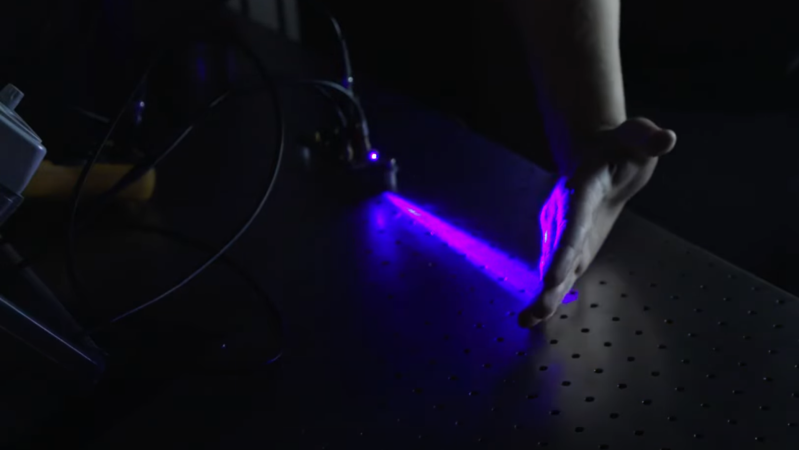
A violet laser beam is shown expanding outward from a diode in a darkened room and illuminating the back of a man's hand.

Driving A Laser At 200 Volts For Nanoseconds

If there’s one lesson to be learned from [Aled Cuda]’s pulsed laser driver, it’s that you can treat the current limits on electronic components as a suggestion if the current duration is measured in nanoseconds.

The components in question are a laser diode and an NPN transistor, the latter of which operates in avalanche mode to drive nanosecond-range pulses of high current through the former. A buck-boost converter brings a 12 volt power supply up to 200 volts, which then passes through a diode and into the avalanche transistor, which is triggered by an external pulse generator. On the other side of the transistor is a pulse-shaping network of resistors and capacitors, the laser diode, and a parallel array of low-value resistors, which provide a current monitor by measuring the voltage across them. There is an optoisolator to protect the pulse generator from the 200 volt lines on the circuit board, but for simplicity’s sake it was omitted from this iteration; there is some slight irony in designing your own laser driver for the sake of the budget, then controlling it with “a pulse generator we don’t mind blowing up.” We can only assume that [Aled] was confident in his work.

The video below details the assembly of the circuit board, which features some interesting details, such as the use of a transparent solder mask which makes the circuit layout clear while still helping to align components during reflow. The circuit did eventually drive the diode without destroying anything, even though the pulses were probably 30 to 40 watts. A pulse frequency of 360 hertz gave a nice visual beating effect due to small mismatches between the pulse frequency of the driver and the frame rate of the camera.

This isn’t the first laser driver to use avalanche breakdown for short, high-power pulses, but it’s always good to see new implementations. If you’re interested in further high-speed electronics, we’ve covered them in more detail before.

Continue reading “Driving A Laser At 200 Volts For Nanoseconds”

Most Powerful Laser Diodes, Now More Powerful

Many hobbies seem to have a subset of participants who just can’t leave well enough alone. Think about hot rodders, who squeeze every bit of power out of engines they can, or PC overclockers, who often go to ridiculous ends to milk the maximum performance from a CPU. And so it goes in the world of lasers, where this avalanche driver module turns Nichia laser diodes into fire-breathing beasts.

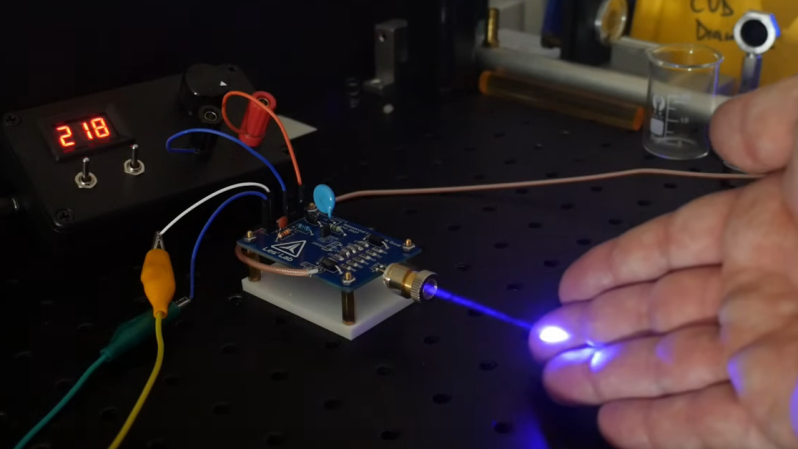
OK, that last bit might be a little overstated, but there’s no denying the coolness of what laser jock [Les Wright] has accomplished here. In his endless quest for more optical power, [Les] happened upon a paper describing a simple driver circuit that can dump massive amounts of current into a laser diode to produce far more optical power than they’re designed for. [Les] ran with what few details the paper had and came up with a modified avalanche driver circuit, with a few niceties for easier testing, like accommodation for different avalanche transistors and a way to test laser diodes in addition to the Nichia. He also included an onboard current sensing network, making it easy to hook up a high-speed oscilloscope to monitor the performance of the driver.

For testing, [Les] used a high-voltage supply homebrewed from a Nixie inverter module along with a function generator to provide the pulses. The driver was able to push 80 amps into a Nichia NUBM47 diode for just a few nanoseconds, and when all the numbers were plugged in, the setup produced about 67 watts of optical power. Not one to let such power go to waste, [Les] followed up with some cool experiments in laser range finding and dye laser pumping, which you can check out in the video below. And check out our back catalog of [Les]’ many laser projects, from a sketchy tattoo-removal laser teardown to his acousto-optical filter experiments. Continue reading “Most Powerful Laser Diodes, Now More Powerful”