When all else fails, there’s radio. Hurricane Helene’s path of destruction through Appalachia stripped away every shred of modern infrastructure in some areas, leaving millions of residents with no ability to reach out to family members or call for assistance, and depriving them of any news from the outside world. But radio seems to be carrying the day, with amateur radio operators and commercial broadcasters alike stepping up to the challenge.
Imagine you’ve got an FM transmitter located some place. Wouldn’t it be mighty convenient if you could control that transmitter remotely? That way, you wouldn’t have to physically attend to it every time you had to change some minor parameters! To that end, [Ricardo Lima Caratti] built a rig to do just that.
The build is based around the QN8066—a digital FM transceiver built into a single chip. It’s capable of transmitting and receiving anywhere from 60 MHz to 108 MHz, covering pretty much all global FM stereo radio bands. [Ricardo] paired this chip with an ESP32 for command and control. The ESP32 hosts an HTTP server, allowing the administration of the FM transmitter via a web browser. Parameters like the frequency, audio transmission mode, and Radio Data Service (RDS) information can be controlled in this manner.
It’s a pretty neat little build, and [Ricardo] demonstrates it on video with the radio transmitting some field day content. We’ve seen some other nifty FM transmitters over the years, too. Video after the break.
Sometimes you need to create a satellite navigation tracking device that communicates via a low-power mesh network. [Powerfeatherdev] was in just that situation, and they whipped up a particularly compact solution to do the job.
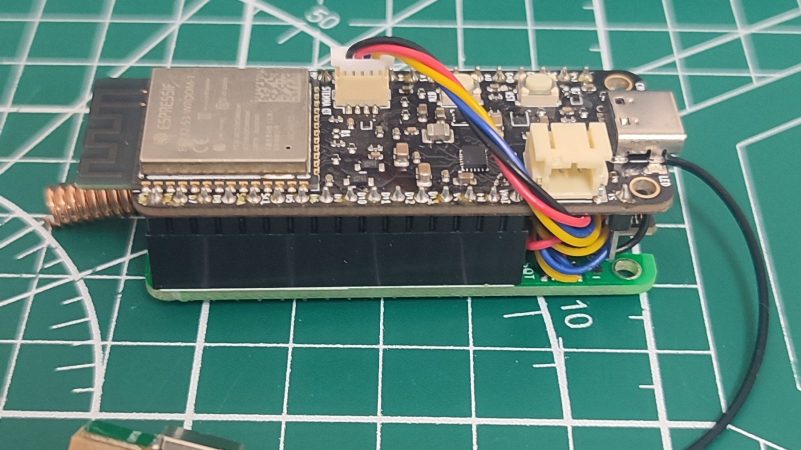
As you might have guessed based on the name of its creator, this build is based around the ESP32-S3 PowerFeather board. The PowerFeather has the benefit of robust power management features, which makes it perfect for a power-sipping project that’s intended to run for a long time. It can even run on solar power and manage battery levels if so desired. The GPS and LoRa gear is all mounted on a secondary “wing” PCB that slots directly on to the PowerFeather like a Arduino shield or Raspberry Pi HAT. The whole assembly is barely larger than a AA battery.
It’s basically a super-small GPS tracker that transmits over LoRa, while being optimized for maximum run time on limited power from a small lithium-ion cell. If you’re needing to do some long-duration, low-power tracking task for a project, this might be right up your alley.
LoRa is a useful technology for radio communications, as we’ve been saying for some time. Meanwhile, if you’ve got your own nifty radio comms build, or anything in that general milleu, don’t hesitate to drop us a line!
Here’s the thing about radio signals. There is wild and interesting stuff just getting beamed around all over the place. Phrased another way, there are beautiful signals everywhere for those with ears to listen. We go about our lives oblivious to most of them, but some dedicate their time to teasing out and capturing these transmissions.
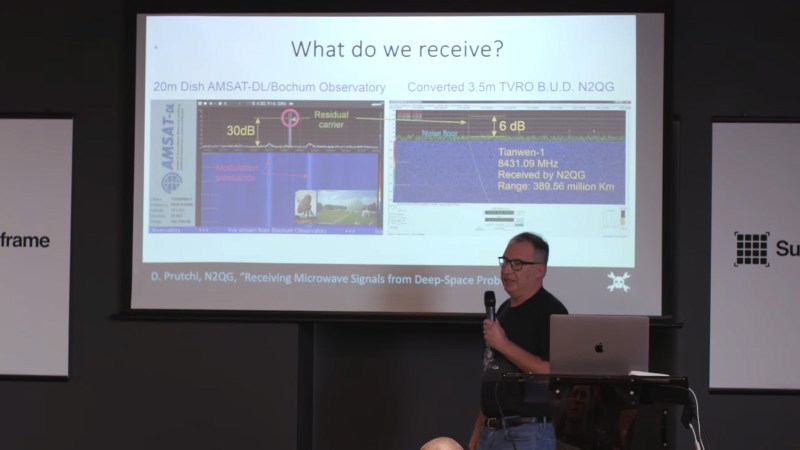
David Prutchi is one such person. He’s a ham radio enthusiast that dabbles in receiving microwave signals sent from probes in deep space. What’s even better is that he came down to Supercon 2023 to tell us all about how it’s done!
In an age where our gadgets allow us to explore the cosmos, we stumbled upon sounds from a future past: an article on historical signals from Mars. The piece, written by [Paul Gilster] of Centauri Dreams, cites a Times essay published by [Becky Ferreira] of August 20. [Ferreira]’s essay sheds light on a fascinating, if peculiar, chapter in the history of the search for extraterrestrial life.
She recounts an event from August 1924 when the U.S. Navy imposed a nationwide radio silence for five minutes each hour to allow observatories to listen for signals from Mars. This initiative aimed to capitalize on the planet’s close alignment with Earth, sparking intrigue and excitement among astronomers and enthusiasts alike.
There was movement in the “AM Radio in Every Vehicle Act” last week, with the bill advancing out of the US House of Representatives Energy and Commerce Committee and heading to a full floor vote. For those not playing along at home, auto manufacturers have been making moves toward deleting AM radios from cars because they’re too sensitive to all the RF interference generated by modern vehicles. The trouble with that is that the government has spent a lot of effort on making AM broadcasters the centerpiece of a robust and survivable emergency communications system that reaches 90% of the US population.
The bill would require cars and trucks manufactured or sold in the US to be equipped to receive AM broadcasts without further fees or subscriptions, and seems to enjoy bipartisan support in both the House and the Senate. Critics of the bill will likely point out that while the AM broadcast system is a fantastic resource for emergency communications, if nobody is listening to it when an event happens, what’s the point? That’s fair, but short-sighted; emergency communications isn’t just about warning people that something is going to happen, but coordinating the response after the fact. We imagine Hurricane Helene’s path of devastation from Florida to Pennsylvania this week and the subsequent emergency response might bring that fact into focus a bit.
For many of us of a particular vintage, the internet blossomed in the ’90s with the invention of the Web and just a few years of development. Back then, we had the convenience of expression on the WWW and the backup of mature services such as IRC for all that other stuff we used to get up to. Some of us still hang out there. Then something happened. Something terrible. Big-commerce took over, and it ballooned into this enormously complex mess with people tracking you every few seconds and constantly trying to bombard you with marketing messages. Enough now. Many people have had enough and have come together to create the Tildeverse, a minimalist community-driven internet experience.
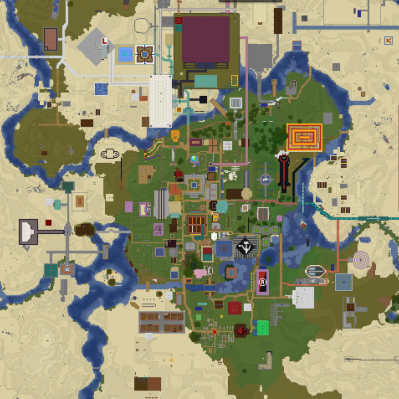
A collaborative Minecraft server hosted on a Tilde site
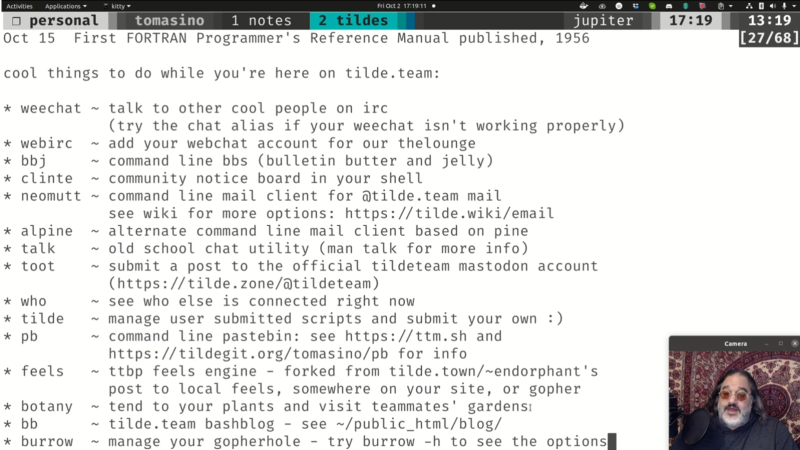
Tilde, literally ‘ ~ ‘, is your home on the internet. You can work on your ideas on a shared server or run your own. Tilde emphasises the retro aesthetic by being minimal and text-orientated. Those unfamiliar with a command line may start getting uncomfortable, but don’t worry—help is at hand. The number of activities is too many to list, but there are a few projects, such as a collaborative Sci-Fi story, a radio station, and even a private VoIP server. Gamers are catered for as long as you like Minecraft, but we think that’s how it should go.
The Tildeverse also supports Gopher and the new Gemini protocol, giving some people a few more options with which to tinker. The usual method to gain access is to first sign up on a server, then SSH into it; you’re then taken to your little piece of the internet, ready to start your minimalist journey into the Tildeverse.
A couple of videos after the break go into much more detail about the whys and hows of the Tildeverse and are worth a chunk of your time.
We’ve talked about the ‘small web’ before. Here’s our guide to Gemini.