Raspberry Pi Radio Streaming Service Guts Yamaha Shelf System

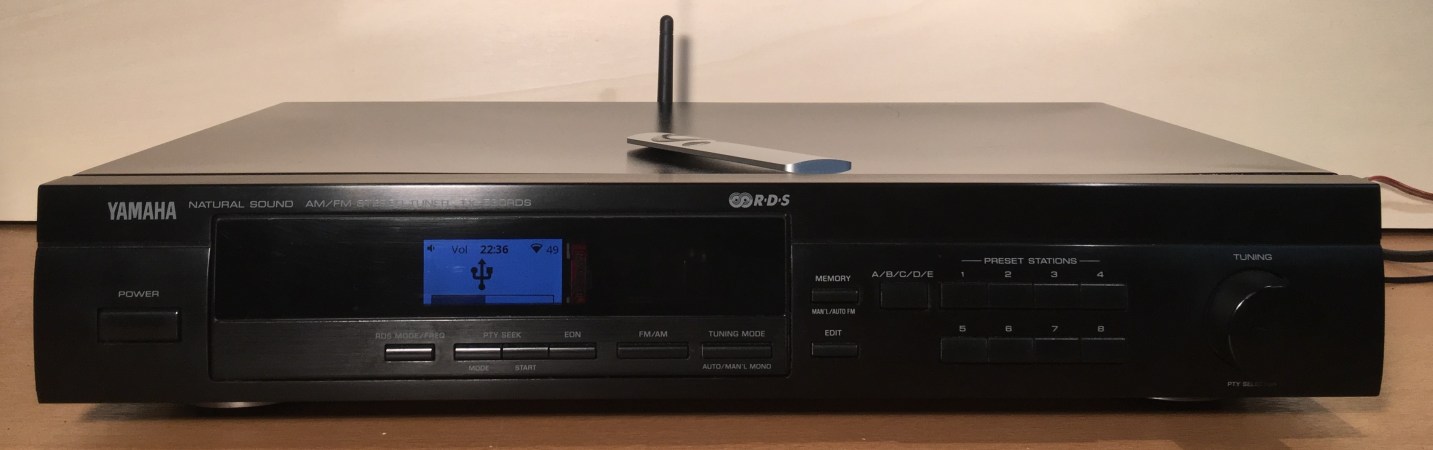
There are dozens — dozens! — of options to meet your music and streaming needs these days.  Looking to make something of his own that retains that 90’s vibe of having a dedicated stereo system but with modern wireless integration, [thk4711] turned an old Yamaha hifi into a Raspberry Pi streaming client.

As far as the case goes, a few modifications allowed [thk4711] to use all of the existing buttons, and a quick-swap of the back-plate and screen gave him a better enclosure than one he could fabricate himself. The power supply proved to be the most difficult part of the project due in part to some “digital noise” interference between the digital and analog components while they were wired to a common ground. This was solved by implementing two transformers, a LM2596 voltage regulator and a LT1084 low-noise power supply to smooth things out.

The Raspberry Pi 2-centered device supports internet radio, Spotify connect, Airplay, USB and auxiliary inputs.

Continue reading “Raspberry Pi Radio Streaming Service Guts Yamaha Shelf System”
Tracking Airplanes From An Autonomous Boat

Airplane tracking systems like FlightRadar24 rely on people running radios that receive the ADS-B signal and forward the data on to them. That doesn’t work so well in the middle of the ocean, though: in spots like the mid-Atlantic, there are no islands to speak of.

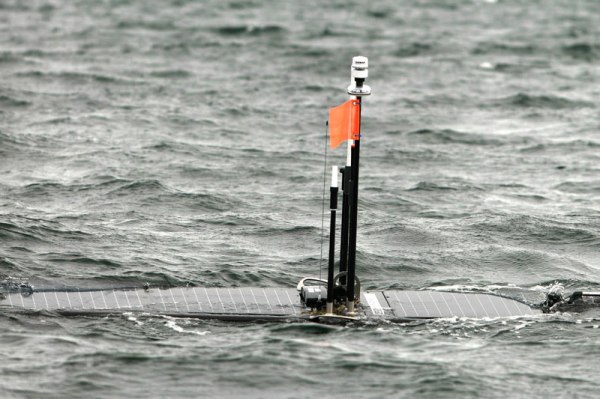
So, the service is now experimenting with a new approach: putting an ADS-B radio onto an autonomous boat. The boat is a Wave Glider from Liquid Robotics, an autonomous boat that harvests the power of the waves to run propulsion, guidance, and its payload. In this case, that payload includes an ADS-B receiver and a satellite transmitter that uploads the plane data to the service, where it is added to their mix of data sources. The boat is planned to spend the next six to eight weeks cruising about 200 miles off the coast of Norway, listening to the broadcasts of planes flying overhead and relaying them back to HQ. They will then be plotted on the live map in blue.

If you’re interested in building your own plane-trackers, we’ve got you covered, at least on land.

Make Your Own Simple VHF Tuning Capacitor

If you enjoy building radio projects you may have noticed something slightly worrying over the last few years in your component supply. Variable capacitors are no longer as plentiful as they used to be. There was a time when all radio receivers contained at least one, now with the advent of the varicap diode and the frequency synthesiser the traditional tuning capacitor is a rare breed. They are still made, but they’re not cheap and they won’t appear so readily in your junk box any more.

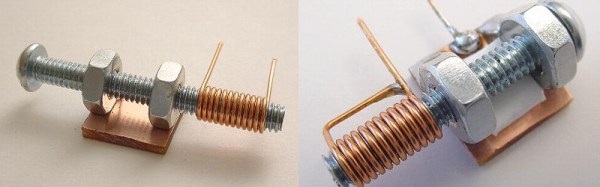
Fortunately a variable capacitor is a surprisingly simple device, and one you can make yourself if you are of a mind to do so. [Patrick] did just that with his home-made capacitor, in this case of a few tens of pF and suitable as a low-power trimmer capacitor or in a single-chip FM radio.

Rather than make a set of interlocking vanes as you’d find in a commercial design, he has gone for a screw in a tube. The capacitance is set by the length by which the screw is inserted into the tube. And his tube is not a tube in the traditional sense, instead he has used a coil of enamelled copper wire wound on the screw thread, whose insulation forms the dielectric. It looks wrong to use a coil in this way as you’d expect a similar coil to form the inductive part of a tuned circuit, but this coil is shorted out to prevent its inductance becoming a factor at the frequency in question.

It’s evidently not the answer to all variable capacitor problems, but it’s a neat piece of lateral thinking and it will make a simple working capacitor from readily available parts.

We’ve featured a couple of more traditional style home-made variable capacitors in the past on these pages, one made from thin aluminium sheet cut with scissors, and another one designed for use in higher power transmitters.

Thanks [PeterF] for the tip.

Build A Tiny (Unstable) Bugging Device

We don’t know who the [amgworkshop] wanted to listen in on, but they apparently went searching for a small FM wireless transmitter. There’s plenty of circuits around, but they wanted something smaller. The original circuit had a variable capacitor to tune the output frequency. The new design uses a fixed capacitor and a spring for an antenna. You can see the build steps in the video below, but don’t expect a lot of frequency stability or fidelity out of a single transistor transmitter.

The parts list is minimal. In addition to a coin cell holder (which serves as the construction base), you need a transistor, two resistors, three capacitors, a homemade inductor (very easy to make with some wire and a drill bit), and an electret microphone. Of course, you need a battery, too. The whole thing is potted with hot glue.

Continue reading “Build A Tiny (Unstable) Bugging Device”

Police Baffled? Send For The Radio Amateurs!

The police force in Evanston, Illinois had a problem on their hands. A mystery transmitter was blocking legal use of radio devices, car key fobs, cellphones, and other transmitters in an area of their city, and since it was also blocking 911 calls they decided to investigate it. Their first call for help went to the FCC who weren’t much use, telling them to talk to the manufacturers of the devices affected.

Eventually they approached the ARRL, the USA’s national amateur radio organisation, who sent along [Kermit Carlson, W9XA] to investigate. He fairly quickly identified the frequencies with the strongest interference and the likely spot from which it originated, and after some investigation it was traced to a recently replaced neon sign power supply. Surprisingly the supply was not replaced with a fault-free unit, its owner merely agreeing to turn it off should any further interference be reported.

The ARRL are highlighting this otherwise fairly unremarkable case to draw attention to the problem of devices appearing on the market with little or no pretence of electromagnetic compatibility compliance. In particular they are critical of the FCC’s lacklustre enforcement response in cases like this one. It’s a significant problem worldwide as huge numbers of very cheap switch-mode mains power supplies have replaced transformers in mains power applications, and in any center of population its effects can be readily seen with an HF radio in the form of a significantly raised RF noise floor. Though we have reported before on the FCC’s investigation of the noise floor problem we’d be inclined to agree with the ARRL that it is effective enforcement of EMC regulations that is key to the solution.

City of Evanston police vehicle picture, [Inventorchris] (CC BY-NC 2.0) via Flickr.

Google Unveils Their Experimental Plan For Wireless Broadband Service

Two years ago, the FCC, with interested parties in Microsoft, Google, and many startups, created the Citizens Band Radio Service (CBRS), a rule that would open up the 3550-3650 MHz band  to anyone, or any company, to create their own wireless backbone between WiFi access points. It is the wireless solution to the last-mile problem, and last year the FCC enthusiastically endorsed the creation of the CBRS.

In a recently released FCC filing, Google has announced their experimental protocol for testing the new CBRS. This isn’t fast Internet to a lamp pole on the corner of the street yet, but it lays the groundwork for how the CBRS will function, and how well it will perform.

Google will be testing the propagation and interference of transmissions in the 3.5 GHz band in places around the US. Most of the Bay Area will be covered in the tests, as well as Boulder, CO, Kansas City, Omaha, Raleigh, NC, Provo, UT, and Reston, VA. Tests will consist of a simple CW tone broadcast in the 3.5 GHz band.

The 3.5 GHz band is already allocated to shipborne navigation and military radar systems, posing an obvious problem to any wireless broadband system using this spectrum. To this end, the FCC is proposing a novel solution to the problem of coexistence between the CBRS and the military. Instead of simply banning transmissions in the spectrum, FCC Chairman Wheeler proposes, “computer systems can act like spectrum traffic cops.” A computer is able to direct the wireless traffic much more effectively than a blanket ban, and will allow better utilization of limited spectrum.

Google’s FCC filing is just for testing propagation and interference, and we have yet to hear anything about how a network built on 3.5 GHz spectrum will be laid out. One thing is for certain, though: you will not have a 3.5 GHz USB networking dongle for the same reason you don’t have a Google Fiber input on your desktop.

Secret Riddle Retro Radio

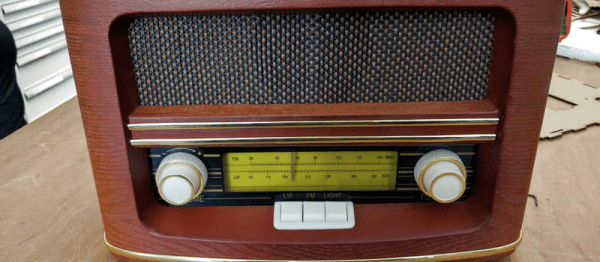
When [the-rene] was building an escape room, he decided to have a clue delivered by radio. Well, not exactly radio, but rather an old-fashioned radio that lets you tune to a faux radio station that asks a riddle. When you solve the riddle, a secret compartment opens up. [the-rene] says you could have the compartment contain a key or a clue or even a cookie.

The outer case is actually an old radio gutted for this purpose. In addition, a laser cut box and a servo motor form the secret compartment.

Continue reading “Secret Riddle Retro Radio”