WiFi Radio Plays Your Tunes In Style

wifi_radio

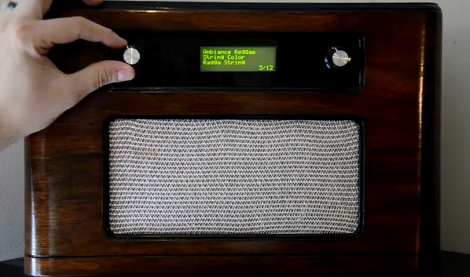
Instructables user [Jan] likes listening to music while hacking away in his workshop, but listening to the same CDs gets tired and boring after awhile. He contemplated listening to streaming audio over the Internet, but hated the idea of needing a computer around at all times. After a bit of reading, he found some information about building a WiFi radio, and got started on constructing his own.

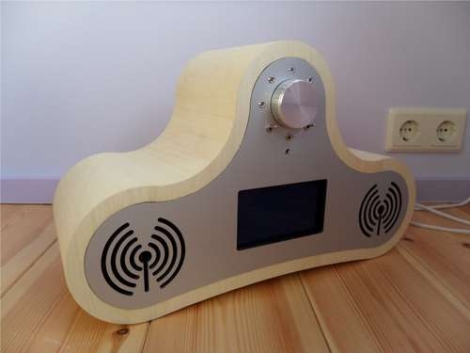
Using a guide he found at the MightyOhm, he hacked an Asus router to use OpenWRT, adding a music player daemon to tune in various stations. He added a small LCD display and an ATmega32 to drive it, as well as a rotary encoder to allow him to switch between stations.

The case was built using several layers of  MDF which were cut using a CNC mill, and joined together with glue and wooden dowels. The front and back panels were milled out of  alucobond sheets, with the remainder of the case covered in white wood veneer. The detail that went into this build is great, we especially love the “WiFi Symbol” speaker grilles.

All of his code and schematics are available for download, should you desire to make a WiFi radio of your own. Stick around to see a video of his completed radio in action.

[via MightyOhm]

Continue reading “WiFi Radio Plays Your Tunes In Style”

Building Your Internet Radio Empire

It all starts with one station in your home office but who knows where it can go from there? If you’ve got dreams of being an Internet radio jockey you can get some ideas about equipment startup from this setup that [Viktor’s] built for a friend.

He started out with a plan to have a station that offers twenty-four hour streaming but also supports live broadcast. Two computers are used in the setup. The first handles automated music broadcast and live mixing. This box has two sound cards, one is used for the automated music by feeding the output into a sound mixer that is a separate piece of hardware. The output of that mixer feeds back into the second sound card on the box. This secondary card outputs the final mix to the computer speakers.

The second computer is where a lot of the live broadcast work is done. Any steaming guest (using VOIP or Skype, etc.) come in through this box as well as jingles and sound effects used during the feed. Its sound card is also connected through the external mixer and joins the final feed headed into one of the sound cards on the primary computer.

In the end the Internet connection for the system isn’t beefy enough to reliably support a streaming station. For this a dedicated streaming service is used. It receives the live feed and then uses its increase bandwidth to propagate the signal to listeners anywhere in the world.

Want to listen to this radio station? Build your own streaming radio module, or outfit classic hardware to work with your computer.

Hear That? It’s A 555 Timer AM Radio

555_timer_am_radio

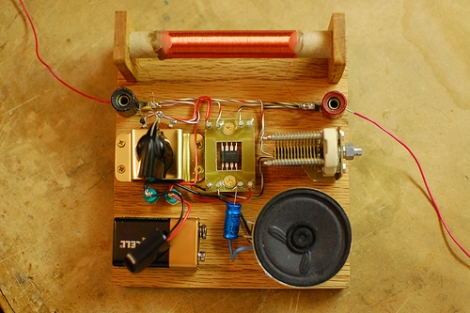
[Eric] recently built an AM radio based on a 555 timer, and posted a few pictures to the Hack-a-Day Flickr pool. He used the 555 timer as an AM demodulator and power amplifier in order to drive the speaker. A hand-wound inductor is used to tune the signal which is then superimposed over the ramp signal produced by the circuit he built. [Eric] points out that he chose a CMOS 555 timer because of its superior performance in this particular application since the timer is used in a bit of a nontraditional manner. He shared his circuit diagram as well as a great video walking through each part of his design, finishing off with a demonstration of the radio, which can be seen below.

This is yet another great project that will be entered in the 555 Design Contest – simple and elegant. We love seeing these, so keep them coming!

If you want to see more cool projects made by Hack-a-Day readers, be sure to check out our Flickr pool as well as the forums.

Continue reading “Hear That? It’s A 555 Timer AM Radio”

Model Rocket Radio Telemetry

rocket_telemetry_data-analysis

[Ken] sent us his Instructable in which he used radio telemetry to monitor the status of his air-powered model rocket through a series of launches. His setup is centered around an Arduino IDE-compatible board that looks to be about the size of a Boarduino, but has the benefit of an embedded 915 MHz radio module. The vendor he used also sells a good handful of add-on modules which he used for his in-flight recording, including a barometric pressure monitor and a 3-axis accelerometer. During flight, the rocket constantly sends data to a base station, provided it stays within radio operating range.

For is initial tests, [Ken] launched his rocket four times, getting usable data on half of them. He found out some interesting things about his model rocket, including the fact that it creates a maximum launch force of 60 Gs. He has plans to revise his setup in the future, such as lightening the battery load as well as adding a high-G analog sensor for recording the forces at take off. This kit, or a more reasonably priced clone, would make for a great addition to any rocket buff’s inventory.

Wireless Sniffing And Jamming Of Chronos And Iclicker

The ubiquitous presence of wireless devices combined with easy access to powerful RF development platforms makes the everyday world around us a wireless hacker’s playground. Yesterday [Travis Goodspeed] posted an article showing how goodfet.cc can be used to sniff wireless traffic and also to jam a given frequency. We’ve previously covered the work of [Travis] in pulling raw data from the IM-ME spectrum analyzer, which also uses goodfet.cc.

The Texas Instruments Chronos watch dev platform contains a C1110 chip, which among other things can provide accelerometer data from the watch to an interested sniffer. The i>clicker classroom response device (which houses a XE1203F chip) is also wide open to this, yielding juicy info about your classmates’ voting behaviour. There is still some work to be done to improve goodfet.cc, and [Travis] pays in beer–not in advance, mind you.

With products like the Chronos representing a move towards personal-area wireless networks, this sort of security hole might eventually have implications to individual privacy of, for example, biometric data–although how that might be exploited is another topic. Related to this idea is that of sniffable RFID card data. How does the increasing adoption of short-range wireless technologies affects us, both for good and bad? We invite you to share your ideas in the comments.

Radios Without Power Sources

[Goodhart] is sharing his process for building a couple different AM radios. It’s surprising how few components he’s using; the first build is just a germanium diode, some wire, and a piezo earpiece. But it strikes us that both of the radios he gives build instructions for have no power source. We’re also amused by the process of selecting the station. His example uses 770 AM, and requires you to take the wire and place it up in a tree with the two ends about 1216 feet apart. We think there’s something a bit off with the math, but with that much conductor to start with there might be enough induced current for you to actually hear something come out the piezo. We don’t think we’ll be trying this anytime soon, but we’d like to hear comments from those of you who do (or already have).

Vintage Car Audio Gets MP3 Input

[Nali] is fixing up a 1966 Rambler Ambassador and decided to give the audio a bit of an upgrade. Instead of replacing the head unit he added a connector for audio input. The method he used is simple, inexpensive, and allows the original unit to continue functioning as a radio. He cut the feed wires going to the volume knob and patched in a headphone jack. The jack he used has an internal switch that is meant to switch off a pair of speakers when headphones are plugged in. The jack will allow the original signal from the radio tuner to pass through whenever there isn’t a connector plugged in. It seems like this is easier on older hardware than it is on modern equipment.

This isn’t where his entertainment enhancements stop. [Nali’s] working on a 7″ in-dash Linux machine so keep your eye on his thread to see what he comes up with.

[Thanks Joel383]