8-bit Computer Project Lands In A Philco Radio Case

We’ve enjoyed seeing the development progress of Veronica, [Quinn Dunki’s] 8-bit computer project. It started out on a breadboard, then moved to edge-connected PCBs, and now [Quinn] has given Veronica a body of her own.

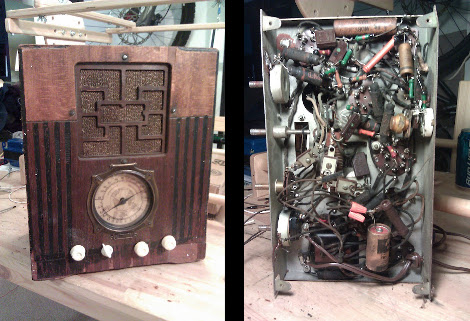
The donor is a Philco Model 42-327T and was produced in 1942. It was chosen because it is non-functional and missing several pieces. We wonder about the collector’s value of the piece but since [Quinn] snagged it from eBay there can’t be in huge demand right now. The teardown images are priceless. There seems to be no reasoning behind component placement for the beast. It looks more like a junk drawer packed full of relic components than something that actually worked once upon a time.

But we digress. After gutting the retro wooden case [Quinn] set out to fabricate her own face plate. Since she’s comfortable working with copper clad, she whipped up a negative design and etched the dashboard seen above. It mounts in the original dial opening, and hosts all of the controls she needs to work with the 8-bit computer. Just below is where the present buttons used to be located. You can just see the hexout display for reading data from the registers mounted in that void.

[Sprite_tm]’s Three-component FM Transmitter

When the Regency TR-1 transistor radio came out onto the market in the 1950s, it was hailed as a modern marvel of microelectronics. With only four transistors and a handful of other components, the TR-1 was a wonder of modern engineering. [Sprite_tm] may have those old-timers beat, though. He built an FM transmitter with the lowest parts count of any transmitter ever.

Like most of [Sprite_tm]’s builds, it’s an unimaginably clever piece of work. [Sprite] overclocked the internal RC oscillator of an ATtiny45 to 24 MHz. After realizing the PLL running at four times the frequency of the oscillator was right in the middle of the FM band, he set about designing a tiny FM transmitter.

[Sprite_tm] remembered his work on MONOTONE and made a short song for hit ATtiny. The firmware for the build takes the notes from his song and varies the 96 MHz PLL frequency a tiny bit, thereby serving as a tiny FM transmitter.

Does it work? Well, if you want to compare it to a Mister Microphone, the range is incredibly limited. That being said it works. It’s an FM transmitter built out of a microcontroller and a battery, and that’s very impressive. Check out [Sprite_tm]’s demo after the break.

Continue reading “[Sprite_tm]’s Three-component FM Transmitter”

Hide Your Repeater And Gain A Radio

[Bradley]’s workplace was recently put into a position where they needed to install a WIFI network to operate some wireless barcode scanners, which was left open for anyone to connect to. Management thought that the people in the shop, who didn’t really need internet, would get less work done if they had access to it. So they just simply stuck the access point as far away as they could. Problem with that theory is that the signal still reaches a little bit where they don’t want it, and people in the shop really want access, so a repeater is needed.

Of course this repeater cant be just sitting out in the open. so [Bradley] decided to hide the it inside of an old radio. Searching around he finally settled on a 10$ ebay radio from the 1980’s, which is large enough to hold the guts of a WRT54G. The routers AC adapter was popped open and wired into the AC input of the radio, the main board and antennas were epoxied to the back. Once everything is buttoned back up you’re left with a hidden repeater, and a fully functional radio.

Now hopefully none of his bosses read his blog!

Amazingly Realistic Skeleton Prop

[Cjmekeel] spent weeks getting his Halloween display ready this year. The centerpiece of his offering is this full-sized motorized skeleton. But there’s a few other gems that he worked on to compliment it. There’s an old-fashioned radio whose dial moves mysteriously and plays a news flash warning of an escaped mental patient. He also spent a couple of dollars to outfit a crow with some glowing red eyes and a servo motor.

But the creepiness of the skeleton means you might not even notice those other props. He started with a rather boring looking plain plastic head and did some real magic to build up the rotting flesh and gaping wounds. Those penetrating eyes don’t hurt either. The head moves on a few servo motors which use random values and sleep periods for disturbingly jerky movements. Check out the video after the break to get a glimpse at what kept kids away from his house on Halloween.

This is just a build log and unfortunately there’s no post yet showing the finished product. If we can get enough information together we’ll try to run a follow-up.

Continue reading “Amazingly Realistic Skeleton Prop”

Makita Jobsite Radio Gets A Few Extra Bells And Whistles

[Jose] added several features to a Makita AM/FM jobsite radio, and did such a good job that you can’t tell they weren’t originally part of the design. The original radio has a compartment for a battery pack used with Makita’s line of rechargeable tools, and offers AM/FM radio, as well as auxiliary audio playback via a pair of speakers. [Jose] augmented those speakers by adding a pair of tweeters as well.

Next on his list of features were a couple of power bus add-ons. In the image on the right you can see the results of adding an automotive cigarette lighter to the side of the unit. Opposite this you’ll find a pair of USB ports that are activated by a lighted toggle switch. The ports are part of a USB car charger that is patched into the battery with a flip of that switch.

Finally, there’s a built-in Bluetooth audio receiver that connects to the auxiliary input. As shown in the image on the left, he can now play tunes from his cellphone without the need for a cord. See him showing off the device in the video after the break.

Continue reading “Makita Jobsite Radio Gets A Few Extra Bells And Whistles”

The “AlarmTock”, A Chumby Hacker Board Alarm Clock

[Thomas] wrote in to tell us about his latest project, the “AlarmTock”. Like many hacks, this was inspired by some outdated hardware, a radio alarm clock from 1992.

After finally getting fed up with his old alarm clock, [Thomas’] wife purchased him a new one for around $10 from a local retail store. Although most likely an improvement, [Thomas] wondered why after so many years he still had to listen to either an annoying “beep” sound or whatever song the DJ on the radio decided to play.

In true hacker form, he decided to do something about it. [Thomas] crammed a [Chumby Hacker Board], which has much of the same hardware as the [Chumby One] device, into his clock radio. RSS-driven text-to-speech was used to tell him exactly what he wanted to know every morning. A sample .wav file is provided as well as the python script used to execute his morning wakeup routine. For another fun hack from [Thomas] check out his Google treadmill hack here!

Cellphone Controlled Retro-radio Stores And Plays Your Digital Library

[Autuin] was worried about having desirable electronics stolen while on the road with his band. He didn’t want to take a laptop along on tour, but he didn’t want to be without his music either. To solve this problem, he built a music player inside of a cheap-looking radio. His write-up covers two different portable MP3 solutions, but it’s the second rendition that catches our attention.

After hollowing out the old radio he filled the void with an Asus WL-HDD 2.5. That hardware is meant to be an easy way to add network storage; it houses a laptop hard drive and has WiFi and Ethernet connectivity. But it also has one USB port, and can be hacked to add a second. [Autuin] did just that, using the two USB connections to add a Bluetooth dongle and a USB sound card. Music is synced with the hard drive via some cat-5 cable that’s hidden in the battery compartment of the vintage box. The NAS runs Linux, and the audio playback software is controlled though a Mobile Java application running on a somewhat broken cellphone. That’s an idea that might find its way into our next project.