Hacking Beer Cans For Fun And Publicity

beer-keyboard

Although beer is generally a good way to get people to come to your trade show booth, [Robofun.ru] decided to put a new spin on things. Instead of (or possibly in addition to) giving out beer, they decided to turn 40 Staropramen beer cans into a keyboard.

This was done using an Arduino hooked up to four Sparkfun MPR121 Capacitive Touch Sensor Breakout Boards, allowing them to act as keys. These inputs are translated via the Arduino into a standard output (we assume USB) that can be plugged into any computer.  Additionally, a Sparkfun MP3 trigger board was used to control the sound effects.  Rounding out the build, a Raspberry Pi computer was used to run the human machine interface, a large plasma display.

Be sure to check out this keyboard in action after the break. If this isn’t enough alternative input fun, why not check our post about how to make a banana piano and giant NES controller. Continue reading “Hacking Beer Cans For Fun And Publicity”

Android Debug Bridge Released For The Raspi

Over on the XDA developers forums, something really cool is happening. Android hacker extraordinaire [AdamOutler] has managed to port the Android Debug Bridge to the Raspberry Pi.

The Android Debug bridge allows hardware tinkerers full access to their Android device. This feature has been used to build everything from telepresence robots to connecting a MIDI keyboard to a phone. With this port of the Android Debug Bridge, anyone can take advantage of the existing hacks and hardware written around the ADB to build something completely new.

Of course, the port of the Android Debug Bridge is only useful if your Raspi is running Android. Current Android builds for the Raspberry Pi are janky at best, but the current rate of progress does look encouraging. Hopefully with the most useful Android tool ported to everyone’s favorite credit-card sized computer, the progress of the Raspi/Android builds will pick up their pace.

Raspberry Pi Foundation Looks At Counterfeit Apple Power Supplies

The Raspberry Pi foundation is in a somewhat unique position. They always test the units that get returned to them in hopes that they can improve the design. They often request that the power supply also be sent back with the RPi unit, as we know the board will not work well if the PSU can’t source enough current. And so they’ve been able to get a look at several counterfeit iPhone chargers. This is not one of the recommended ways to power the RPi, but their ability to collect failed hardware means that they have identified three different fakes on the market.

Seen here is a genuine Apple product on the left. The others are fake, with the easiest way of spotting them being the shiny chrome plug connectors. The genuine part has a matte finish on the connectors. There is also a difference in the chamfering, and even a variation on the orientation of the USB port on some of them. Unfortunately we don’t get a look inside, which is what we really wanted. But you can see in the video after the break that weighing the adapter will also give it away as a fake, showing that the components within probably vary quite a bit. This reminds us of some other fake PSUs that have been exposed.

Continue reading “Raspberry Pi Foundation Looks At Counterfeit Apple Power Supplies”

Wearable Raspberry Pi Turns You Into The Borg

The Hoboken hackerspace, MakerBar, recently hosted a very special guest – [Rob Bishop] from the Raspberry Pi Foundation. Wanting to impress [Rob], [Zach] and a few others from MakerBar put together a wearable computer based on the Raspberry Pi in just a few hours.

Putting a Raspi, small Bluetooth keyboard and mouse combo, and a USB charger equipped with lithium-ion battery wasn’t that hard. The tricky part was finding a wearable display. Luckily, [Zach] had a pair of MyVu Crystal video glasses lying around and after a tricky bit of dissassembly, the folks at MakerBar had a completely wearable computer.

Apart from the RCA cable connecting the Raspi to the glasses, the project is completely wireless; with a small webcam also mounted to the display, the Pi in the Face could easily be a platform for figuring out what to do with Google Glass.

[Zach] said the entire setup could be reconstructed for about $100, a fair price for being turned in to [Locutus] of Borg

advice

Machine Offers Cheap Advice – Charges More For Something Profound

[Nick Johnson] recently wrote in, sharing a neat project he put together in his spare time.

Our readers are most likely familiar with the ubiquitous “fortune” program that ships with many *nix distros, offering cheeky comments and quotes with the press of a button. [Nick] thought it would be cool to build a fortune telling machine using the app, resulting in the handsome device you see above.

The laser-cut wooden case is home to a Raspberry Pi which does the heavy lifting, a coin acceptor, an LCD screen for displaying the device’s status, along with a SparkFun thermal printer. Upon feeding the machine some money, the user can press the “Advise Me” button, prompting the RaspPi to present a printed fortune from its vast database of sayings. [Nick] took some time to do some rough categorization of the fortune databases, enabling the machine to offer more substantial content as the user inputs more coins.

Check out the video below to see [Nick’s] fortune telling machine in action.

Continue reading “Machine Offers Cheap Advice – Charges More For Something Profound”

Hackaday Links: September 21, 2012

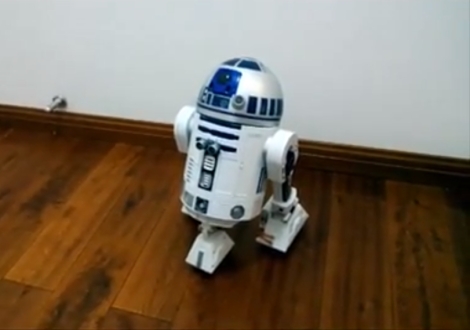
And then Obi-wan said, “you were supposed to be the chosen one!”

Yesterday, a little bird told us Makerbot will be moving to a closed source model for their newest printer. This was confirmed, and now [Zach Smith] a.k.a. [Hoeken] – creator of the RepRap Research Foundation and co-founder of Makerboth Industries is weighing in with his take on the situation.

Hey! Free stuff!

Remember that DIP28 ARM chip with BASIC? Remember how I told you Coridium will be giving a few hundred away as samples? Yeah, that’s happening now.

Replacing a scroll wheel with titanium

[Rhett] has been using a Logitech mouse for a few years now. Recently the scroll wheel became corroded, so [Rhett] replaced it with a titanium version. The perfect match for the trusty battle axe, theIBM Model M keyboard.

Web-based IDE for the Raspi

[Phil Torrone] sent in a video of something he and [ladyada] are working on. It’s a web-based IDE for the Raspberry Pi. We’ll do a full review of this when it’s released.

Intro to software defined radio

So you have one of those TV tuner dongles and want to get in to software defined radio. Where do you start? [Al Williams] over at Dr. Dobbs has a great introduction to SDR, and gives a few pointers that should help you get that cool looking waterfall plot very quickly. Thanks for sending this in, [Chris].

3D Printer Control For The Raspi

Instead of dedicating his laptop to control his RepRap all night, [Walter] is using a Raspberry Pi as an Internet-enabled front end for his 3D printer.

Before [Walter] got his hands on a Raspberry Pi, he set up his laptop next to his RepRap and let the machine do its work for hours on end. Obviously, this tied up his laptop for a while so when his Raspi was delivered he was eager to offload the responsibilities of controlling a printer to his new Linux board.

Right now, [Walter] has his Raspberry Pi set up as a web interface able to control his printer similar to Pronterface. We have to note that the Raspberry Pi isn’t driving servos or feeding filament onto the bed; those responsibilities are still handled by the RepRap electronics, but the ability to use a 3D printer over the web is still pretty cool.

[Walter] is putting the finishing touches on his 3D printer web interface, after which he’ll upload everything onto the git. Planned features for future updates include uploading gcode from the web and an option to connect a webcam for visual feedback when controlling a remote printer.

Video demo after the break.

Continue reading “3D Printer Control For The Raspi”