Bikinis Of The Future!

bikini_duo

It’s always interesting to see what happens when hacking meets clothing – check out this pair of bikinis, for instance.

This first item, called the N12 bikini (mildly NSFW), comes from Continuum Fashion and is composed entirely from Nylon 12, hence the name. Shapeways uses 3D Selective Laser Sintering (SLS) to create the tiny circles that make up this piece of swimwear. The suit is held together by tiny stretchy strings made of the same nylon, and the bikini can be printed to order. It seems like an interesting idea, but we wonder how it would hold up against some big waves or a game of beach volleyball.

The second item is a bit more functional. Designer [Andrew Schneider] has put together a bikini that can solve all of your energy needs while sitting by the pool. His solar bikini is covered with hand-sewn flexible solar cells that work together to produce up to 5v, available via a USB connection. He claims that you are free to go swimming in the suit, so long as you dry out the USB port before using it again. For all the guys out there crying foul, don’t worry – he’s got a suit for you too. He’ll be putting together a men’s suit in the near future that powers a 1.5 amp Peltier cooler to keep your beer cold – we just don’t want to know where the hot side of the Peltier goes…

Music Tank Puts The Boom In Boombox

music_tank

When you think of Memorial Day weekend, what comes to mind? Well around here, all we can think about is this tank cum boombox that Instructable user [Elian_gonzalez] put together.

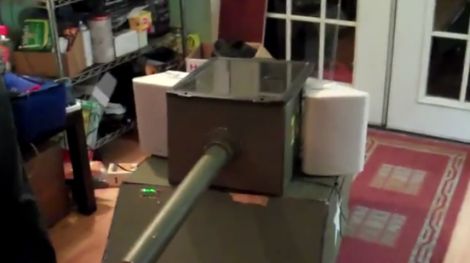
This build is actually the third version of his Music Tank, and it comes with all sorts of improvements over previous models. The tank is primarily constructed out of plywood, with cavernous compartments for holding all of its goodies. In its capacious body, the tank sports a 60 Watt stereo system that powers a pair of external speakers mounted on either side of the turret. The turret itself contains an air-powered cannon built from PVC tubing, which we imagine can be used to shoot a multitude of different projectiles.

While the concept itself is pretty cool, the tank happens to be nearly self-sustaining as well. The tank has a pretty deep battery well and uses a 50w home made solar panel to help keep things topped off while in use. [Elian] does not specify a total running time, but we imagine that it can go for hours on a nice, sunny day.

Keep reading to see a long video walkthrough of the Music Tank MK3 in action. Continue reading “Music Tank Puts The Boom In Boombox”

Dimming Control For An Ikea Solar Desk Lamp

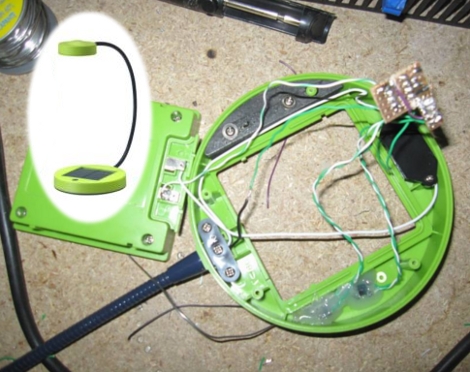
[Frank] decided to augment his desk lamp’s features by adding dimming controls (translated). Since the light source is a triad of LEDs the best method of dimming their intensity is to use Pulse Width Modulation. That’s the method that he went with, and luckily the SUNNAN lamp from Ikea which he’s using as the donor for the project has just enough room to squeeze in the parts necessary for this hack.

You need two main bits to use PWM with a lamp like this; a microcontroller (or possibly a timer chip like the 555) and a transistor to protect that chip from the current necessary to run the LEDs at full brightness. [Frank] went with an ATtiny13 and a 2N2222 transistor, both quite common and very inexpensive (you can even pull the microcontroller from a light bulb if you know where to look). Two buttons were added to the top of the lamp base which allow for up and down controls. There’s even an SOS function which is triggered by pressing both buttons at the same time. [Frank’s] happy to show off the completed project in the clip after the break.

Continue reading “Dimming Control For An Ikea Solar Desk Lamp”

Scout, The Autonomous Transatlantic Boat

autonomous_boat

Sailing a small boat across the Atlantic ocean is quite the daunting task. As many have discovered, it is a journey often fraught with perils, typically ending in failure. A team of four college students decided the best way to get a small boat across the ocean would be to remove the human element from the process, so they set off to build an autonomous craft to take on the task.

Like most projects, this one started as a handful of wild ideas exchanged between friends [Dylan Rodriguez and Max Kramers]. As they thought about it more, they decided that turning [Max’s] sailboat into an autonomous ocean-going craft would be pretty awesome, so they got to work. Recruiting help from their friends [Brendan Prior and Ricky Lyman], the project started to quickly take shape, and Scout was born.

Scout is 8 feet long and consists of foam core covered in carbon fiber. It is filled with various electronic components such as a SPOT tracker, a battery bank that will power the boat for up to 25 hours, and the various servos and motors which will be used to pilot the craft.

It’s a rather ambitious project, though the boat is nearly complete – just in time for their launch, slated for May 29th. We’ll certainly be keeping an eye on this project as the launch date approaches – good luck guys!

Head on over to their Kickstarter page to see a promo video introducing Scout.

Continue reading “Scout, The Autonomous Transatlantic Boat”

Auxiliary Battery Pack For Field Operations

portable_battery_pack

Ham operator [Ken – wa4mnt] wrote us to share a small project that he uses nearly every time he goes out in the field. His portable sealed lead acid battery pack (PDF) always ensures that he has a 12v power source at his fingertips, both for fun as well as in emergency situations.

The battery pack is pretty simple, and includes a 12v, 17ah battery strapped into a light aluminum chassis which he fabricated. The battery is secured with zip ties, so it can easily be swapped out or replaced without much fuss. The frame also sports a tiltable 4w, 17.5v solar panel that keeps the battery topped off and ready to go at all times. He stuck a voltmeter to the top of the battery to keep an eye on things, and he employs a 10A fuse to make sure he doesn’t fry any sensitive radio components should something go wrong.

The battery pack is pretty compact when you think about it, and we imagine it would be great to have on hand for a wide array of outdoor activities. Even if you’re not into Ham field operations, it’s hard to argue with its usefulness during power outages.

[Ken] doesn’t appear to have any published plans for the chassis or the electronic portion of the pack, but we’re pretty sure he would share if asked.

Solar-powered GameBoy Color Never Runs Out Of Juice

solar_gbc

Instructables user [Andrew] was given a free, but damaged GameBoy color by a friend. The friend’s dog had done quite a number on the outside of the handheld, but it was definitely usable.  After replacing some of the outer shell, [Andrew] decided that he would try tweaking the GameBoy to utilize a solar cell in order to keep the batteries topped off.

He bought a solar garden light for $5 and disassembled it, being careful not to damage the heavily-glued solar panel in the process. The GameBoy was pulled apart next, and the solar panel was soldered to the handheld’s battery leads. Once the wires were properly routed through the case, he reassembled the handheld and picked up a pair of rechargeable AA batteries to test things out.

[Andrew] tells us that the solar panel works nicely, and that simply setting it out face-down keeps his batteries charged and ready to go.

Stick around for a quick video demo of his solar-powered GameBoy.

Continue reading “Solar-powered GameBoy Color Never Runs Out Of Juice”

Solar-powered MP3 Playing Speaker

solar_speakers

[Valentin] bought a small battery-powered cube speaker with a built-in amp some time ago, but didn’t have much patience for replacing or recharging the batteries. It sat on the shelf for awhile until he decided to revive an old MP3 player he had sitting around.

He gutted a pair of solar garden lamps, retaining the solar panels, the built-in charging circuits, as well as the included rechargeable batteries. The MP3 player was disassembled, and its components were built into the speaker enclosure. The player’s buttons were relocated to the outer shell of the speaker box with a few pieces of wire, allowing him to easily control his music without having to build in a method for opening the case. Both the speaker and the MP3 player are powered by the batteries salvaged from the solar lamps, which is why he opted to mount both of the solar panels on the the side of the speaker enclosure rather than just one.

We like it even though the speaker looks a bit rough at the moment, especially where the MP3 player’s buttons were transplanted. After a few minutes of touch-up work however, it’ll look great.

If you’re interested in some more solar hacks, check out this solar-powered junkbot, these solar toys for kids, and this solar-powered WiFi repeater we featured in the past.