Track The Sun For Home Lighting.

sun_track

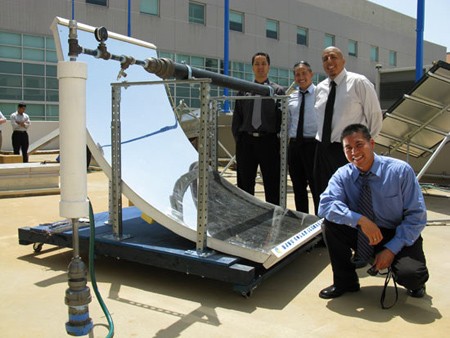
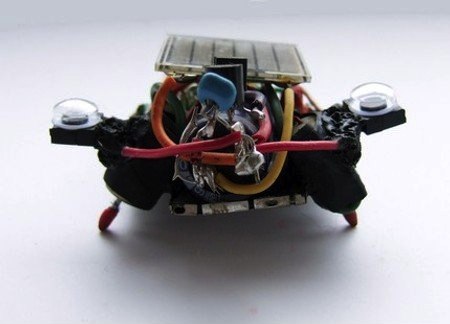
Have a room in your house that really could benefit from some sunlight? Build a Suntrack to reflect light in as long as possible. The two axis motor set up is built from a couple of  satellite dish positioning motors with the control electronics removed. The whole thing is controlled with a PIC 18f2520.  Once calibrated, it will reflect the sun into your room, updating every twenty seconds. While this may not be the most efficient way of lighting a room, it is a cool way to do it if you absolutely must have sunlight. We can’t help but wonder if there would be a way of using a solar powered system to do this to save energy. Could this possibly be done using BEAMhead” circuit?

[via Hacked Gadgets]
60 Watt Solar Panel Built From Cells

Our love for solar projects continues on with this method to make your own solar panels. [Mike] built a 60 watt solar panel from individual solar cells he purchased off eBay. Procuring parts off of eBay normally causes others hardship when they try to duplicate the project, however in this case there are so many types of cells people can use to produce their own unique solar panel. Even cells that are extremely damaged my still be used, as in this example. To charge a 12 volt battery the number of cells in series just needs to be 16-18 volts, and the rest in parallel will supply more current. Charging a battery without a charge controller is not recommended, but commercial ones are easily had. Those not interested in jumping all the way in with solar may want to test the waters by building their own panel and putting it to use as a charging station for your portable gadgets.

Solar Powered Ice Maker

solar powered ice maker
Producing ice without electricity just got a lot easier thanks to these engineering students from San Jose State University. Their system uses solar heat to facilitate evaporation of a coolant. When the sun goes down and the coolant turns back to liquid, its temperature drops drastically due to extreme pressure differences. The unit can produce 14 pounds of ice per day with zero carbon footprint. It has no moving parts and an entirely sealed system, this should mean that the only maintenance necessary would be keeping the unit clean.
[via DVICE]

Drive A Robot In Australia Over The Web


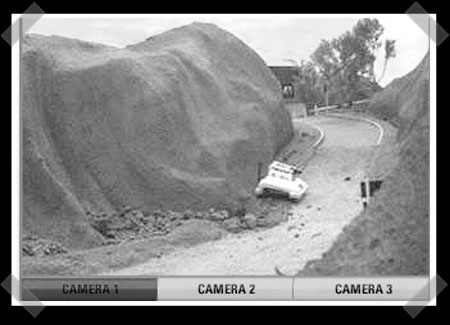
BP Australia has commissioned an online game where you get to drive robots around an obstacle course. Make no mistake, these are real robots. Actually they are modified versions of the Surveyor SRV-1 vehicles that are popular with research labs, and schools everywhere.

Go to the website, get in queue and pray for no clouds. These babies are solar powered, so you’ll have to try to get in while its day time in Australia. The entire set is built in miniature, so you feel like you’re driving a tank around a city.

[via Robots Dreams]

Breakthrough In Water Based Energy Storage


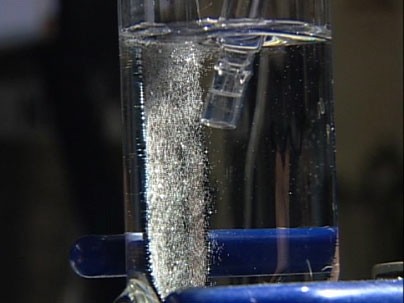
[Daniel Nocera], working with the MIT Energy Initiative, has come up with a method to easily and cheaply store energy generated from solar electricity with water. The method uses two catalysts of non-toxic and abundant metals to separate the water into both oxygen and hydrogen. These gases are then stored, and later recombined in a fuel cell to generate power. The process was inspired by photosynthesis, and helps to make sources such as solar power viable around the clock. Current storage technologies are both expensive and inefficient, so technologies like solar are only useful when the source is available. This will allow homes to cheaply and easily store power generated through solar and other technologies. While this is only part of the solution towards the current energy problem, it could go a long way towards decreasing our use of non-renewable sources. When combined with other new breakthroughs in the field, you can easily imagine more homes coming off the grid. Check out the short video after the break.

Continue reading “Breakthrough In Water Based Energy Storage”

Spotlight On Tinyminds


Etsy places a spotlight on tinyminds, creator of the much-hyped solar robots. [Jenny], the brains behind tinyminds and self-described “all round nerd and non-stop crafter”, claims to draw inspiration for her BEAM solar bug and monster robots from things as varied as paper and wood. She describes the process of creating her robots and working with solar energy as “magical”. The fact that they’re solar-powered is a huge advantage – these “pets” never die and never need recharging, only light. Her Cthulhu robot was linked to by BoingBoing Gadgets, and is unfortunately sold out at the moment. tinyminds has plenty of other inventive, equally inspiring robots available for purchase.

Cheap Hack May Double Solar Panel Power

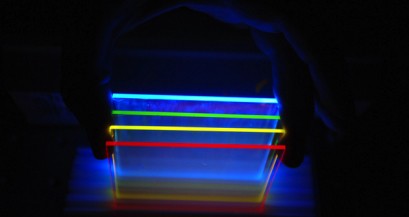
MIT researchers have devised something they call the Solar Concentrator which is to be placed on top of existing solar cells. Its purpose is to separate the visible and infrared spectra of light by absorbing the visible spectrum and routing the energy to specialized cells. They claim this could lead to doubling the panel’s efficiency and greatly reducing costs.

We have seen many promising advances to solar panel efficiency in the past few years, but what is special about this one is the amazingly simple and cheap technique. Essentially, all the team has done is coat a piece of glass with simple organic dyes. After the organic molecules absorb the visible light, they remit the energy to the sides of the glass where it can be routed to their specific cells. The process is more efficient because the dye absorbs the light rather than something expensive like silicon. That means less silicon, and thus a better price range. Also, the fact that this material is just a piece of glass also opens up the possibility of solar windows.