
LiDAR Matrix Sensor Sees In 3D

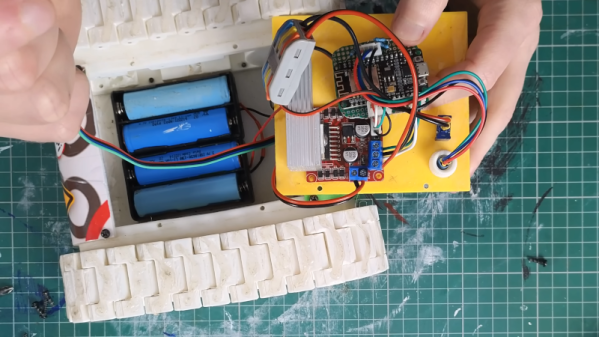
[Mellow_Labs] picked up a few LiDAR matrix sensors and found them very exciting. While a normal time-of-flight sensor can accurately determine a range,  the matrix sensor is like an array of 64 sensors that can build a 2D map of distances from 2 cm to 3.5 m. [Mellow] wanted to add the sensor to his robot to help it see what was in front of it. You can see how it worked out in the video below.

The robot in question is Zippy, a 3D printed tank-like robot with an ESP32. By default, the robot requires control inputs, but using the sensor will enable autonomous operation. For good or ill, the sensor mounted to Zippy was seeing the floor with about half of the rows. That means about 50% of the data went to waste. However, we think having a robot be able to see the floor in front of it might be a good thing.

[Mellow] used an LLM to write most of the code, so there were a number of iterations required to get things working. This required decimating even more of the data from the sensor. Still, pretty impressive.

Want to learn more about ToF sensors? Or if you want to focus on the practical, there’s code you can borrow.
Continue reading “LiDAR Matrix Sensor Sees In 3D”

Theremin-Style MIDI Controller Does It With Lasers

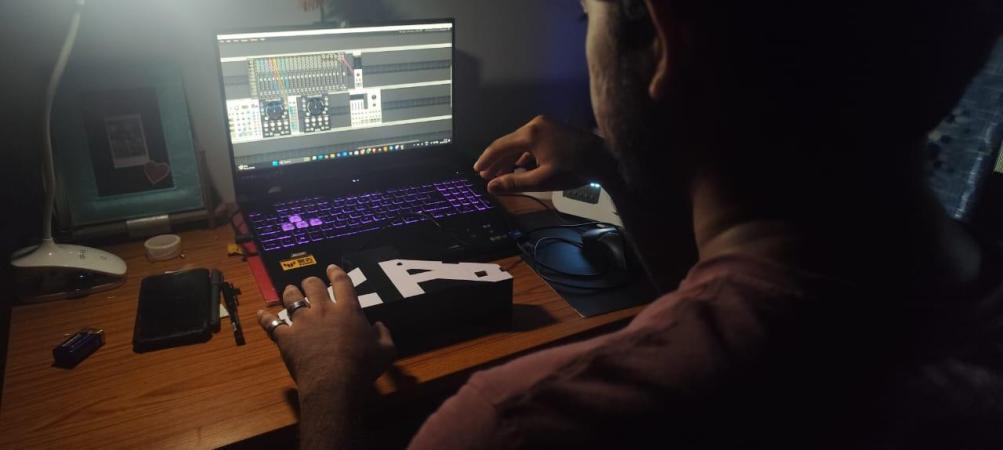
Strictly speaking, a Theremin uses a pair of antennae that act as capacitors in a specific R/C circuit. Looking at [aritrakdebnath2003]’s MIDI THEREMIN, we see it works differently, but it does play in the manner of the exotic radio instrument, so we suppose it can use the name.

The MIDI THEREMIN is purely a MIDI controller. It sends note data to a computer or synthesizer, and from there, you can get whatever sound at whatever volume you desire. The device’s brain is an Arduino Uno, and MIDI-out for the Arduino has been a solved problem for a long while now.

Continue reading “Theremin-Style MIDI Controller Does It With Lasers”

Playing Rock, Paper Scissors With A Time Of Flight Sensor

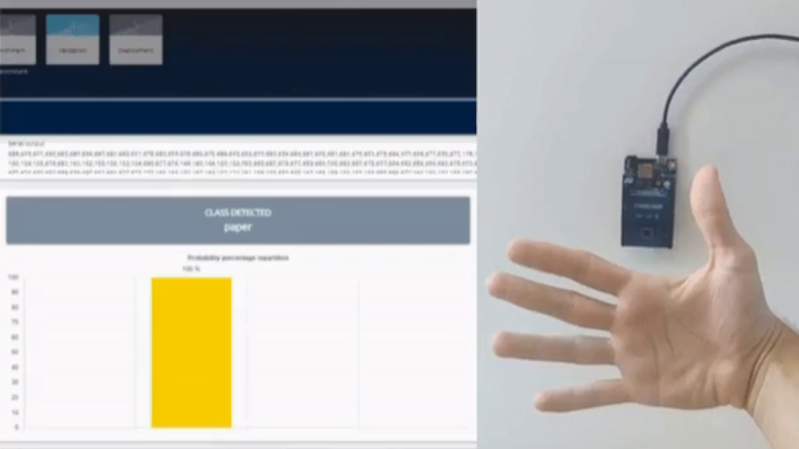
You can do all kinds of wonderful things with cameras and image recognition. However, sometimes spatial data is useful, too. As [madmcu] demonstrates, you can use depth data from a time-of-flight sensor for gesture recognition, as seen in this rock-paper-scissors demo.

If you’re unfamiliar with time-of-flight sensors, they’re easy enough to understand. They measure distance by determining the time it takes photons to travel from one place to another. For example, by shooting out light from the sensor and measuring how long it takes to bounce back, the sensor can determine how far away an object is. Take an array of time-of-flight measurements, and you can get simple spatial data for further analysis.

The build uses an Arduino Uno R4 Minima, paired with a demo board for the VL53L5CX time-of-flight sensor. The software is developed using NanoEdge AI Studio. In a basic sense, the system uses a machine learning model to classify data captured by the time-of-flight sensor into gestures matching rock, paper, or scissors—or nothing, if no hand is present. If you don’t find [madmcu]’s tutorial enough, you can take a look at the original version from STMicroelectronics, too.

It takes some training, and it only works in the right lighting conditions, but this is a functional system that can determine real hand sign and play the game. We’ve seen similar techniques help more advanced robots cheat at this game before, too! What a time to be alive.









