
ATtiny85 Plays The Chrome Dinosaur Game

If you’ve ever had your internet connection drop out while running Chrome, you’ve probably seen a little dinosaur pop up to tell you what’s going on. You might have then tapped a key and learned that it’s actually a little mini-game built into the browser where you have to hop your intrepid T-rex over a bunch of cactii. [Albert David] is well familiar with this little Easter egg, and set about building a system to automatically play the game for him.

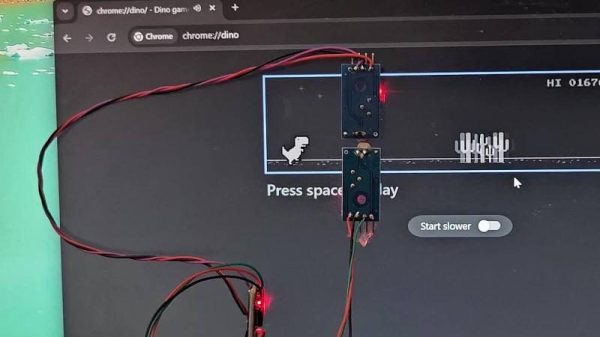
The build uses an Digispark ATtiny85 microcontroller board to run the show. It’s set up to plug in to a PC and enumerate as a USB HID device, so it can spoof the required key presses to play the game. To sense the game state, the device uses a pair of LM393 light-dependent resistor comparator modules. The bottom sensor is used to detect cactus obstacles in the game, while the upper sensor detects flying bird obstacles. Armed with this information, the microcontroller can deliver keypresses at just the right time to jump over cactuses while dodging birds overhead.

[Albert] does a great job of explaining how the project came together in the write-up. There are also useful calibration instructions that indicate how to place the sensors and tweak their thresholds so they trigger reliably and help you net a suitably high score.

Interestingly enough, this isn’t the first time we’ve seen a microcontroller take Chrome’s hidden game for a spin. The game itself has become popular enough that we’ve also seen it ported to other platforms.
Continue reading “ATtiny85 Plays The Chrome Dinosaur Game”
512 Bytes Ought To Be Enough For Dinosaurs

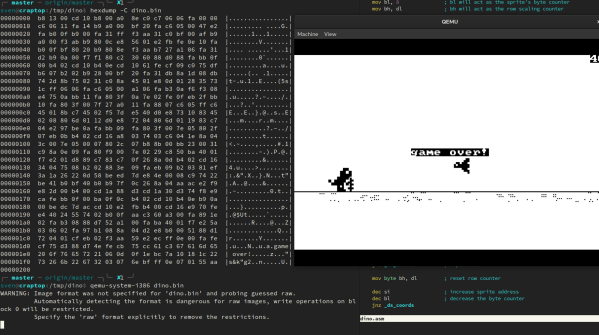
It’s said that slow internet is worse than no internet at all, which is mainly a matter of continuously crushing all hope and sanity vs. finding peace in accepting a fate out of your control. Plus, you can easily pass the time of being catapulted back to the prehistoric ages by navigating a jumpy little creature from that same age through a field of cacti — at least if you’re using Chrome or Chromium. But neither a browser nor actually an operating system are really necessary for that, as [franeklubi] shows with a boot sector implementation of the same game.

Sure, the graphics aren’t quite on par, but compared to the original’s 3000+ lines of JavaScript, [franeklubi] managed to implement it in a few hundred lines of assembly, and was of course constrained by the 512 bytes of the boot sector itself (well, 510 plus the signature). This constraint causes a few limitations, like a slight lack of randomness in the obstacle arrangements, and a constant running speed, but it also makes it the perfect playground and starting point to delve into the world of nifty knacks and hacks, trying to squeeze every last byte.

If you want to give it a try for yourself, all you need is NASM and QEMU — and while you’re at it, why not have some Tetris along the way? We could also see this nicely combined with the real-world jumping version from a few weeks back, and turn it into a standalone arcade game. Bounce Crouch Revolution anyone?

Mechanical Build Lets You Jump Cacti In Real Life

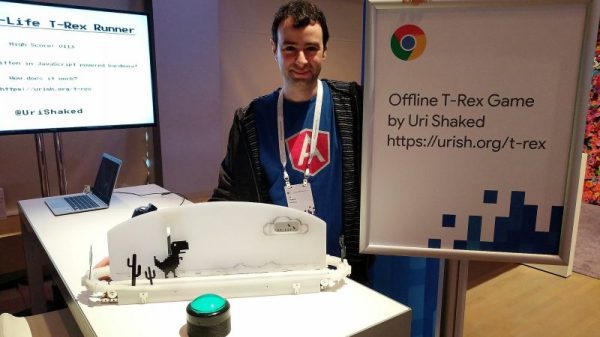
Simple to learn, hard to master, a lifetime to kick the habit. This applies to a lot of computer games, but the T-rex Runner game for Chrome and its various online versions are particularly insidious. So much so that the game drove one couple to build a real-world version of the digital game.

For those not familiar with the game, it’s a simple side-scroller where the goal is to jump and duck a running dinosaur over and under obstacles — think Flappy Birds, but faster paced. When deciding on a weekend hackathon project, [Uri] thought a real-life version of the game would be a natural fit, since he was already a fan of the digital version. With his girlfriend [Ariella] on the team, [Uri] was able to come up with a minimally playable version of the game, with a stepper motor providing the dino jumps and a simple straight conveyor moving the obstacles. People enjoyed it enough that version 2.0 was planned for the Chrome Developer Summit. This version was much more playable, with an oval track for the obstacles and better scorekeeping. [Uri] and [Ariella] had to expand their skills to complete the build — PCB design, E-Paper displays, laser cutting, and even metal casting were all required. The video below shows the final version — but where are the pterosaurs to duck?

Real-world jumping dinos aren’t the first physical manifestation of a digital game. As in the cyber world, Pong was first — either as an arcade version or a supersized outdoor game.

Continue reading “Mechanical Build Lets You Jump Cacti In Real Life”









