Off-Grid Electricity And Hot Water From Scrap Wood

Cooking with charcoal is a fairly common human activity, as much as others have come to prefer fuels like propane and propane accessories for their outdoor, summertime grilling. Although it’s made from wood, it has properties that make it much more useful for cooking — including burning at a higher temperature and with more consistent burn rates. It can also be used as a fuel for generating heat and electricity, but since it’s not typically found lying around in the forest it has to be produced, which [Greenhill Forge] has demonstrated his charcoal production system in one of his latest videos.

The process for creating charcoal is fairly simple. All that needs to happen is for wood to be heated beyond a certain temperature in the absence of oxygen. At this point it will off-gas the water stored in it as well as some of the volatile organic compounds, and what’s left behind is a flammable carbon residue. Those volatile organics are flammable as well, though, so [Greenhill Forge] uses them to heat the wood in a self-sustaining reaction. First, a metal retort is constructed from a metal ammo box, with a pipe extending from the side and then underneath the box. A few holes are drilled in this part, and the apparatus is mounted above a small fire on a metal stand. With the fire lit the wood begins heating, and as it heats these compounds exit the pipe and ignite, adding further fuel to the fire. Eventually the small fire will go out, allowing the retort to heat itself on the gasses released from the wood alone.

To generate the hot water, [Greenhill Forge] has taken an extra step and enclosed the retort in a double walled metal cylinder. Inside the cylinder is a copper tube packed in sand, which harvests the waste heat from the charcoal production for hot water. In his test runs, the water in a large drum was heated to the point that the tubing he used for the test began to melt, so it is certainly working better than he expected.

After the retort cools, [Greenhill Forge] uses the charcoal in another process that generates about a days’ worth of electricity and hot water. It’s part of a complete off-grid system that’s fairly carbon neutral, since trees are an abundant renewable resource compared to fossil fuels. Heating with wood directly is still common in many cold areas around the world, with the one major downside being the labor required to keep the stove running. But we’ve seen at least one project which solves this problem as well.

Continue reading “Off-Grid Electricity And Hot Water From Scrap Wood”

A Wood Gas Powered Lawn Mower

When mowing the lawn, you generally have a choice of pushing power, electric or gasoline. Thanks to the nutty inventor [Colin Furze], you can now add wood gas to the list, as long as you don’t mind some inconvenience. He built a wood gas generator on top of a formerly gasoline powered lawn mower, so he can now run his lawn mower on wood chips.

Wood gas generators have been used with internal combustion engines for a very long time, reaching their peak in the later parts of WW2 when fuel shortages plagued Europe. When wood is burned at high temperature but with limited oxygen, it produces a combustible gas mix that can be fed into an internal combustion engine. [Colin]’s generator went through a number of iterations, and the problem-solving that goes into a project like this is always interesting to watch. We would not recommend running tests like these indoors, but we suppose no [Colin Furze] video would be complete without a bit of danger.

On his first version he had an extraction fan that was too close to the outlet of the burn chamber, so it melted very quickly. The combustion temperature was also not high enough, which required some changes to the chamber geometry. The main problem that plagued the project was filtering out the moisture and tar. [Colin] did eventually get the lawn mower to run on wood gas, but tar was still getting into the engine, which prevented it from starting the second time. The filtering system will need some refinement, which [Colin] will address in his next video, which he also hints will involve some sort of diabolical swing set. Continue reading “A Wood Gas Powered Lawn Mower”

Can A Motorized Bicycle Run On Trees?

Some of the earliest automobiles weren’t powered by refined petrochemicals, but instead wood gas. This wood gas is produced by burning wood or charcoal, capturing the fumes given off, and burning those fumes again. During World War II, nearly every European country was under gasoline rations, and tens of thousands of automobiles would be converted to run on wood gas before the war’s end.

In the century or so since the first car rolled on wood gas, and after hundreds of books and studies were published on the manufacturing and development of wood gas generators and conversion of internal combustion engines, there’s one question: can someone convert a moped to run on wood gas? [NightHawkinLight] finally answered that question.

The basic setup for this experiment is a tiny, tiny internal combustion engine attached to a bicycle. Add a gas tank, and you have a moped, no problem. But this is meant to run on firewood, and for that you need a wood gas generator. This means [NightHawkinLight] will need to burn wood without a whole lot of oxygen, similar to how you make charcoal. There is, apparently, the perfect device to do this, and it’ll fit on the back of a bike. It’s a bee smoker, that thing bee keepers use to calm down a hive of honeybees.

The bee smoker generates the wood gas, which is filtered and cooled in a gallon paint bucket filled with cedar chips. The output from this filter is fed right into where the air filter for the internal combustion engine should be, with an added valve to put more air into the carburetor.

So, with that setup, does the weird bike motorcycle wood gas thing turn over? Yes. The engine idled for a few seconds without producing any useful power. That’s alright, though, because this is just a proof of concept and work in progress. Getting this thing to run and be a useful mode of transportation will require a much larger wood gas generator, but right now [NightHawkinLight] knows his engine can run on wood gas.

Building a gasometer

Building A Gasometer To Store Wood Gas And Other Bio-Fuels

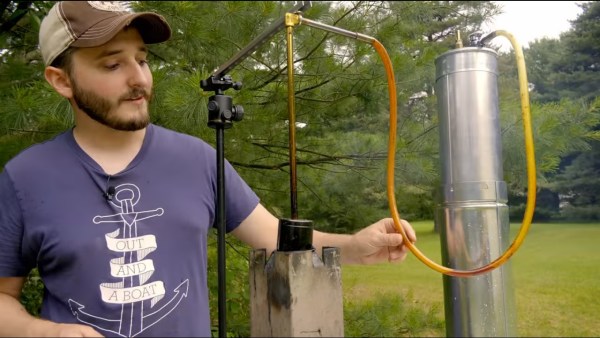
Old solutions are often so elegant and effective that they keep coming back. The gasometer, or gas holder, is one such example. Now [NightHawkInLight] has built one for storing the wood gas he’s been experimenting with, and it’s pretty neat to watch it rise and fall as he first adds gas and then burns it off. The mechanism couldn’t be simpler.

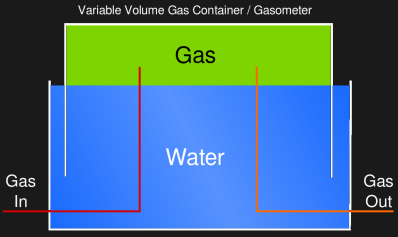
How a gasometer works

For those who, like us, are hearing about this low tech for the first time, gasometers are a means of safely storing gas stemming from the 1700s when gas was king and electricity was little more than a gentleman scientist’s pursuit. In its simplest form, it consists of a container of water with another container filled with gas sitting upside down in the water. Gas pressure is controlled by the weight of the gas-filled container and the water provides a seal, preventing the gas from escaping. Adding gas simply raises the gas-filled container, and removing or using gas lowers it. Simple, safe, and elegant.

We’ll leave the details of how he made his gasometer to the video below, but suffice it to say that his use of a double-walled gas pipe originally intended as a furnace chimney just adds more elegance to this whole hack.

[NightHawkInLight’s] cool projects have graced the pages of Hackaday before. For example, in the area of gas alone there’s his propane-powered plasma rifle, his transparent hybrid rocket engine, and his thermic lance which was hot enough to melt rocks.

Continue reading “Building A Gasometer To Store Wood Gas And Other Bio-Fuels”