Mechanical CPU clock is just as confusing as its namesake

posted Apr 16th 2012 2:04pm by
filed under: clock hacks

[Lior Elazary] designed and built this clock to simulate the function of a CPU. The problem is that if you don’t already have a good grasp of how a CPU works we think this clock will be hopelessly confusing. But lucky for us, we get it, and we love it!

Hour data is shown as a binary number on Register A. This is the center column of red parts and is organized with the MSB on the bottom, the LSB on the top, and left-pointing bits function as digital 1. The clock lacks the complexity necessary for displaying any other time data. But that’s okay, because the sound made by the ball-bearing dropping every minute might drive you a bit loony anyway. [Lior] doesn’t talk about the mechanism that transports that ball bearing, but you can see from the video after the break that a magnet on a circular path picks it up and transports it to the top of the clock where gravity is used to feed the registers. There are two tracks which allow the ball to bypass the A register and enter the B register to the right. This works in conjunction with register C (on the left) to reset the hours when the count is greater than 11.

If you need a kickstart on how these mechanical adders are put together, check out this wooden adder project.

Read the rest of this entry »

A glorious mechanical seven segment display

posted Apr 15th 2012 11:08am by
filed under: clock hacks

If you’ve ever wondered why you’ve never seen a mechanical seven-segment display, now you know. They’re fairly complicated and most likely absurdly expensive, especially when a few light bulbs or LEDs would do the same job equally well. This didn’t stop [kiu] from completing his mechanical seven-segment clock he calls SevenBlocks, and for that we are thankful.

Each of the 28 segments in [kiu]‘s clock is made of three layers of acrylic and a short section of a rack gear. Unlike every seven-segment display you’ve ever seen, tiny hobby servos provide the indication for each segment. For the electronics, An ATMega8 is used for the brains of the outfit with a 74HC595 shift register to expand the number of I/O lines. A DS1307 RTC module provides accurate timekeeping, and the dozens of servo outputs visible in the ‘guts shot’ makes you realize why you’ve never seen a mechanical seven segment display before – they’re really friggin’ complex.

If you want to build your own mechanical seven-segment clock, [kiu] put all the files up on Github. Everything is there, from the .DXF files ready to feed to a laser cutter to the schematic and board files for each of the three PCBs. A video showing this clock in action is sort of necessary, so you can check that out after the break.

Read the rest of this entry »


Building a game clock for Go or Chess

posted Apr 11th 2012 4:21pm by
filed under: clock hacks

[Matias] is just getting into hobby electronics and decided to push the limits of his skill by building this game clock. He comes from a software design background and that really shows through in the UI design seen in the video after the break. We enjoy the journey through his prototyping process which started with an Arduino and a breadboard, and ended with this standalone timer.

After building the first working prototype with four buttons and a character LCD, he migrated to a plastic ice cream container as an enclosure. This worked well enough, but the flimsy case needed an upgrade. As he looked toward the next version he decided to move to an Arduino Nano board to save on space. The rest of the components were soldered to some protoboard, with a pair of pin headers to receive the Nano. The finished board is the same length as the Nano and only about twice as wide.

The box was modeled on the computer (it looks like SketchUp to us be we could be wrong) then cut from pieces of Masonite. It hosts the character LCD with a pair of arcade buttons for each player to shift the time burden to his or her opponent. The middle button pauses the game, and there’s a trimpot on the back to adjust the screen contrast. [Matias] managed to include a surprising number of settings which will make this little box useful for a wide range of game types.

Read the rest of this entry »

Building a word clock with genetic algorithms

posted Apr 10th 2012 12:01pm by
filed under: clock hacks, Software Development

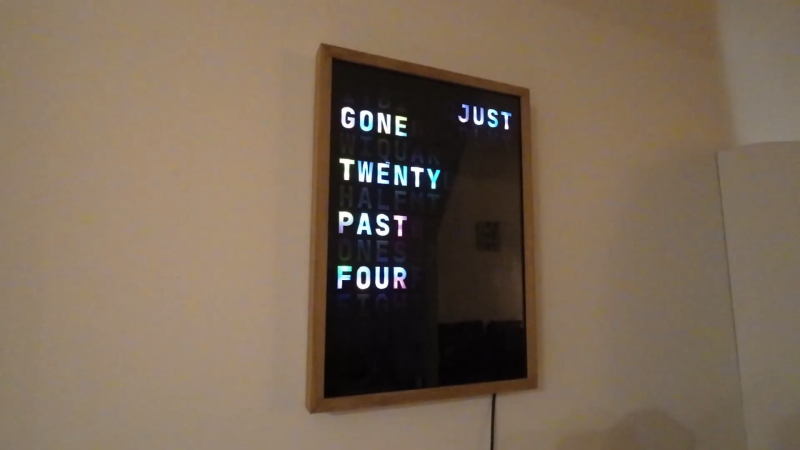
Maybe it was a language barrier he ran into, or possibly an inclination to do things the hard and smart way, but we really like [Alessio]‘s take on building the display for his word clock. Instead of relying on a pre-designed word layout, he made his own word pattern with a genetic algorithm.

While looking at other word clock builds on the Internet, [Alessio] noticed all the DIY copies used the same pattern of letters as the original QLOCKTWO word clock. There are obvious reasons for this, laziness chief among them, but [Alessio] decided to do one better. Armed with JGAP, he made a 10×10 German language word clock and a 11×11 English language word clock.

[Alessio]‘s algorithm takes a list of regular expressions – ‘five past four’ and ‘four five’ are both valid expressions for 4:05 – and combines solutions together for a hopefully optimal solution. One added bonus of [Alessio]‘s method is the ability to generate non-square word clocks. On his project page, [Alessio] put up examples for round, triangular, and diamond-shaped word clocks.

[Alessio] ended up building a 10×10 square German language word clock with an Arduino Nano, DS1307 real-time clock, RGB LEDs, and a few shift registers. Very nice work for a custom-designed word clock.

Quieting a pendulum clock every night

posted Apr 1st 2012 6:01am by
filed under: clock hacks

[Vinnie] has a wonderful old clock from his grandmother; it’s an exquisite antique with a real mechanical movement and a charming set of bells that ring every hour. Unfortunately, those chimes are a bit of a disturbance to neighbors at 2 o’clock in the morning. Previously, [Vinnie] had been stopping the clock every evening, and hoped he would remember to start the pendulum in motion 12 hours later. This was a chore, so he decided to automate the process.

The build is simple and clever; a small stepper motor is mounted in the clock just underneath the pendulum. Every 12 hours, the stepper motor moves a lever and slowly stops the pendulum over the course of a dozen or so seconds, silencing the clock movement. Twelve hours later, the motor turns again setting the pendulum in motion.

The parts count for this build is very low – basically just an ATmega88, a Darlington array to drive the stepper, and a 32.768kHz crystal. We can think of a few friends and relatives with loud clocks in their house, so we might have to build a few of these to give away.

Take a look at the demo video after the break to see how [Vinnie] stops his grandmother’s clock every night.

Read the rest of this entry »


Make your own Atomic clock

posted Mar 24th 2012 12:01pm by
filed under: clock hacks

We see plenty of clock projects come through, but usually it is their visual or mechanical design that stands out. The DCF-77 LED PIC clock is fun because it is synchronized with the Atomic clock in Braunschweig Germany. The clock picks up the radio signal at 77.5 KHz known as DCF77, and that’s where it got its name.

The circuit looks surprisingly simple and usually costs less than $30 to build, depending on how you piece it together. You can download the schematics and code from the site, but you may have to do a little research about how to catch the signal from your location. The person who wrote this was located in Europe.

[found via HackedGadgets]

Analog clock display uses a Nipkow disk

posted Mar 15th 2012 4:19pm by
filed under: clock hacks

Although [Serokoy] is not thrilled with the outcome of his Nipkow disk clock (translated), but we really enjoy it. It uses the Persistence of Vision concept to create a light display from a rotating disk.

We’ve come across a lot of rotating disk clocks. Several were based off of the platters of a hard drive, using a slit, or series of slits to make up the display. This Nipkow disk uses a similar technique but in a more general way. The series of holes arranged in a spiral pattern allows a grid of concentric rings to be used as pixels when the disk is spinning. The bottom portion of the disk is used as the display area. Each pixel is illuminated at just the right time by LEDs below in order to freeze that pixel in the viewer’s eye. The demo is a bit rough, and [Serokoy] mentions that the precision of the hole layout makes all the difference. He drilled these by hand in a CD which was spray painted matte black. Even though he used a computer to lay out and print a template, it took four tries to get a suitable disk.

[Thanks Svofski]

Robotic doodle clock

posted Mar 14th 2012 10:01am by
filed under: clock hacks, robots hacks

This clock has a robotic twist to it. It will show you the time by drawing it in dry-erase marker. There’s a bit of play in the arm joints and some loose motor precision which results in a wavy font that prompted [Ekaggrat] to name his project the Doodle Clock.

The shape and building material used here really make the timepiece look great. We think if the arm holding the acrylic writing surface had been at right angles this would not look nearly as pleasing. The video after the break shows the bot in action, at first flexing its wrist to switch back and forth between marker and eraser. From there it starts to draw the time, tracing the segments of each digit multiple times to achieve a readable number. The entire thing is driven by an Arduino compatible board mounted on the base of the clock.

This reminds us of that felt-tipped Turing Machine. A variation on that would also make a really nice clock display.

Read the rest of this entry »


Hack a Day serves up fresh hacks each day, every day from around the web as well as hacking related news.

Send us your hacks


Hacks

Resources