Making sweet floppy drive music with a calculator

posted Dec 1st 2011 7:01am by
filed under: misc hacks, musical hacks, news

floppy-music-ti83-style

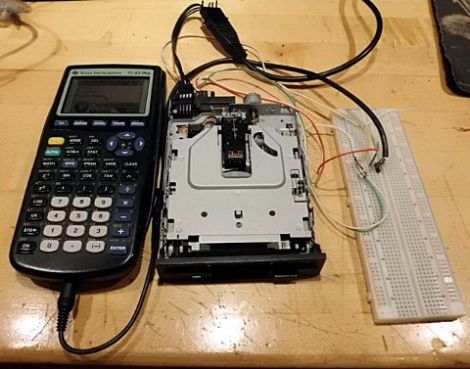
[Chris] says that he’s been pretty busy lately, leaving little opportunity for hacking. However he did manage to find a little time to put together a small project that has occupied his to-do list for a while – a floppy drive music controller.

We have seen hacks that use microcontrollers to actuate floppy drive motors before, but we can’t remember anything that used a calculator to do the job instead. While a microcontroller gives you plenty of I/O pins to play with, [Chris’] Ti-83+ only has two.

Even with the calculator’s I/O limitations, he didn’t find the task too overly difficult as he merely needed to hold a pair of the drive’s pins low, while pulsing two others. He modified a media player written for Ti calculators to output the necessary control signals, then he cranked out some tunes.

As you can see in the video below, his simple setup works quite well – not bad for just a few hours’ work.

Read the rest of this entry »

Global CALCnet: your TI-83 just acquired Internet

posted Feb 22nd 2011 12:00pm by
filed under: handhelds hacks

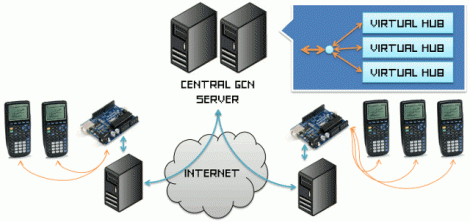
Global CALCnet lets you connect your TI graphic calculator to the Internet and use your favorite services like instant messaging and Internet relay chat. It also provides the option of worldwide multiplayer functionality for games ported to the device such as Scorched Earth and Tetris. We looked in on [Christopher Mitchell's] CALCnet in December when it was being used to create local area networks with the adding machines. He’s taken that up a notch with a helping hand from Arduino. An Arduino board is used to connect the serial communications from the calculator to an Internet connected PC via the Arduino’s USB capabilities.

Think this will waste a lot of time in schools? Unlikely since an Internet connected computer is integral for this system to work. If you have a computer in front of you why waste time on the calculator network? Still, how hard would it be to build a WiFi module that can directly connect them to an access point? That may be a moot point as the Slashdot article that pointed us to global CALCnet also links to a calculator port of DOOM. It runs quite well, as you can see in the video after the break. This is a must-have for anyone owning a TI Nspire that can run it.

Read the rest of this entry »


Metal Race combines operation and calculator game

posted Oct 9th 2009 9:00am by
filed under: arduino hacks, classic hacks

metal_race

[Greg] was feeling nostalgic about the game RACE for to TI-83 graphing calculator. In the game, your car is stationary with controls to move the scrolling maze from side to side in order to avoid a crash. He set out to build a physical version of the game with a don’t-touch-the-side concept that reminds us of Operation.

The game board is a wire frame constructed from paperclips then attached to a motorized frame. The vehicle is also metal and is attached to the lens sled from a scrapped CD-ROM drive. The maze scrolls from left to right with up and down vehicle motion controlled by two arcade buttons. An Arduino controls the motors and monitors the button inputs. He has plans to add a buzzer that sounds when the metal car “crashes” in to the wire walls of the maze. We’ve embedded video of the working game after the break. For more build photos take a look at his flickr set. Read the rest of this entry »

TI-83 intervalometer

posted Jun 9th 2008 12:00pm by
filed under: digital cameras hacks


The headline How to Make Time Lapse Video With Your DSLR didn’t really grab us. Honestly, you pay that much for a camera and it can’t do time lapse out of the box? Well, we nearly missed the real story: [Chris Martino] was using a TI-83 to act as the intervalometer for the camera. The calculator has a 2.5mm audio jack for it’s data port and the camera has an identical port for the shutter trigger. The TI-83 runs a program with a FOR loop to act as the timer. When the loop completes it sends data to the port, and the voltage triggers the shutter. The rate isn’t very exact and varies depending on the charge left in the batteries. [Chris] estimated 10000 program iterations ends up being about 26 seconds between pictures. This technique has been tested on 84, 86, and 89 series calculators too. There are a couple example time lapse videos embedded after the break.

Read the rest of this entry »

Hack a Day serves up fresh hacks each day, every day from around the web as well as hacking related news.

Send us your hacks


Hacks

Resources