Hackerspace Intro: HeatSync Labs In Mesa Arizona

Following along with our request for hackerspace tours [Will] sent in this fantastic tour of HeatSync Labs in Mesa Arizona. This is exactly what we love to see. A quick tour, showing us who you are, where you are, what is going on, and what people have done. This place looks like a really well run hackerspace too. Lots of equipment ranging from soldering stations to wood shop, welding booth, laser cutter, 3d printing, 3d scanning, and hopefully (eventually) a fully functional electron microscope! Great job folks, if we’re ever in the area, we’ll be sure to stop by and see what you’ve got going on.

Check out the video tour after the break.

Continue reading “Hackerspace Intro: HeatSync Labs In Mesa Arizona”
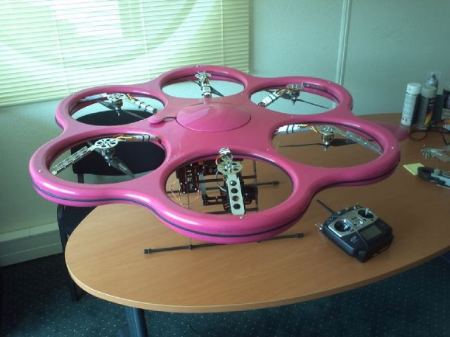
Giant Pink Hexacopter Is Slightly Safer Than The Rest

Check out this giant pink hexacopter.  We see tons of quad copters here, but their bigger brothers/sisters the hexacopters don’t visit very often. When they do though, they get all dressed up as you can see in the picture above. This prototype frame is meant to protect both the props, and the innocent bystanders as you inevitably veer into something you shouldn’t.  The frame is constructed mainly from carbon fiber and adds a total of about 1 Kg of weight to the copter. While it does fly, [AirvewLive] is looking for guidance on what prop/motor combo would yield more endurance. Anyone have some recommendations?

We know some of you will notice pretty quickly that he refers to this as a “ducted fan”. We realize it isn’t and we’ll forgive him this once because his build is so cool.

[thanks for the tip Mike]

ATiny Powered Kinect Fire Cannons For Dance Fx

[Paul] is at it again with some kinect controlled fire poofers. You may remember [Paul’s] previous shenanigans with the gigantic hand made hydraulic flame-sailed pirate ship.  This time he is building a small flame poofer (possibly a series of poofers) for SOAK, a regional (unaffiliated) Burning Man style festival in Oregon.

Any one who remembers the build will recognize the brains of the new cannons, they are just the pirate ship’s custom ATiny board unceremoniously torn from their previous home and recycled for the new controller. This time though they have Kinect! The build seems to function much like the evil genius simulator by simply using a height threshold to activate each cannon, but [Paul] has plans for the new system. This hardware test uses the closed source OpenNI but will meet its full potential when it is reborn in SkelTrack, which was just released a few weeks ago. The cannons are going to go around a small single person dance floor, presumably with the Kinect nearby.

Check out the brief test video after the jump.

Continue reading “ATiny Powered Kinect Fire Cannons For Dance Fx”

7 Foot Long Flying Dragon Breathes Fire

What do you have to do to win best of show at an R/C event in Toledo? Build a 7 foot long fire breathing radio controlled dragon of course! [Rick Hamel] stuffed his electronics, a turbine engine, a kerosene tank, and a stun gun into a home built body shaped like a dragon. You can see a few construction pics that show how he is able to steer. It looks like it flies just like any r/c airplane. This one, however could burn down a village and keep going. Check out the videos after the break to see it flying and testing out its fire breathing mechanism.

Continue reading “7 Foot Long Flying Dragon Breathes Fire”

Build A Rig To Make Orbs In Your Light Paintings

We’ve covered plenty of light painting projects here. People are always finding new ways to create interesting things in this fairly new medium. This project covers a method of creating orbs or spheres in your light paintings. The author points out that many people do this currently by putting the light source at the end of a string, swinging it in front of them like a propeller, and turning slowly in a circle. He wanted to automate the process a bit, so he combined his motorized telescope tripod, a power drill, a strip of RGB LEDs, and a few scraps of wood. He now has an automated system to make perfect orbs. Some of the examples he shows are quite stunning.

Playing Pong With Your Mind

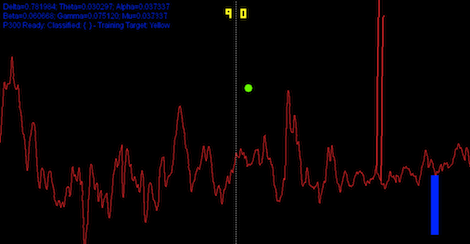
It seems [Charles Moyes] and [Mengxiang Jiang] won’t suffer from the sore wrists and thumbs from an Atari controller any longer. They built a version of Pong played by concentrating and relaxing while wearing an EEG headset.

Right now, there’s only enough hardware for one player; when the player operating the red paddle concentrates the paddle moves up – relax, it goes down.

The hardware portion of the build is fairly tricky business. [Chuck] and [Mengxiang] built a circuit to amplify the tiny voltages between their ears into something a microcontroller can read. The circuit is loosely based on this Arduino EEG build, but highly refined as the elegance of an ATMega644 requires.

The EEG amplifier has a cutoff of under 50 Hz, perfect for reading the Alpha waves correlated with concentration. The oscillations from the skull-cap are sent through the ATMega to MATLAB where after a pass through an FFT the brain waves are converted to mouse scroll wheel output.

There’s a demo video available where you can see spectators screaming at the poor test subject telling him to relax and concentrate on command. You can check that out after the break.

Continue reading “Playing Pong With Your Mind”

Arduino BASIC Interpreter Using LCD, Keyboard, And SD

This Arduino BASIC interpreter will make a really fun one-day project if you’ve already got the parts on hand. [Usmar A. Padow] put together an Arduino Uno, SD card, four line character LCD, and PS/2 keyboard. but he’s also included alternative options to go without an LCD screen by using a computer terminal, or without the SD card by using only the Uno’s RAM. As you can see in his demo after the break, this simple input/output is all you need to experiment with some ancient computing.

It’s hard for us to watch this and not think back to an orange or green monochrome display. Just like decades past, this implementation of BASIC has you start each line of code with a line number, and doesn’t allow for character editing once the line has been input. The example programs that [Usmar] shows off are simple to understand but cover enough to get you started if you’ve never worked with BASIC before.

Last August we saw another hack which ported Tiny BASIC to the Arduino. You may want to take a gander at that one as well.

Continue reading “Arduino BASIC Interpreter Using LCD, Keyboard, And SD”